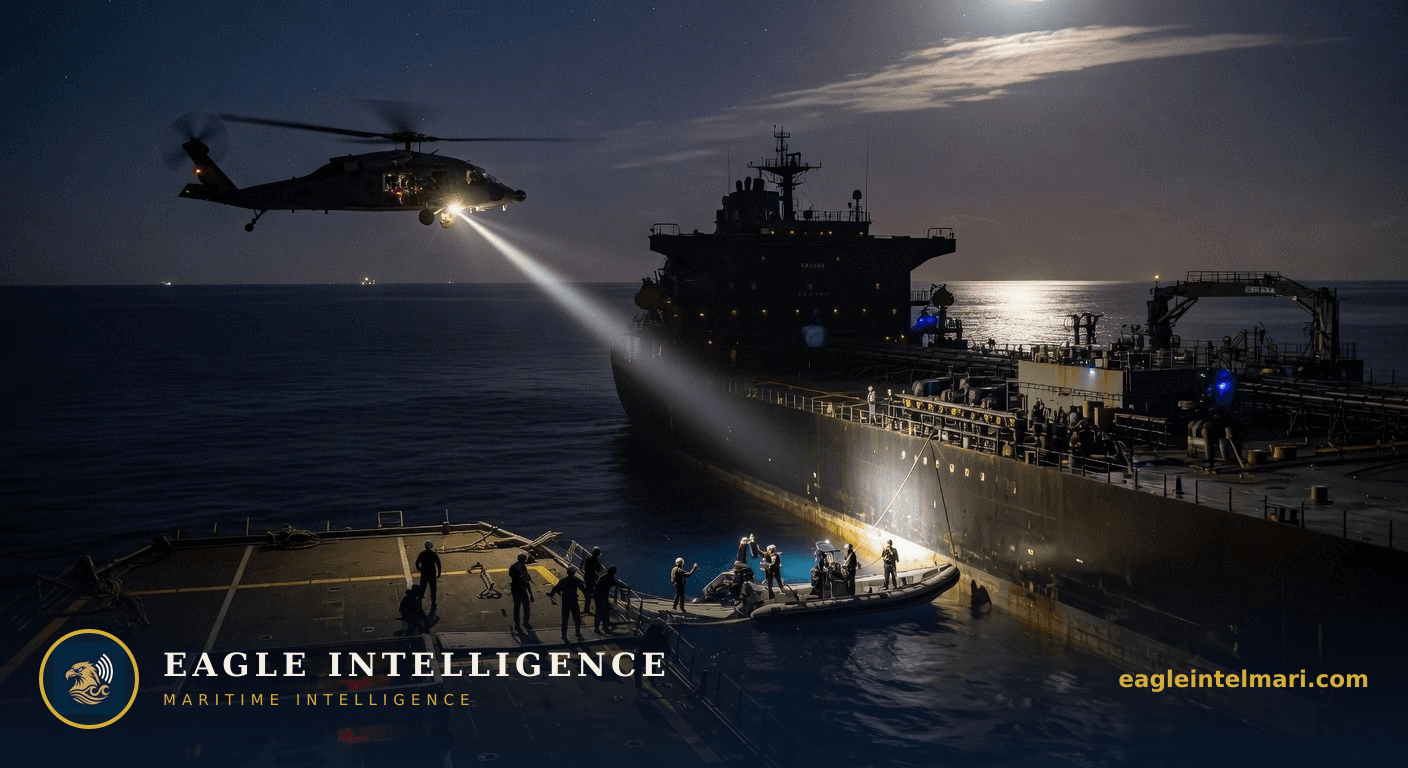
U.S. forces operating from USS John L. Canley boarded the sanctioned, stateless MT Davina in the Indian Ocean, the latest move in an expanded blockade that is already cutting Iranian oil exports.
Advertisement
Advertisement
U.S. Indo-Pacific Command forces have boarded MT Davina, a tanker previously known as MT Lenore, in the Indian Ocean as part of an intensified campaign to choke Iranian crude shipments. The vessel, sanctioned for its Iran links and flying a false Curaçao flag, represents the sharp end of enforcement that is measurably reducing Tehran’s export volumes.
MT Davina carries IMO 9259367 and has operated under multiple names while attempting to mask its ownership chain. Its claimed Curaçao registry is invalid, leaving it effectively stateless and exposed to seizure under international sanctions authorities. Such identity laundering has become standard practice for vessels moving sanctioned Iranian barrels, yet the boarding demonstrates that paper trails are no longer sufficient cover once U.S. naval assets are cued.
Forces embarked on the expeditionary sea base USS John L. Canley conducted the interdiction late Thursday. The operation sits inside a broader U.S. effort to interdict vessels linked to Iranian ports rather than relying solely on secondary sanctions. By positioning mobile boarding teams across key transit corridors in the Indian Ocean, Washington has shifted from passive designation to active physical disruption, raising the operational risk for any tanker that accepts Iranian cargo.
Tehran’s crude shipments have already registered a measurable decline coinciding with the stepped-up interdictions. Each successful boarding removes a vessel from the rotation for weeks or months, forcing remaining operators to accept higher insurance costs or longer, more circuitous routes. The cumulative effect is a tightening supply that directly affects both Iranian revenue and the shadow fleet’s utilization rates.
P&I clubs and hull underwriters will almost certainly widen exclusions or raise premiums for any tonnage that has called Iranian ports or carried Iranian crude in the preceding twelve months. War-risk syndicates at Lloyd’s are already monitoring the frequency of these boardings; sustained activity at the current pace would justify a formal high-risk area designation for the western Indian Ocean, pushing additional costs onto charterers and owners alike.
Curacao’s maritime authority now confronts a documented case of false flagging that undermines its reputation. Port state control officers worldwide will increase scrutiny of vessels with similar name changes or opaque ownership structures, creating friction at routine bunkering and cargo stops. Owners who have tolerated loose flag standards will face detention risk and potential blacklisting by major terminals.
If interdictions continue at one or more per month, Iranian exports could fall another 15-20 percent by December, tightening global heavy-sour crude balances and supporting higher OPEC+ output elsewhere. A diplomatic channel that pauses further boardings in exchange for nuclear talks would allow the shadow fleet to resume partial operations, though at persistently elevated insurance rates. The least likely but highest-impact outcome is a kinetic escalation involving Iranian escorts or mining threats, which would trigger a rapid spike in global war-risk premiums and force commercial traffic into longer routing around the Cape.
Crews on interdicted vessels face prolonged detention while authorities determine nationality and complicity. Owners and managers who placed seafarers on sanctioned tonnage now confront both legal exposure and reputational damage, likely accelerating the migration of competent officers away from high-risk Iranian-linked operators.
Advertisement
Advertisement
⚠️ Intelligence Disclaimer: This analysis is produced by Eagle Intelligence's AI-assisted automated analysis system and is provided for informational purposes only. See our editorial standards. It is not a substitute for official maritime safety advisories from UKMTO, MSCHOA, IMO, or flag state authorities. Operational decisions should always be based on official guidance and professional judgment. Eagle Intelligence accepts no liability for any loss arising from reliance on this content.
Live chokepoint status, war-risk shifts, and the daily maritime wire, straight to your inbox. Free.
Leave a comment
All comments moderated for quality
