A fresh US interdiction of a sanctioned tanker signals Washington’s determination to push enforcement beyond the Gulf and into the wider Indian Ocean, raising risks for owners, insurers and crude flows.
Advertisement
Advertisement
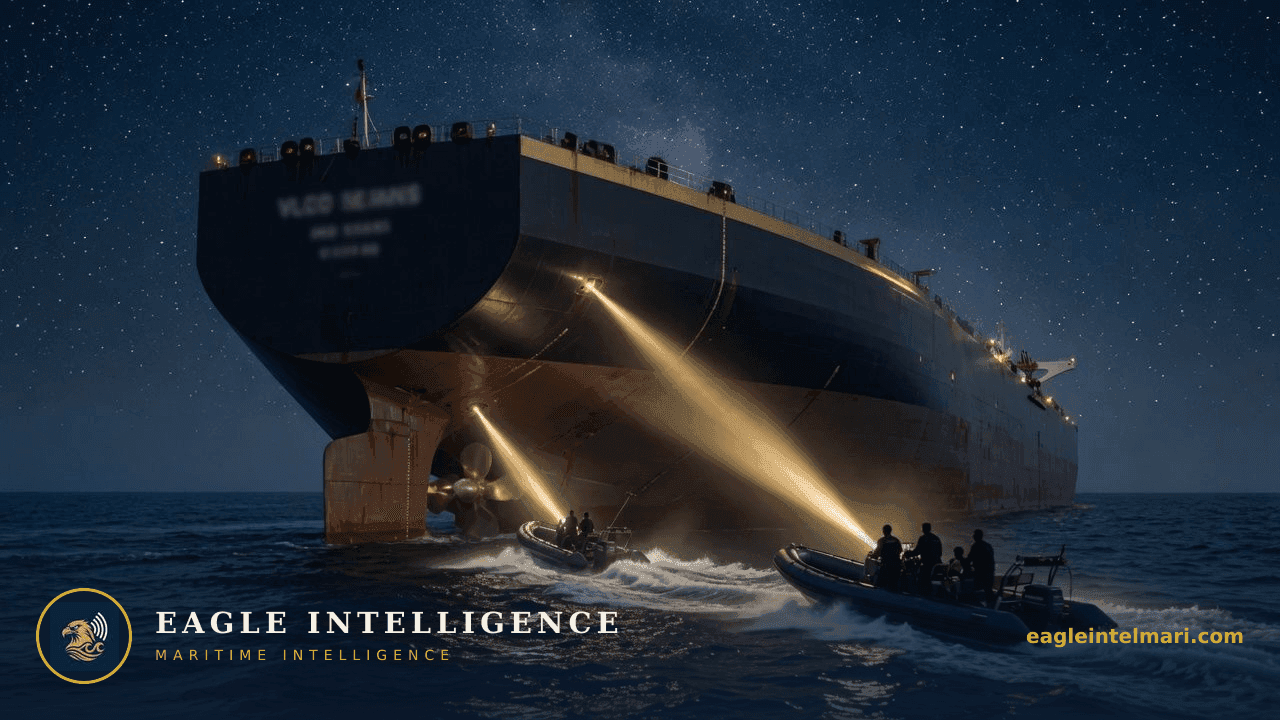
US forces have boarded a sanctioned tanker operating in the Indian Ocean, marking the clearest sign yet that enforcement against Iran’s shadow fleet has moved well beyond the Strait of Hormuz.
Until recently, most documented boardings occurred inside the Persian Gulf or immediately outside it. The overnight action shows Washington now treats the northern Indian Ocean as an active enforcement zone. This geographic shift forces shadow-fleet operators to choose longer, more exposed routes or accept higher probabilities of interception when they attempt direct runs to Asian buyers.
Owners and managers of aging VLCCs and Suezmaxes linked to Iranian crude now confront a narrowing set of options. Continuing to accept Iranian parcels means accepting the possibility of boarding, cargo seizure and potential detention in a third-country port. Switching to legitimate cargoes requires fresh documentation, new flag arrangements and, in many cases, a change of beneficial owner—steps that are both costly and time-consuming. Those unwilling or unable to make the transition are increasingly left with only the highest-risk voyages.
P&I clubs and hull underwriters have already begun tightening language around “sanctioned cargo” and “designated entities.” The Indian Ocean boarding supplies fresh precedent that enforcement can occur far from traditional chokepoints. Expect syndicates to widen exclusion zones or raise deductibles for any vessel whose last three cargoes cannot be independently verified. Charterers carrying Iranian barrels will find cover increasingly expensive or unavailable on the open market.
Seafarers aboard these vessels remain the most exposed constituency. Boardings conducted at night, often by special forces, introduce immediate physical risk. Should a vessel be detained in a distant port, crews face prolonged uncertainty over wages, repatriation and legal status. Flag states that have tolerated shadow-fleet registrations now confront diplomatic pressure to delist vessels before their nationals become collateral in future operations.
The interdiction arrives as several VLCCs that previously carried Iranian crude have idled or diverted. Spot rates for legitimate tonnage on the Middle East–Asia route have already ticked higher as charterers compete for clean vessels. Should further boardings materialise, the discount at which Iranian barrels trade may widen, but the physical volume reaching buyers could contract if operators park ships rather than risk seizure. Energy traders are monitoring whether Chinese and Indian refiners accelerate alternative sourcing from Russia or West Africa.
Continued low-level interdictions without Iranian retaliation would gradually attrit the usable shadow fleet, pushing more vessels into lay-up. A single high-profile Iranian response—such as a Revolutionary Guard fast-boat confrontation—would likely trigger a sharp spike in war-risk premiums across the entire Indian Ocean. A negotiated de-escalation, perhaps tied to wider nuclear talks, remains possible but would require verifiable limits on shadow-fleet activity that neither side has yet shown willingness to accept.
Advertisement
Advertisement
⚠️ Intelligence Disclaimer: This analysis is produced by Eagle Intelligence's AI-assisted automated analysis system and is provided for informational purposes only. See our editorial standards. It is not a substitute for official maritime safety advisories from UKMTO, MSCHOA, IMO, or flag state authorities. Operational decisions should always be based on official guidance and professional judgment. Eagle Intelligence accepts no liability for any loss arising from reliance on this content.
Live chokepoint status, war-risk shifts, and the daily maritime wire, straight to your inbox. Free.
Leave a comment
All comments moderated for quality