The Middle East operator’s largest-ever newbuilding order accelerates fleet renewal on high-volume RoRo trades while testing Xiamen Shipbuilding’s ability to deliver large dual-fuel car carriers on schedule.
Advertisement
Advertisement
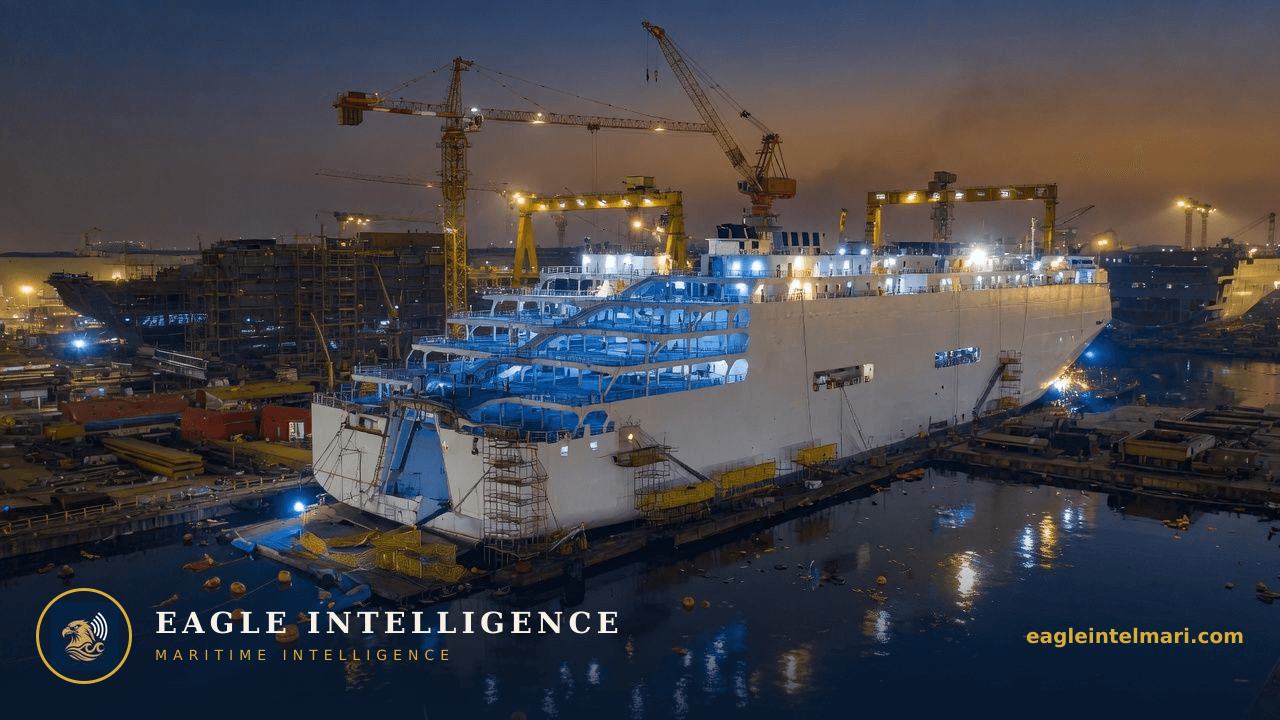
Sallaum Lines has committed to four 8,600-CEU dual-fuel PCTCs at Xiamen Shipbuilding, a move that will materially enlarge and modernise its fleet at a moment when emissions compliance and automotive supply-chain reliability are both tightening.
Xiamen Shipbuilding has quietly scaled its PCTC capacity in recent years, moving from smaller domestic projects to international orders above 7,000 CEU. The yard’s ability to integrate large dual-fuel systems without extending delivery schedules is now under scrutiny; Sallaum’s 2+2 contract is among the first visible tests of that capability at true 8,600-CEU scale. Historical parallels with the rapid rise of Chinese yards in the containership sector suggest that once price and schedule credibility are established, repeat orders follow quickly.
The choice of dual-fuel propulsion points to LNG or methanol capability tailored for Sallaum’s core trades between Asia, the Middle East and Europe. At 8,600 CEU the vessels will offer roughly 15 % more capacity than the operator’s existing largest units, translating into fewer port calls per voyage and lower slot costs even after higher newbuilding financing charges. Fuel-flexibility also hedges against the widening spread between very-low-sulphur fuel oil and alternative fuels expected after 2027 when the next round of IMO measures tightens.
Committing to four vessels at once marks a departure from Sallaum’s previous pattern of piecemeal acquisitions and second-hand purchases. The scale of the investment implies either strong balance-sheet support or long-term charter cover already secured with automotive manufacturers relocating production to lower-cost regions. For a privately held operator focused on Middle East logistics, the order simultaneously deepens ties with Chinese yards and reduces reliance on older tonnage that faces increasing charterer scrutiny on emissions.
Larger, more efficient vessels will tighten the supply-demand balance for high-spec PCTC tonnage on the Asia–Europe and Asia–Middle East lanes. Charterers locked into older, less efficient ships may face higher relative costs or pressure to renegotiate contracts once the newbuildings enter service around 2028–2029. Automotive OEMs seeking predictable, lower-carbon transport options will gain additional negotiating leverage, particularly on contracts that include Scope 3 emissions reporting.
The new vessels will require officers and ratings trained on dual-fuel systems, a skill set still in short supply. Sallaum will likely seek flags with established dual-fuel inspection regimes; this could tilt preference toward Singapore or Marshall Islands registers already handling similar PCTC fleets. Hull and machinery underwriters will price the newbuildings at lower premiums than older tonnage, but P&I clubs will watch machinery-claim records closely during the first two years of operation when dual-fuel teething issues typically surface.
If Xiamen delivers on time and budget, Sallaum could capture additional contract-of-affreightment volumes and trigger a second wave of orders from peer operators. Should delivery slip by more than nine months, charterers may accelerate fixtures on existing large PCTCs, pushing period rates higher through 2028. A third pathway sees methanol or ammonia retrofits becoming mandatory earlier than expected; in that case Sallaum’s early dual-fuel choice would convert from competitive advantage into stranded-asset risk, forcing rapid second-hand disposal of the new units.
The order therefore functions less as routine fleet replacement and more as a calculated wager on the timing of both regulatory tightening and Chinese shipbuilding maturity.
Advertisement
Advertisement
⚠️ Intelligence Disclaimer: This analysis is produced by Eagle Intelligence's AI-assisted automated analysis system and is provided for informational purposes only. See our editorial standards. It is not a substitute for official maritime safety advisories from UKMTO, MSCHOA, IMO, or flag state authorities. Operational decisions should always be based on official guidance and professional judgment. Eagle Intelligence accepts no liability for any loss arising from reliance on this content.
Live chokepoint status, war-risk shifts, and the daily maritime wire, straight to your inbox. Free.
Leave a comment
All comments moderated for quality
