China's weekend surge of amphibious forces and maritime-strike bombers to Scarborough Shoal raises fresh questions about shipping disruption risk in the South China Sea that the Hormuz-centric narrative has overlooked, with direct stakes for vessels serving Philippine ports and ASEAN supply chains.
Advertisement
Advertisement
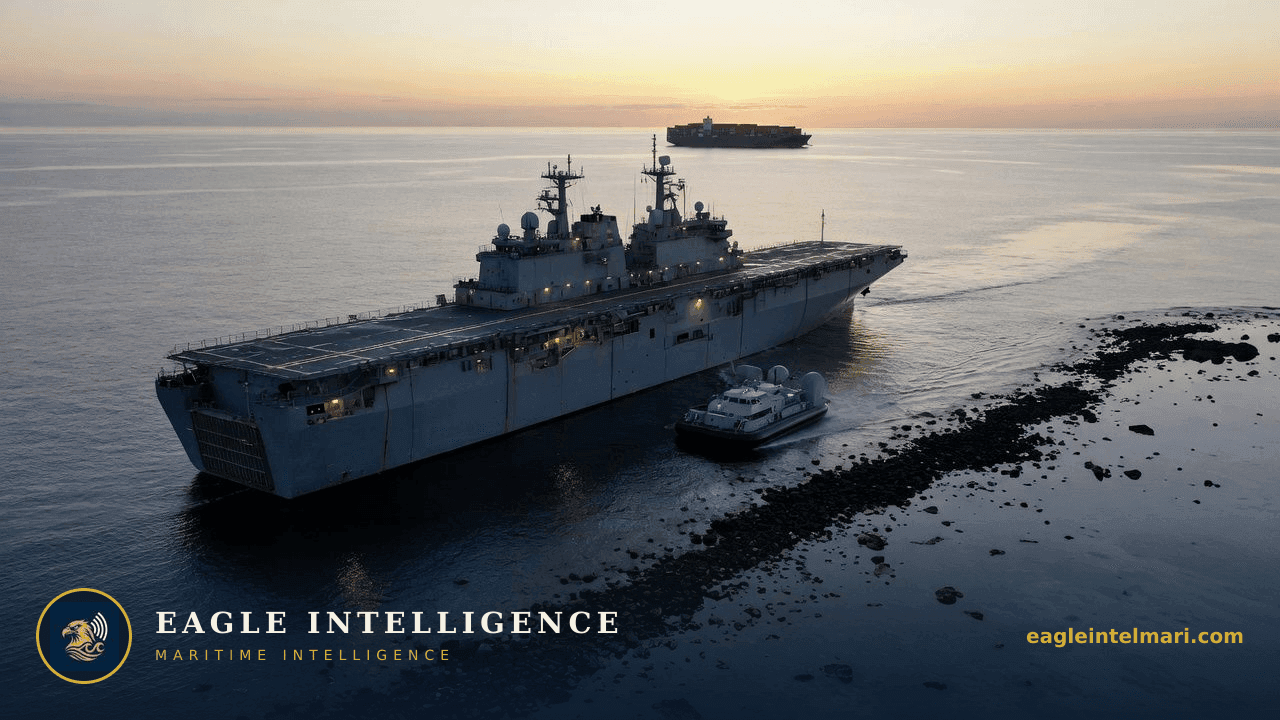
Beijing deployed an amphibious group together with bombers configured for maritime strike missions to the waters around Scarborough Shoal over the weekend of 1-2 August 2026. The People's Liberation Army Southern Theater Command stated the drills were intended to safeguard China's territorial sovereignty and maritime rights under its 10-Dash Line claim. Scarborough Shoal lies 120 nautical miles west of the Philippines, placing it well inside the exclusive economic zone claimed by Manila.
The move marks a visible increase in visible surface and air assets at the feature compared with routine patrols. An amphibious group typically includes landing ships capable of supporting sustained presence, while the bomber component adds reach for anti-surface operations. No specific vessel names or exact numbers beyond the general description of the group have been released in open sources.
Shipping operators have not yet reported any immediate rerouting or delays on routes passing near the shoal. However, the presence of strike-capable aircraft and amphibious lift changes the operational risk calculation for vessels that routinely transit the area en route to or from Subic Bay, Manila, or Cebu.
Tankers, bulk carriers and container ships calling at Philippine terminals must decide whether to maintain normal speeds and closest-point-of-approach distances to Scarborough Shoal or accept added mileage by standing farther offshore. The 120-nautical-mile proximity means that even a modest exclusion zone or heightened alert status could force masters to adjust courses by tens of miles, adding fuel burn and schedule slippage on already tight liner schedules.
Crew welfare considerations arise immediately. Masters operating under the Philippine flag or carrying Filipino nationals face the additional factor that any incident near Scarborough Shoal would likely trigger direct Manila government involvement. Fatigue management becomes harder if vessels elect to steam at higher speeds through the area to reduce exposure time, while any requirement to monitor multiple radio circuits for military traffic increases bridge workload.
Port congestion at Manila or Batangas could worsen if a single incident triggers even temporary advisories from classification societies or insurers. Unlike the Hormuz situation, where alternative routes exist around Africa at high cost, the geography of the South China Sea offers fewer easy detours for vessels whose final destination is the Philippines itself.
China's assertion of rights under the 10-Dash Line directly conflicts with the 2016 arbitral award that found the line incompatible with UNCLOS. Any Chinese enforcement action that interferes with innocent passage or freedom of navigation near Scarborough Shoal would therefore place coastal states and flag states in a difficult compliance position. European and Japanese owners, in particular, must weigh whether their insurance policies contain war-risk exclusions that would be triggered by a declared exclusion zone or by kinetic activity.
The European Union has already demonstrated willingness to board sanctioned vessels in the Mediterranean under Operation IRINI. A similar enforcement posture has not yet emerged in the South China Sea, yet the legal precedent exists. Philippine authorities could request assistance from treaty allies, creating overlapping jurisdictions that shipowners must navigate without clear guidance from classification societies.
Flag-state obligations also remain untested. A Liberian or Marshall Islands flagged vessel transiting the area would need to decide whether to comply with any Chinese radio challenge or to treat the area as high seas. The absence of recent boarding data in the South China Sea leaves owners without recent case law to calibrate their response.
Clarksons recorded record first-half profits explicitly attributed to Hormuz-related disruption. The Scarborough Shoal deployment introduces a second, geographically separate risk premium that has not yet been priced into the same freight indices. Container lines serving the Philippines already face Ningbo Containerized Freight Index volatility; any sustained increase in war-risk premiums would compound those costs.
Bunker markets remain sensitive to Middle East tensions, yet a South China Sea incident would affect different refineries and supply corridors. Singapore bunkering could see demand shifts if operators elect to stem fuel in Japan or Korea instead, altering regional arbitrage that has been stable for months.
Asset values for older tonnage may diverge. Suezmax and VLCC owners have benefited from Hormuz-driven demand, but handy-size and coastal tonnage serving Philippine domestic trades would face direct exposure without the same rate upside.
Twenty-two Chinese-linked vessels crossed the Red Sea without reported interference during the same period that a Bermuda-flagged LNG carrier carrying Qatari cargo was struck northeast of the Bab el-Mandeb. This differential treatment suggests Beijing may be testing or enjoying de facto safe passage arrangements that are not extended to other flags.
Owners whose vessels share Chinese charterers or ownership structures may therefore face lower immediate risk in the South China Sea than competitors. The asymmetry complicates pooling arrangements and war-risk clubs that assume uniform exposure across flags.
The pattern also raises questions about whether future Scarborough Shoal activity could be calibrated to spare Chinese-controlled tonnage while raising costs for others, creating competitive distortions in the dry-bulk and container sectors that serve Philippine exports.
Filipino seafarers constitute a large share of the global officer and rating pool. Any escalation that leads to prolonged loitering or diversion near Scarborough Shoal increases fatigue and separation time from families already accustomed to extended contracts. Manning agencies would need updated guidance on whether to offer hazard pay or route-specific refusal rights.
Abandonment risk, already present in shadow-fleet cases in the Mediterranean, has not yet surfaced in the South China Sea. Yet if a vessel were damaged or detained following an incident, the absence of established consular channels comparable to those operating in the Gulf could leave crews in limbo for weeks.
Open-source tracking of the amphibious group and bomber activity remains limited to the Southern Theater Command release. Commercial AIS data may show vessel movements, but aircraft activity and submerged contacts are invisible to standard shipboard systems. Masters therefore operate with incomplete situational awareness compared with the dense satellite and drone coverage available in parts of the Middle East.
AI-driven routing tools used by major operators have not been trained on sustained Chinese bomber presence at Scarborough Shoal. The settlement-calculator error highlighted in recent freight cases illustrates how even sophisticated models can produce costly misjudgments when underlying threat data changes rapidly.
We know that an amphibious group and maritime-strike bombers conducted drills around Scarborough Shoal on or around 1-2 August 2026, with the stated purpose of protecting Chinese sovereignty claims. We know the location is 120 nautical miles from the Philippines. We do not know the precise composition of the amphibious group, the duration of the deployment, or whether any exclusion zones have been communicated to mariners.
We also lack verified reports of any interference with commercial traffic to date. Eagle Assessment: the deployment raises the probability of future interference above the baseline that existed before the weekend, with medium confidence that at least one vessel will experience a radio challenge or close-quarters incident within the next thirty days. The risk to actual kinetic engagement remains low but is no longer negligible.
The strongest counter-case holds that these drills are routine sovereignty signaling that will not materially affect commercial routing. Evidence that would support this view includes the absence of any new notice to mariners, continued normal speeds by vessels within 50 nautical miles of the shoal, and no increase in war-risk premium quotes from London underwriters over the next two weeks. If those conditions hold, the episode would rank as another data point in a long series of Chinese exercises rather than a structural shift.
How will classification societies update their guidance for vessels trading to Subic or Manila if the drills extend beyond seven days? What specific radio procedures are owners instructing masters to follow when challenged by Chinese naval units near Scarborough Shoal? Which war-risk clubs have already circulated updated area lists that include the 10-Dash Line features, and at what additional premium? How are Filipino manning agencies revising contract language for voyages that pass within 150 nautical miles of Scarborough Shoal? Will ASEAN port-state authorities coordinate any joint reporting mechanism for incidents in the area? What is the threshold, in days of sustained presence, at which liner services will begin publishing schedule recovery surcharges for Philippine calls?
Next 24 hours: Any new notice to mariners or coastal state advisory from the Philippines or China concerning Scarborough Shoal. Next seven days: First reported instance of a commercial vessel altering course by more than 20 nautical miles to avoid the feature, or a published war-risk premium increase specific to the South China Sea. Next thirty days: Evidence that at least three operators have inserted South China Sea routing clauses into new charter parties, or a documented boarding or detention of a non-Chinese flagged vessel in the vicinity.
Advertisement
Advertisement
Live Hormuz transit status and war-risk band.
Live 1–5 shipping war-risk level across monitored chokepoints.
⚠️ Intelligence Disclaimer: This analysis is produced by Eagle Intelligence's AI-assisted automated analysis system and is provided for informational purposes only. See our editorial standards. It is not a substitute for official maritime safety advisories from UKMTO, MSCHOA, IMO, or flag state authorities. Operational decisions should always be based on official guidance and professional judgment. Eagle Intelligence accepts no liability for any loss arising from reliance on this content.
Live chokepoint status, war-risk shifts, and the daily maritime wire, straight to your inbox. Free.
Leave a comment
All comments moderated for quality
