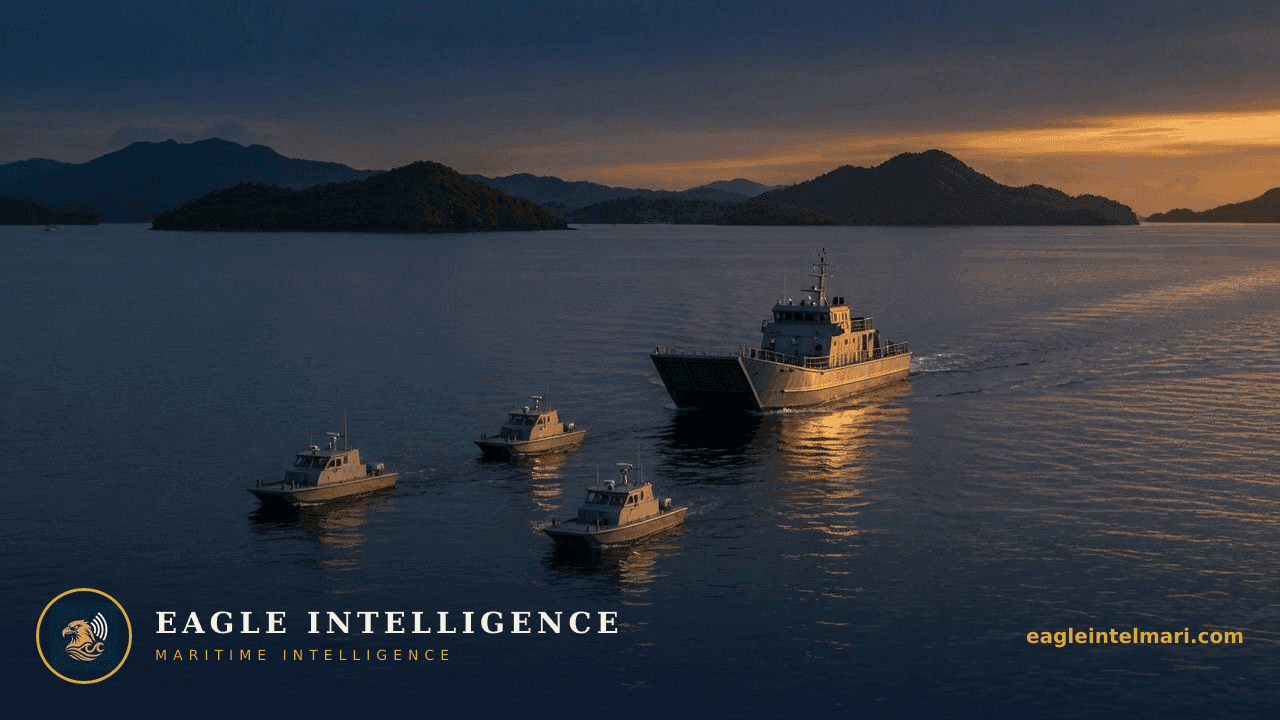
Three drone boats screened a landing craft carrying Philippine Army vehicles during the Salaknib exercise, marking the Army's latest push to harden sustainment routes inside the first island chain against potential Chinese interdiction.
Advertisement
Advertisement
The U.S. Army has begun fielding small unmanned surface vessels to screen its own logistics craft during joint training in the Philippines, a concrete step toward sustaining ground forces under contested maritime conditions.
Hawaii-based soldiers from the 25th Infantry Division operated at least three unmanned surface vessels last week to create a protective maritime screen around a landing craft loaded with Philippine Army vehicles. The activity occurred inside the annual Salaknib exercise, which focuses on rapid deployment and resupply across the archipelago. By placing unmanned hulls between potential threats and manned logistics platforms, the Army is testing a low-cost layer that could multiply the survivability of resupply runs between islands if sea lanes come under missile or fast-attack pressure.
Ground formations in the Western Pacific have historically relied on the Navy for escort and sealift. The current experiment signals that the service now intends to own part of the maritime security problem during the most dangerous phases of a campaign. Three small drone boats can provide persistent radar and electro-optical coverage at a fraction of the cost and risk of a manned patrol craft, allowing commanders to keep manned assets farther from shore-based anti-ship missiles while still maintaining a visible picket line.
Commercial operators moving fuel, ammunition and spares into forward Philippine ports will watch how these tactics evolve. If U.S. doctrine incorporates routine unmanned escorts, hull and war-risk premiums on voyages inside the first island chain could ease slightly for vessels traveling under allied protection. Conversely, any perception that the same waters are becoming a live testing ground for unmanned systems may prompt some P&I clubs to add temporary exclusions or raise deductibles until operating patterns stabilize.
Philippine ports hosting the exercise have seen no reported interference with civilian traffic, yet the presence of armed unmanned vessels raises new questions for harbor masters. Local authorities will need clear rules of engagement and identification protocols to avoid misidentification incidents with fishing fleets or inter-island ferries. Seafarers on commercial vessels may also face added training requirements to recognize and deconflict with U.S. unmanned systems operating in the same waters.
The current trials echo the U.S. Navy’s Ghost Fleet Overlord program and the Royal Navy’s unmanned mine-hunting experiments in the Persian Gulf, both of which began as small-scale drills before scaling into operational capabilities. In each case, early integration with manned logistics units proved more valuable than the technology itself, suggesting the Salaknib results will be judged less on sensor performance and more on how smoothly the drone boats mesh with existing Army-Navy command chains.
If the Army declares the concept operational within 18 months, unmanned escorts could become standard for any Philippine-based logistics movement during heightened tensions, reducing reliance on scarce Navy surface combatants. A second pathway sees the technology remain experimental, limited to annual exercises, while budget pressures keep numbers low. The third, higher-risk outcome involves rapid Chinese countermeasures—electronic warfare or cheap attritable drones—rendering the current USV generation obsolete before it reaches wider fielding, forcing a second round of investment.
Advertisement
Advertisement
Live 1–5 shipping war-risk level across monitored chokepoints.
⚠️ Intelligence Disclaimer: This analysis is produced by Eagle Intelligence's AI-assisted automated analysis system and is provided for informational purposes only. See our editorial standards. It is not a substitute for official maritime safety advisories from UKMTO, MSCHOA, IMO, or flag state authorities. Operational decisions should always be based on official guidance and professional judgment. Eagle Intelligence accepts no liability for any loss arising from reliance on this content.
Live chokepoint status, war-risk shifts, and the daily maritime wire, straight to your inbox. Free.
Leave a comment
All comments moderated for quality
