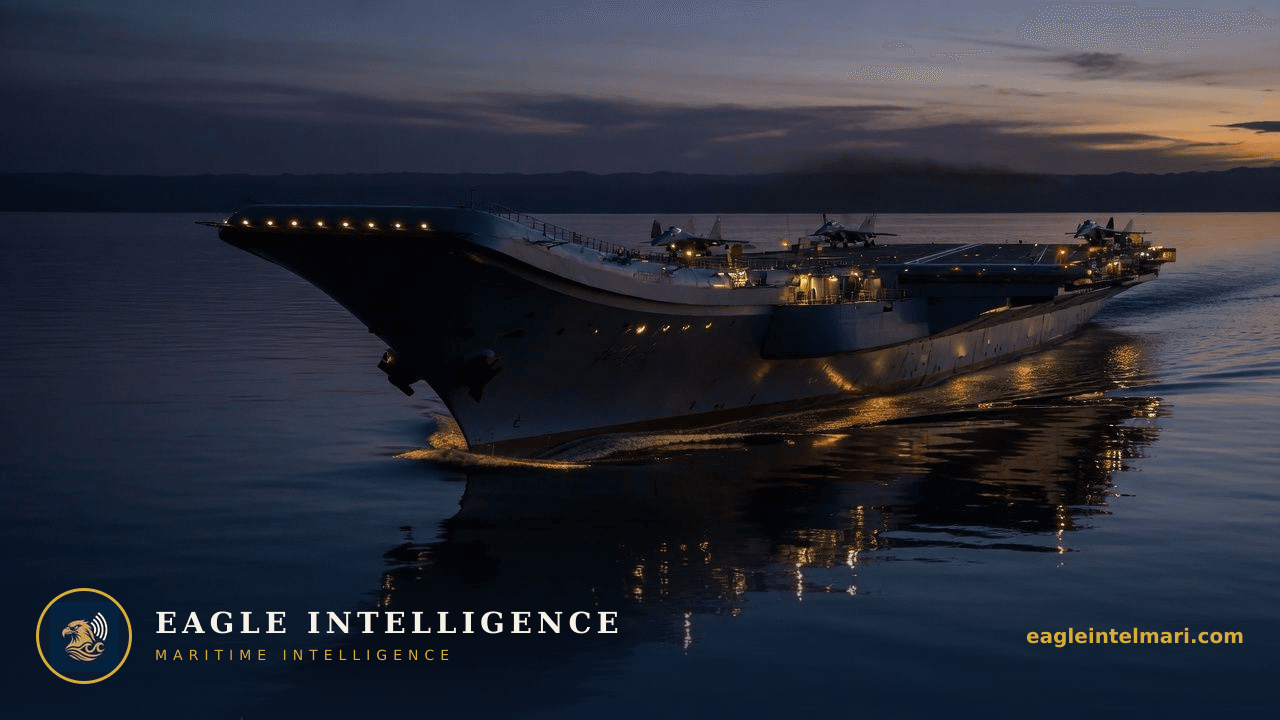
Shipowners and charterers routing vessels through the Philippine Sea must now decide whether to maintain heightened war-risk cover and routing vigilance after the Liaoning carrier strike group returned to Qingdao on 22 June following its May 19 deployment.
Advertisement
Advertisement
For owners and charterers moving crude, LNG and container tonnage through the Philippine Sea, the immediate decision is whether to keep war-risk premiums and routing buffers in place after the Liaoning carrier strike group docked in Qingdao on 22 June.
The 40-day mission that began 19 May took the strike group through both the South China Sea and the western Philippine Sea, a corridor used by roughly 40 percent of global LNG trade and a growing share of intra-Asia crude flows. Past Liaoning deployments rarely exceeded three weeks; this one stretched the operational envelope, signalling that Beijing now treats sustained carrier presence as routine rather than exceptional.
Hull and P&I underwriters began quoting elevated rates for Philippine Sea transits within ten days of the carrier’s departure. Several large operators have since added 150–200 nautical miles of sea room east of Luzon, adding roughly 18 hours of steaming and $35,000–45,000 in daily fuel and charter costs for a 180,000 dwt bulker. Those detours remain in effect despite the group’s return.
Manning agencies rotating Filipino and Vietnamese officers through Manila and Subic are now briefing masters on visual identification protocols for Chinese surface groups. Two ports in northern Luzon have quietly requested that vessels declare last port of call and intended routing before berthing, a step not seen since the 2023 water-cannon incidents near Second Thomas Shoal.
LNG spot cargoes destined for southern China that normally hug the Philippine eastern seaboard are now being priced with a 4–6 cent per million Btu war-risk adder. Charterers locked into fixed freight contracts absorb the hit; those on voyage charters are pushing the surcharge back to owners. The effect is already visible in the June–July Baltic Exchange clean-tanker index for the Singapore–Qingdao route.
The pattern echoes the 2016–2018 period when Liaoning first began extended Philippine Sea loops. Each cycle was followed by a short stand-down, then a larger, more integrated deployment. Commercial traffic that failed to adjust after the second cycle encountered live-fly exercises within 30 nm of established sea lanes.
Returning the carrier now allows maintenance and air-wing rotation while preserving the option to surge again within three weeks. The timing also coincides with the annual PLAN South Sea Fleet exercise calendar, raising the probability of coordinated surface and submarine activity east of the Spratlys through mid-July.
Track any fresh departure from Qingdao after the first week of July; an earlier exit would confirm the new operational rhythm and force another round of routing and insurance adjustments.
Advertisement
Advertisement
Live 1–5 shipping war-risk level across monitored chokepoints.
⚠️ Intelligence Disclaimer: This analysis is produced by Eagle Intelligence's AI-assisted automated analysis system and is provided for informational purposes only. See our editorial standards. It is not a substitute for official maritime safety advisories from UKMTO, MSCHOA, IMO, or flag state authorities. Operational decisions should always be based on official guidance and professional judgment. Eagle Intelligence accepts no liability for any loss arising from reliance on this content.
Live chokepoint status, war-risk shifts, and the daily maritime wire, straight to your inbox. Free.
Leave a comment
All comments moderated for quality
