Skip to content
Eagle Intelligence
Search

Maritime News Today

Live war-risk alerts, Hormuz status, regulatory changes, port disruptions and shipping-market intelligence — updated around the clock.

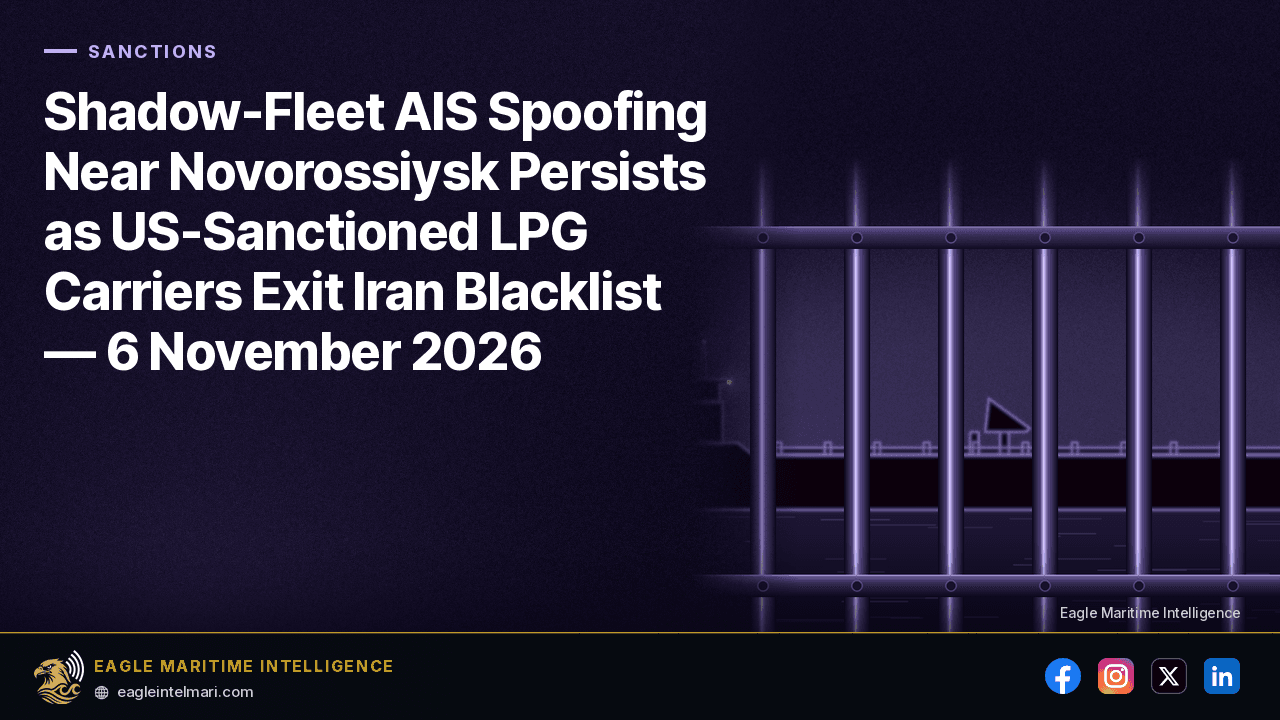
Shadow-Fleet AIS Spoofing Near Novorossiysk Persists as US-Sanctioned LPG Carriers Exit Iran Blacklist — 6 November 2026
SanctionsHIGH ALERT1d ago

Shadow-Fleet AIS Spoofing Near Novorossiysk Persists as US-Sanctioned LPG Carriers Exit Iran Blacklist — 6 November 2026

Seven sanctioned Russian tankers have been spoofing AIS signals for 90 days to mask voyages from Novorossiysk while US-sanctioned LPG carriers were removed from Iran’s PGSA non-compliance list; the pattern shows enforcement announcements outpacing actual detentions and leaves charterers, agents and crews exposed to unpaid claims and port refusals.

Eagle Intelligence · Read full article →

Houthis Test Bab el-Mandeb Control After Hormuz Corridor Collapse
War Risk
Critical
Jul 29·Eagle Intelligence3 min read

Houthis Test Bab el-Mandeb Control After Hormuz Corridor Collapse

The Houthis' declared maritime blockade on Saudi shipping and repeated strikes on tankers in the Red Sea represent the day's most consequential development, directly driving CMA CGM's 42% profit surge through route diversions while exposing operators to doubled bunker costs and regulatory clashes.

Eagle IntelligenceRead →
The Daily Eagle Brief — 2026-07-28: Hormuz Crossings Fall 70 Percent as Tankers Shift to Iranian Route and Diplomacy Pauses Strikes
Analysis
Critical
Jul 28·Eagle Intelligence Analysis1 min read

The Daily Eagle Brief — 2026-07-28: Hormuz Crossings Fall 70 Percent as Tankers Shift to Iranian Route and Diplomacy Pauses Strikes

Open conflict has cut Strait of Hormuz tanker transits by 70 percent, forcing remaining vessels onto the Iranian coastal route and concentrating legal, physical and insurance exposure for crews and hulls. US-Iran attacks paused for a third night while Tehran rules out direct talks and accuses Ukraine of striking an Iranian vessel in the Caspian. Black Sea attacks have intensified with the sinking of Golden Leo and resumed loadings at Novorossiysk after prior halts. Bab el-Mandeb crossings dropped another 50 percent after Houthi strikes on Saudi facilities. Markets have yet to price the concentrated chokepoint risk now facing energy supply chains and operators.

Eagle IntelligenceRead →
Hormuz Conflict Forces Tanker Fleet onto Iranian Route, Raising Insurance and Supply Risks
War Risk
Critical
Jul 28·Eagle Intelligence3 min read

Hormuz Conflict Forces Tanker Fleet onto Iranian Route, Raising Insurance and Supply Risks

The return of open conflict has cut Strait of Hormuz crossings by 70 percent, pushing remaining tankers onto the Iranian route and exposing crews, hulls and energy supply chains to concentrated legal and physical hazards that markets have not yet priced.

Eagle IntelligenceRead →
The Daily Eagle Brief — 2026-07-27: Hormuz Mine Strike and Houthi Blockade Disrupt Oil Tanker Routing
Analysis
Critical
Jul 28·Eagle Intelligence Analysis1 min read

The Daily Eagle Brief — 2026-07-27: Hormuz Mine Strike and Houthi Blockade Disrupt Oil Tanker Routing

An oil tanker exploded in the Strait of Hormuz after striking a naval mine, according to multiple Iranian media reports on 27 July. The Houthi blockade declared on 20 July continues to affect Saudi crude movements, with one confirmed strike on the products tanker Encelia and early signs of upward pressure on tanker freight. Shipping access to Ukrainian ports remains suspended following Russian attacks near Odesa, including the sinking of Golden Leo. Diplomatic pauses between the US and Iran have held for a second day, though Tehran has linked the Hormuz incident to broader escalation. Decision-makers must now weigh rerouting costs against selective enforcement risks in two critical chokepoints.

Eagle IntelligenceRead →
Houthi Blockade Tests Saudi Crude Resilience While Tanker Rates Climb
War Risk
Critical
Jul 27·Eagle Intelligence3 min read

Houthi Blockade Tests Saudi Crude Resilience While Tanker Rates Climb

The Houthi naval blockade declared on 20 July 2026 against Saudi ports raises immediate questions over whether selective enforcement will sustain oil flows or force costly rerouting, with early evidence showing one confirmed strike on the products tanker Encelia and renewed upward pressure on tanker freight.

Eagle IntelligenceRead →
The Daily Eagle Brief — 2026-07-26: Hormuz Tanker Crossings Fall to Two-Month Low Amid US Strikes and Stranded Seafarers
Analysis
Critical
Jul 26·Eagle Intelligence Analysis3 min read

The Daily Eagle Brief — 2026-07-26: Hormuz Tanker Crossings Fall to Two-Month Low Amid US Strikes and Stranded Seafarers

Iranian interdictions and US strikes on merchant vessels have reduced Strait of Hormuz tanker transits to the lowest level in two months. Roughly 6,000 seafarers are now stranded in the affected region, prompting a UN call for Gulf states to assist evacuation. Oman-mediated talks remain the primary channel to restore safe passage before a potential 40-nation naval coalition alters the operational environment. Energy markets face immediate pressure from the dual choke-point risk involving both Hormuz and the Red Sea. Decision-makers must weigh rerouting options against the risk of further interdictions in the next 24-48 hours.

Eagle IntelligenceRead →
Hormuz Standoff: Iran's Stoppages and the Race to Reopen the Strait
War Risk
Critical
Jul 26·Eagle Intelligence3 min read

Hormuz Standoff: Iran's Stoppages and the Race to Reopen the Strait

Iran's reported interdiction of tankers and Houthi strikes on Saudi targets have driven Hormuz tanker crossings to a two-month low while stranding roughly 6,000 seafarers; the central question is whether Oman-mediated talks can restore safe transit before a broader naval coalition forms and energy markets fracture further.

Eagle IntelligenceRead →
The Daily Eagle Brief — 2026-07-25: Hormuz Transits Fall Over 50 Percent as Red Sea Attacks Resume
Analysis
Critical
Jul 25·Eagle Intelligence Analysis3 min read

The Daily Eagle Brief — 2026-07-25: Hormuz Transits Fall Over 50 Percent as Red Sea Attacks Resume

US strikes on Iran entered their 13th day while Houthi forces resumed Red Sea attacks, cutting Hormuz tanker crossings to the lowest level since May. Commercial operators now face sustained war-risk premiums and the practical choice between accepting elevated exposure or committing to longer reroutes. Black Sea attacks have separately halted Ukrainian grain exports and killed an Indian seafarer, adding pressure on multiple chokepoints simultaneously. Germany has withdrawn two navy ships previously slated for Hormuz escort duties. The central operational question is how many owners will treat the current exposure as temporary versus structural.

Eagle IntelligenceRead →
Hormuz and Bab el-Mandeb Face Prolonged Disruption as US Strikes Iran for 13th Day
War Risk
Critical
Jul 25·Eagle Intelligence3 min read

Hormuz and Bab el-Mandeb Face Prolonged Disruption as US Strikes Iran for 13th Day

Sustained US military action against Iran combined with Houthi resumption of Red Sea attacks has driven Hormuz transits down more than 50 percent week-on-week, raising the central question of how long commercial operators will accept elevated war-risk exposure before rerouting becomes structural.

Eagle IntelligenceRead →
The Daily Eagle Brief — 2026-07-24: Maersk suspends Black Sea calls as Houthi tanker attacks push oil above $100
Analysis
Critical
Jul 24·Eagle Intelligence Analysis3 min read

The Daily Eagle Brief — 2026-07-24: Maersk suspends Black Sea calls as Houthi tanker attacks push oil above $100

Maersk has halted calls at Ukraine’s Black Sea ports after intensified Russian strikes on the grain corridor, forcing reroutes through already restricted Russian facilities. Houthi forces announced a maritime embargo on Saudi ports and attacked a fuel tanker that is now drifting toward the Somali coast, triggering sharp insurance increases and multiple tanker U-turns. Oil prices have topped $100 for the first time since May amid renewed fears over Hormuz transit. These developments concentrate risk on grain, crude and container flows through three separate chokepoints simultaneously.

Eagle IntelligenceRead →

Showing 181–190 of 921 articles