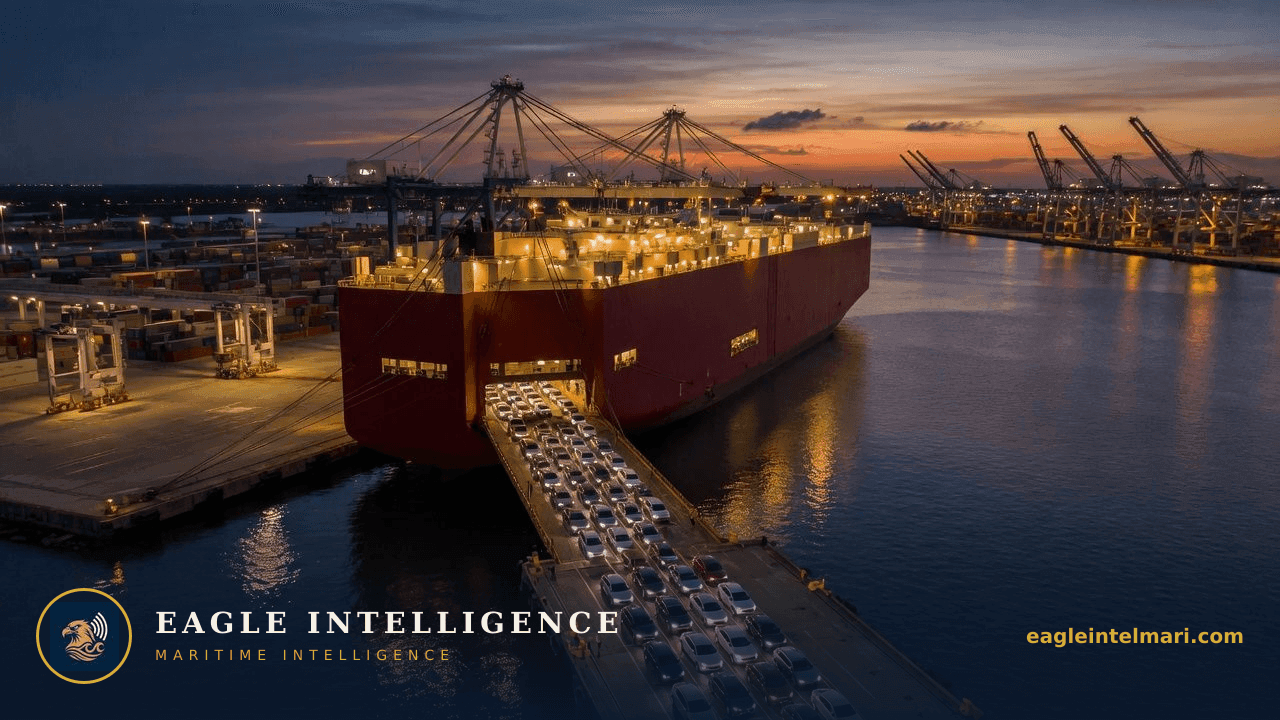
Volkswagen Group of America has crossed 250,000 vehicles processed at Port Freeport just over two years after launching its dedicated Gulf Coast hub, underscoring a deliberate shift toward Texas for import and distribution efficiency.
Advertisement
Advertisement
Volkswagen’s achievement of 250,000 vehicles handled at Port Freeport by 28 May 2026 marks more than a corporate milestone; it illustrates how European automakers are locking in Gulf Coast capacity to shorten inland delivery legs and diversify away from congested Atlantic and Pacific gateways.
Vehicle carriers typically seek ports that combine deep draft, wide turning basins and adjacent processing compounds. Port Freeport’s combination of these features has allowed pure car and truck carriers to maintain higher port-call frequency without the draft restrictions that sometimes constrain calls at older East Coast facilities. With VW now routing roughly 125,000 units per year through the terminal, operators have secured multi-year volume commitments that improve vessel utilization on the North Atlantic and Mediterranean–Gulf lanes.
Traditional discharge at Jacksonville or Baltimore forces many Midwest-bound vehicles onto longer rail or truck hauls. By contrast, Freeport sits closer to the Dallas–Houston corridor and offers direct interstate access, trimming an estimated 300–500 miles for a significant share of VW’s North American deliveries. Charterers therefore gain leverage in contract negotiations, while owners of large car carriers can market the port’s efficiency as a competitive advantage when bidding for automotive contracts.
The 2022 announcement and subsequent 2024 start-up coincided with capacity pressure at Houston’s Barbours Cut and Bayport terminals. Freeport responded by dedicating acreage for vehicle processing and investing in covered storage to protect high-value units from Gulf weather. Neighbouring ports are now watching closely: any decision by another OEM to follow VW’s model would accelerate infrastructure spending and could shift cargo share within the Texas port cluster within 18–24 months.
Jacksonville’s rise as an import hub for Japanese and German brands in the late 1990s followed a similar pattern—initial modest volumes, rapid terminal customization, then lock-in by multiple manufacturers. Freeport is compressing that timeline because modern vehicle logistics already favour Gulf routing for certain destination clusters, suggesting the Texas facility could reach 400,000–500,000 annual units sooner than Jacksonville did at the equivalent stage.
Continued OEM clustering at Freeport would lift annual throughput above 350,000 units and trigger additional PCC capacity calls, provided global vehicle demand remains stable and no new U.S. tariffs disrupt European exports. A second path sees volumes plateau near 250,000 if supply-chain disruptions or shifting consumer preferences toward North American-built models reduce import needs. The third scenario envisions a temporary surge above 400,000 units should European production be redirected to offset potential North American plant strikes or parts shortages, with the trigger being a sustained six-month spike in transatlantic bookings.
Higher vehicle throughput increases exposure for hull and cargo underwriters covering Ro-Ro tonnage on Gulf approaches during hurricane season. Crews benefit from more frequent but shorter port stays, reducing fatigue risk, yet they face tighter berthing windows that demand precise arrival planning. Flag states whose registries carry significant car-carrier tonnage will monitor whether Freeport’s growth alters typical voyage patterns enough to affect safety statistics.
Advertisement
Advertisement
⚠️ Intelligence Disclaimer: This analysis is produced by Eagle Intelligence's AI-assisted automated analysis system and is provided for informational purposes only. See our editorial standards. It is not a substitute for official maritime safety advisories from UKMTO, MSCHOA, IMO, or flag state authorities. Operational decisions should always be based on official guidance and professional judgment. Eagle Intelligence accepts no liability for any loss arising from reliance on this content.
Live chokepoint status, war-risk shifts, and the daily maritime wire, straight to your inbox. Free.
Leave a comment
All comments moderated for quality
