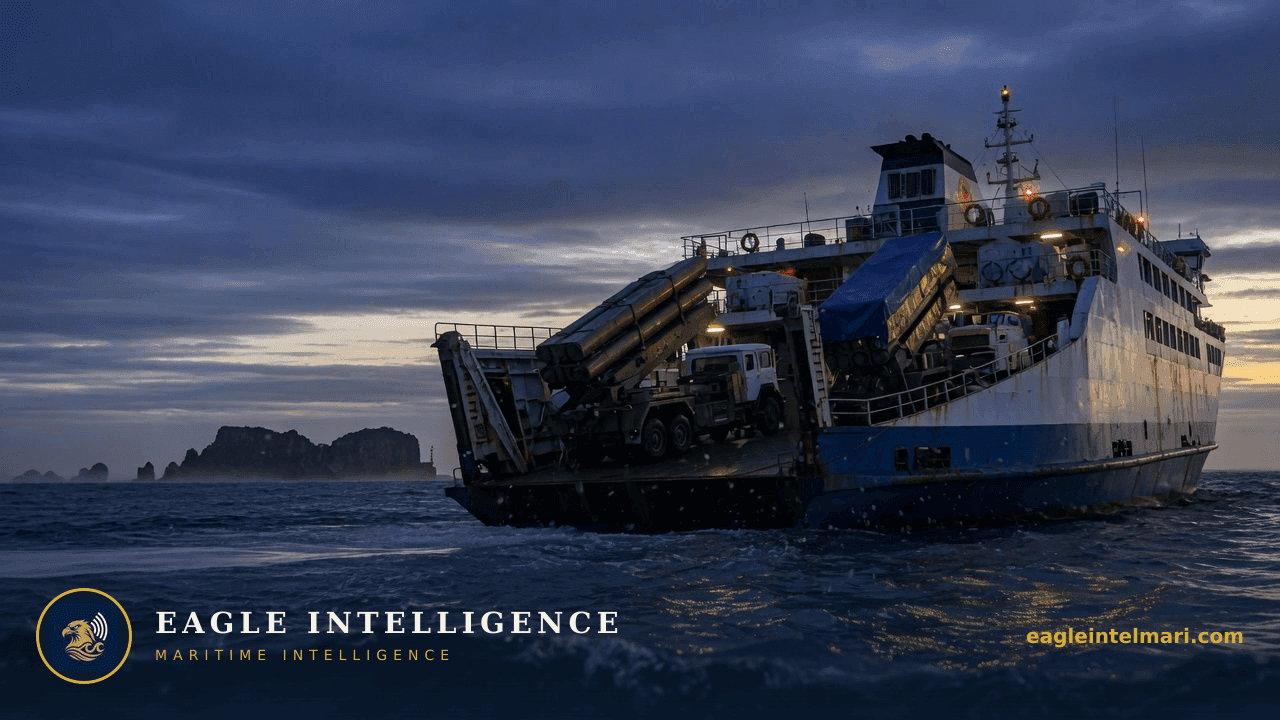
Charterers and ferry owners operating in the Luzon Strait now weigh military transport contracts against exposure to escalation near Taiwan, after the 3rd Marine Littoral Regiment landed anti-ship and air-defense systems on Calayan during June KAMANDAG drills.
Advertisement
Advertisement
Ferry operators and charterers in Philippine domestic routes must decide whether to accept U.S. Marine Corps contracts that place their vessels in the forward edge of a potential Taiwan contingency.
The 3rd Marine Littoral Regiment moved NMESIS launchers and associated air-defense equipment aboard contracted Philippine roll-on/roll-off ferries to Calayan Island earlier this month. The move turns routine inter-island tonnage into a distributed logistics node 200 nautical miles from Taiwan’s southern coast. Owners now face explicit questions about whether their vessels will be asked to repeat the trip under wartime conditions.
Hull and P&I underwriters have so far treated these movements as training. Once the same vessels are listed on a U.S. force list or operate inside a declared exclusion zone, war-risk premiums can jump from 0.05 % to 1.5 % of hull value within days. Clubs are already circulating questionnaires asking members to declare any prior military carriage in the Babuyan Channel.
Calayan lies on the northern edge of the Luzon Strait, a corridor that carries roughly 40 % of Asia-Europe container traffic when southern routes are congested. Any perception that commercial ferries are being militarized raises the chance that Chinese coast-guard or naval units will increase boardings or shadow transits. Charterers of bulk carriers and tankers that routinely pass the same waters are already modeling one- to two-day delays and the associated bunker burn.
Filipino seafarers constitute the majority of ratings on these ferries. Manning agencies rotating crews through ports such as San Fernando and Aparri now confront the possibility that personnel will be asked to handle classified cargo or operate under radio silence. Several agencies have begun inserting clauses allowing crew to decline military-tasked voyages without penalty.
The Philippine Maritime Industry Authority must decide whether to issue new guidance classifying these movements as cabotage or as sovereign military support. A formal reclassification could trigger additional inspections for vessels flagged under the Philippine registry and used in future drills. Port authorities at Batangas and Subic are also reviewing whether dedicated military loading berths are required to keep commercial traffic flowing uninterrupted.
The concept mirrors the U.S. Navy’s use of small inter-island craft to stage supplies ahead of the Okinawa invasion. Then, as now, civilian hulls provided the only realistic way to disperse assets across hundreds of small islands faster than dedicated amphibious shipping could manage. The difference today is that those same hulls remain commercially insured and crewed by civilians.
Monitor any announcement that the next KAMANDAG iteration will include live missile launches from Calayan or that additional Philippine ferry operators have signed multi-year support agreements. Either step would mark the transition from exercise to standing operational posture.
Advertisement
Advertisement
Live 1–5 shipping war-risk level across monitored chokepoints.
⚠️ Intelligence Disclaimer: This analysis is produced by Eagle Intelligence's AI-assisted automated analysis system and is provided for informational purposes only. See our editorial standards. It is not a substitute for official maritime safety advisories from UKMTO, MSCHOA, IMO, or flag state authorities. Operational decisions should always be based on official guidance and professional judgment. Eagle Intelligence accepts no liability for any loss arising from reliance on this content.
Live chokepoint status, war-risk shifts, and the daily maritime wire, straight to your inbox. Free.
Leave a comment
All comments moderated for quality
