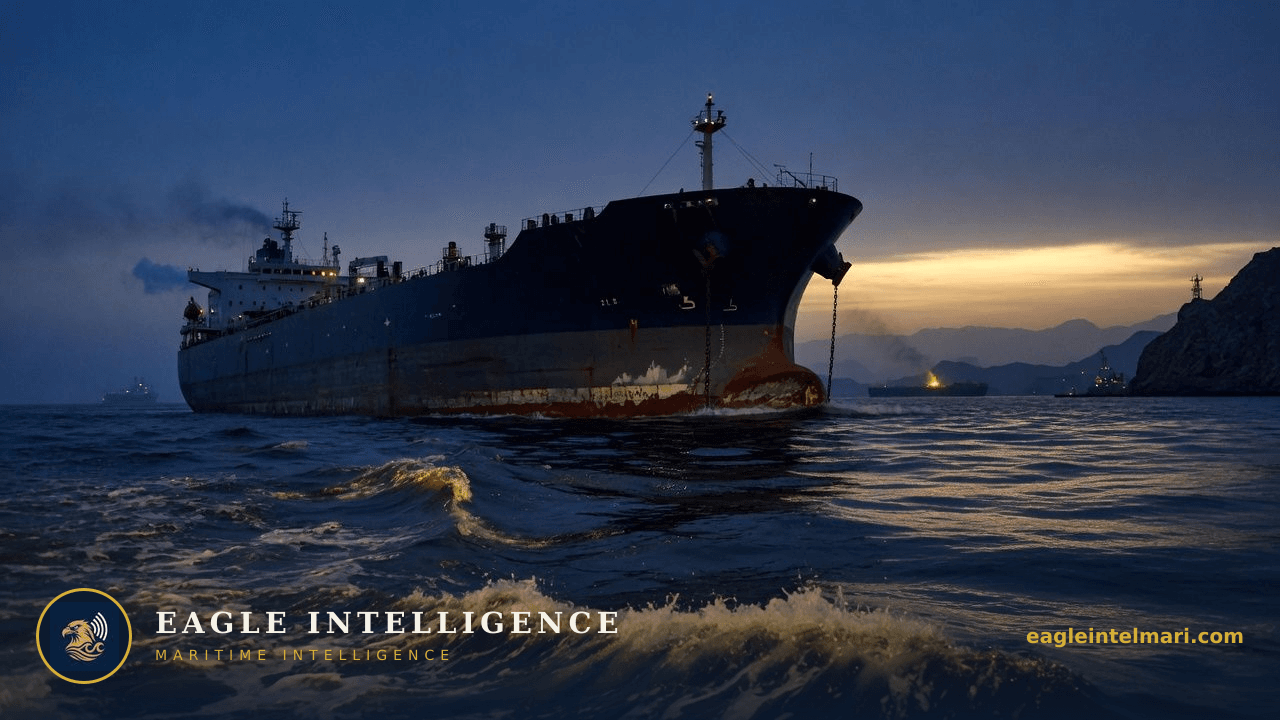
Owners and charterers with crude carriers in the Gulf must decide within the next 24-48 hours whether to accept sharply higher war-risk cover or divert around the Cape of Good Hope after a tanker was struck in the Strait of Hormuz and the US responded with fresh strikes on Iran.
Advertisement
Advertisement
Shipowners and charterers routing crude carriers through the Strait of Hormuz now confront an immediate choice between absorbing war-risk premiums that have jumped several hundred percent or committing to 12-to-15-day Cape diversions that erase voyage economics.
The US military carried out additional strikes on Iranian targets hours after the tanker incident, according to the initial reports. For any operator with a vessel currently eastbound or westbound in the Gulf, the clock is running on whether the next transit remains viable.
Hull and P&I underwriters began repricing exposures within hours of the first confirmed strike. Quotations for a VLCC loading at Ras Tanura for a European discharge have risen from roughly 0.15 percent of hull value to between 0.60 and 0.85 percent for single transits, with some syndicates quoting 1 percent or more for repeated passages. Charterers who have not already secured coverage for the next fixture are now competing for the remaining capacity at these elevated levels.
The immediate effect is visible in the freight market. Several fixtures that were under negotiation for July loadings have been withdrawn, and at least two major traders have instructed brokers to seek alternative tonnage willing to route via the Cape rather than absorb the new risk layer.
Vessels flagged in open registries with crews drawn from the Philippines, India and Sri Lanka are seeing the fastest pull-back. Manning agents report that several senior officers have already declined to sign on for Hormuz transits scheduled after 30 June. For companies still rotating crew through ports such as Fujairah or Jebel Ali, the cost of emergency airlifts and replacement personnel is now being factored into daily operating expenses.
Owners with Greek or Norwegian flags have marginally more flexibility because their war-risk clauses often allow master’s discretion to divert without breaching charter-party terms. That contractual margin is narrowing as more hull syndicates insert explicit Hormuz exclusion riders.
London and Singapore underwriters are expected to issue updated joint war-risk lists within days. The precedent from 2019 shows that once Hormuz or the adjacent Gulf of Oman is listed, cover can be withdrawn or surcharged on 48 hours’ notice. Hull brokers are already advising clients to secure seven-to-fourteen-day extensions before any formal announcement, because post-listing capacity dries up quickly.
P&I clubs are watching the same timeline. Several clubs have circulated internal guidance reminding members that any vessel entering a newly declared war-risk area without prior notification risks a denial of cover for subsequent incidents.
Saudi and Iraqi cargoes bound for Europe and the US East Coast are the most exposed. A sustained closure or effective insurance-driven boycott of the Strait would add roughly 2.2 million barrels per day to the Cape route, requiring an additional 25-30 VLCCs simply to maintain current liftings. That tonnage is not readily available without pulling vessels out of the Atlantic basin, which would tighten clean-product freight rates in the process.
Traders are already modeling a $3-to-$5 per barrel freight differential for cargoes forced around the Cape. The spread is wide enough to make some marginal Middle East grades uneconomic for certain European refiners, shifting demand toward West African and US Gulf crudes instead.
Time-charterers with options declared for the third quarter are being advised to exercise those options immediately while counterparties remain willing to accept Hormuz routing. Voyage charterers should insert explicit deviation clauses that permit Cape routing without penalty if insurance becomes unavailable. Owners who have not yet done so should review their current war-risk policies for aggregate limits and notice periods before the next fixture is fixed.
Advertisement
Advertisement
Indicative Additional War Risk Premium (AWRP) ranges — not a binding insurance quote.
Live Hormuz transit status and war-risk band.
Live 1–5 shipping war-risk level across monitored chokepoints.
⚠️ Intelligence Disclaimer: This analysis is produced by Eagle Intelligence's AI-assisted automated analysis system and is provided for informational purposes only. See our editorial standards. It is not a substitute for official maritime safety advisories from UKMTO, MSCHOA, IMO, or flag state authorities. Operational decisions should always be based on official guidance and professional judgment. Eagle Intelligence accepts no liability for any loss arising from reliance on this content.
Live chokepoint status, war-risk shifts, and the daily maritime wire, straight to your inbox. Free.
Leave a comment
All comments moderated for quality
