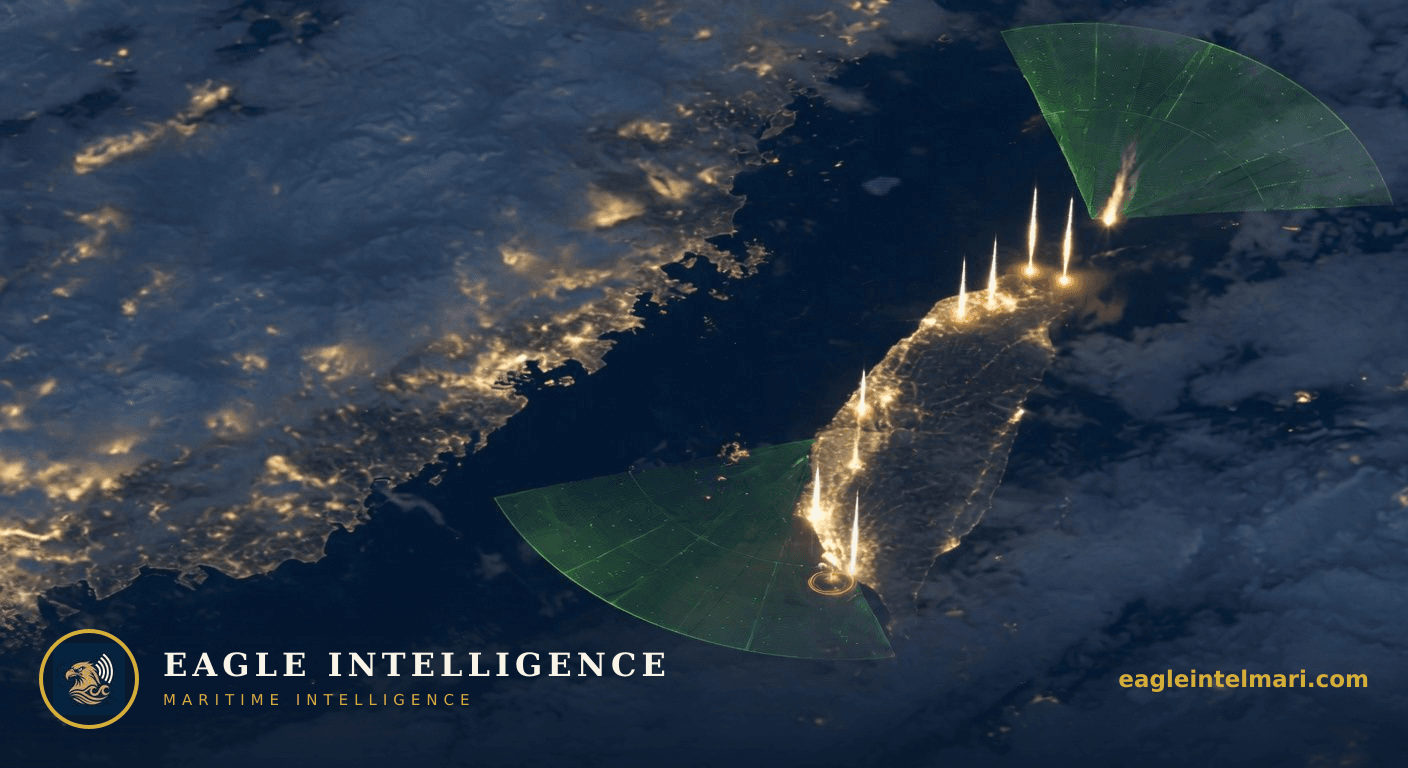
Taiwan's planned expansion to more than 1,800 anti-ship missiles by early 2029 signals a deliberate effort to raise the cost of any Chinese blockade or amphibious operation, with direct consequences for commercial traffic through the Taiwan Strait.
Advertisement
Advertisement
Taiwan's decision to field more than 1,800 anti-ship missiles by early 2029, according to Reuters calculations, is calibrated to complicate Chinese planning rather than to achieve parity in raw firepower. The weapons, a mix of mobile coastal batteries and ship-launched systems, are intended to saturate any invasion flotilla or blockade screen within the first 48 to 72 hours. For commercial operators this timeline matters: a single contested day in the strait can already reroute ultra-large container vessels around the Philippines, adding four to six days and roughly $300,000 in fuel and charter costs per sailing.
Hull and war-risk underwriters have already begun adjusting attachment points for vessels declaring Taiwan Strait transits. The addition of hundreds of mobile launchers increases the probability of unintended escalation from a single misidentified fishing vessel or drone. P&I clubs are therefore reviewing whether routine calls at Kaohsiung or Keelung will trigger higher additional premiums or outright exclusions once the 1,800-missile inventory is reached. Charterers of product tankers and LNG carriers are watching the same numbers; any sustained spike in war-risk rates above 0.25 percent of hull value will push marginal cargoes onto longer routes via the Malacca Strait.
Ports in southern Japan and the northern Philippines are quietly expanding cold-berth capacity and bunkering slots in anticipation of diverted traffic. Flag states with large bulk and container registries have begun advising masters to maintain continuous AIS transmission through the strait while simultaneously preparing contingency plans for radio silence if electronic warfare intensifies. These measures are not yet mandatory, yet the pattern mirrors the voluntary recommendations issued for the Persian Gulf in 2019 when anti-ship missile threats were similarly elevated.
The current buildup echoes the 1980s Tanker War, when both Iran and Iraq deployed anti-ship missiles against neutral shipping to coerce third-party behavior. Then, as now, the weapons were not aimed primarily at commercial hulls but at altering the risk calculation of every vessel transiting the contested waterway. The difference today is speed and precision: modern Taiwanese systems can engage targets at ranges exceeding 200 nautical miles with far higher hit probabilities, compressing the decision window for masters and owners from days to hours.
First scenario: steady missile deliveries and training cycles proceed without incident, gradually normalizing higher insurance costs that are ultimately passed to cargo owners; container lines maintain two to three weekly services via the strait under selective routing. Second scenario: an accidental close encounter between Taiwanese patrol craft and a Chinese coast-guard vessel triggers a brief exchange of fire, prompting a three-month spike in war-risk rates above 0.75 percent and forcing most energy traders to reroute LNG and crude cargoes south of Taiwan. Third scenario: Beijing responds to the missile expansion with its own accelerated deployment of long-range anti-ship ballistic missiles and drones, producing a sustained deterrence stalemate that keeps commercial traffic flowing but under constant electronic-warfare interference and elevated crew-risk premiums.
Owners are already revising contracts for Taiwan Strait voyages to include enhanced war-risk bonuses and the right to refuse transit if missile-related NOTAMs or NAVAREA warnings are issued. Unions representing Filipino and Indian ratings have begun discussing whether service on vessels regularly routing through the strait should trigger automatic hazard pay once the 1,800-missile threshold is crossed. Retention of experienced masters willing to accept these transits is likely to become the binding constraint before hull availability itself.
Advertisement
Advertisement
Live 1–5 shipping war-risk level across monitored chokepoints.
⚠️ Intelligence Disclaimer: This analysis is produced by Eagle Intelligence's AI-assisted automated analysis system and is provided for informational purposes only. See our editorial standards. It is not a substitute for official maritime safety advisories from UKMTO, MSCHOA, IMO, or flag state authorities. Operational decisions should always be based on official guidance and professional judgment. Eagle Intelligence accepts no liability for any loss arising from reliance on this content.
Live chokepoint status, war-risk shifts, and the daily maritime wire, straight to your inbox. Free.
Leave a comment
All comments moderated for quality
