Washington has decoupled any sanctions relief from Iranian promises to keep the Strait of Hormuz open, anchoring future access instead to verifiable nuclear dismantlement.
Advertisement
Advertisement
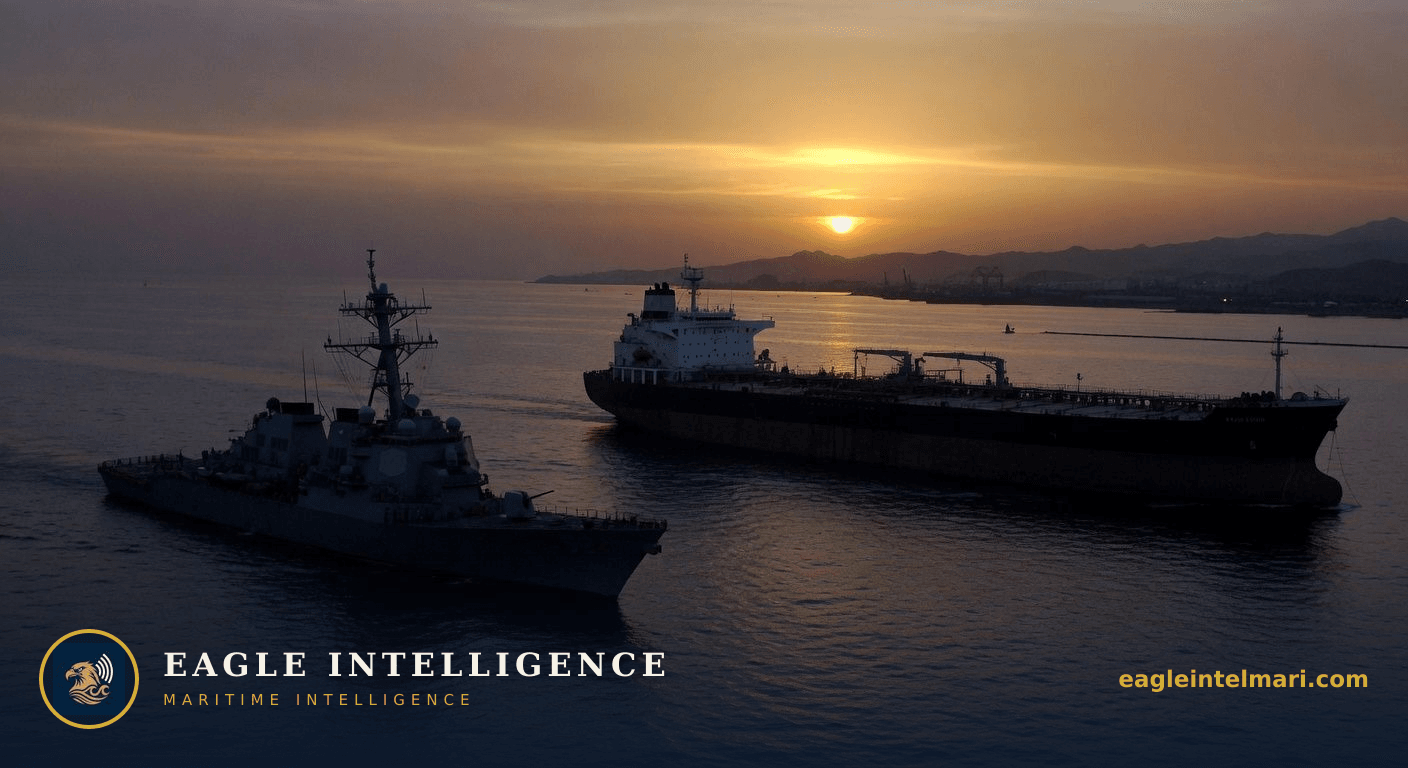
Marco Rubio’s Tuesday statement to Congress makes clear that the Trump administration will not barter sanctions relief simply to restore Hormuz transit; any easing remains contingent on Tehran abandoning its nuclear program. The position raises the threshold for de-escalation and embeds long-term uncertainty into one of the world’s most critical maritime chokepoints.
Rubio’s clarification removes the narrow transactional option that some shipowners and traders had quietly hoped for—an implicit swap of sanctions relief for Iranian assurances of safe passage. Instead, the Strait’s operational status is now tethered to the same red line that has defined U.S. policy since the 2018 JCPOA withdrawal. For maritime planners this linkage converts a recurring navigation risk into a structural geopolitical constraint that could persist for years.
With roughly 21 million barrels of oil and condensate transiting the Strait daily in normal conditions, even partial closure forces VLCCs and Suezmaxes into the longer Cape route around Africa, adding 12–15 days and roughly $1.8–2.2 million in fuel and time costs per voyage. Charterers already booking June and July liftings from the Gulf are inserting Hormuz force-majeure clauses and war-risk surcharges into fixtures, shifting more of the exposure onto owners. The economics favor larger, slower-burning vessels that can absorb the extra mileage, further concentrating the fleet profile on the route.
Protection and indemnity insurers have already begun reviewing their Hormuz endorsements following the Rubio remarks. Clubs that had maintained standard war-risk exclusions are now modeling scenarios in which Iranian Revolutionary Guard naval activity intensifies as leverage in nuclear talks. Hull underwriters, meanwhile, are widening the geographic scope of high-risk zones to include approaches within 50 nautical miles of Iranian waters, a move that will push additional premiums onto operators regardless of actual incidents.
Fujairah, Khor Fakkan and other UAE bunkering hubs that serve as the last safe stops before Hormuz are seeing increased demand for floating storage and STS transfers as charterers seek to minimize time inside the Strait. Omani ports such as Duqm and Salalah are quietly marketing themselves as alternative staging points, yet their limited draft and bunker capacity cannot absorb the full volume of diverted tonnage. Port authorities in both countries have begun contingency planning for extended vessel queues should Iranian forces conduct even sporadic inspections or missile tests near the traffic lanes.
The current dynamic recalls the 1984–1988 “Tanker War,” when Iran and Iraq targeted neutral shipping to pressure external powers. Then, as now, the absence of a clear off-ramp prolonged the threat, driving war-risk premiums above 2 percent of hull value and prompting the U.S. Navy’s Earnest Will escort operation. The key difference today is that sanctions relief—the principal lever used in the 1980s to modulate Iranian behavior—is explicitly withheld until nuclear concessions materialize, removing a tool that once allowed tactical de-escalation.
Three plausible trajectories emerge. First, sustained U.S. pressure combined with secondary sanctions on Chinese buyers could force Tehran back to the table on nuclear limits within 12–18 months, gradually normalizing Hormuz traffic. Second, Iranian internal economic stress could prompt limited, unannounced reductions in harassment of shipping as a tacit signal, even without formal sanctions relief. Third, and most disruptive, Tehran could respond to the hardened U.S. line by increasing Revolutionary Guard naval presence and mine-laying drills, triggering a sharp spike in insurance rates and a measurable rerouting of at least 15 percent of Gulf crude onto the Cape route by year-end. The trigger for each path will be visible in Iranian nuclear-site access reports and Revolutionary Guard statements rather than in any sudden reopening announcement.
Advertisement
Advertisement
Live Hormuz transit status and war-risk band.
Live 1–5 shipping war-risk level across monitored chokepoints.
⚠️ Intelligence Disclaimer: This analysis is produced by Eagle Intelligence's AI-assisted automated analysis system and is provided for informational purposes only. See our editorial standards. It is not a substitute for official maritime safety advisories from UKMTO, MSCHOA, IMO, or flag state authorities. Operational decisions should always be based on official guidance and professional judgment. Eagle Intelligence accepts no liability for any loss arising from reliance on this content.
Live chokepoint status, war-risk shifts, and the daily maritime wire, straight to your inbox. Free.
Leave a comment
All comments moderated for quality
