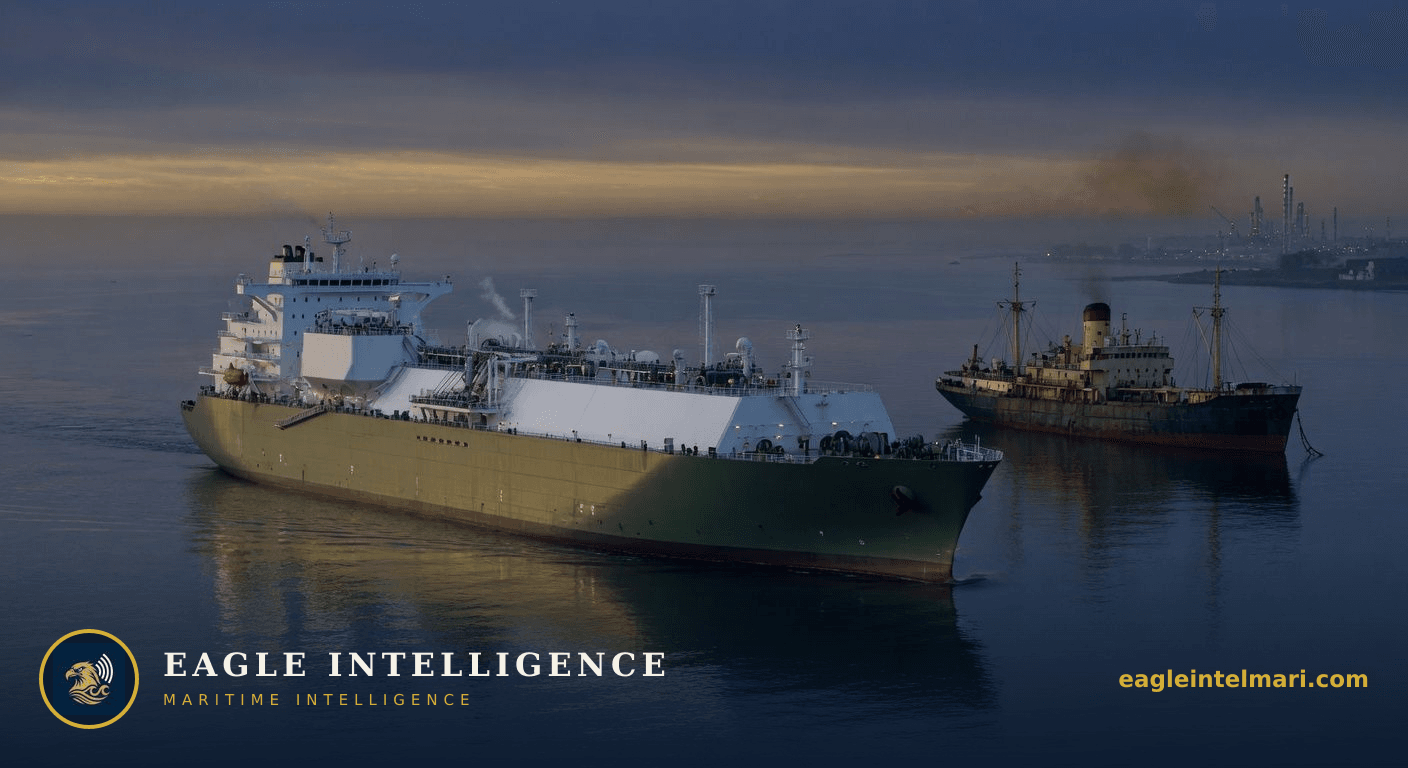
Tightening EU emissions rules are driving a widening economic gap between modern LNG carriers and older steam-turbine vessels, reshaping charter strategies and renewal decisions.
Advertisement
Advertisement
European carbon costs are forcing LNG owners to confront an accelerating split between vessels that can absorb new levies and those that cannot, with older tonnage facing rapid commercial obsolescence.
Wood Mackenzie’s analysis shows that EU ETS inclusion for maritime transport, now fully phased in for voyages calling at European ports, adds roughly $3,000–$5,000 per day in compliance costs for a typical 170,000 m³ steam-turbine carrier burning high-sulphur fuel oil. Dual-fuel DFDE and X-DF vessels, by contrast, incur less than half that burden thanks to lower carbon intensity and better fuel efficiency. The result is an immediate 12–18 % widening of daily operating cost differentials that charterers can no longer ignore.
Major energy traders and LNG portfolio players are already embedding ETS pass-through clauses that penalise non-eco tonnage. On the spot market, steam vessels are seeing fixture rates soften by $8,000–$12,000 per day relative to 2024 levels, while modern carriers with verified CII A or B ratings command premiums. This dynamic is most visible on the US Gulf–Europe and Qatar–Europe routes, where voyage frequency exposes owners to repeated carbon charges.
Hull and machinery underwriters have begun adjusting premium structures to reflect elevated laid-up risk for pre-2015 steam carriers. Several Nordic and London syndicates are now requiring proof of forward compliance plans before renewing cover on vessels older than 15 years. Banks providing sale-and-leaseback facilities are similarly tightening covenants, accelerating the decision point for owners weighing scrubber retrofits against early demolition.
The current divide echoes the 2020 IMO sulphur cap, when scrubber-fitted vessels captured most of the premium while non-fitted tonnage was pushed into secondary trades or lay-up. However, unlike the one-time fuel switch, ETS costs rise annually with the EU cap trajectory, creating a compounding rather than static penalty that favours vessels with the lowest baseline emissions from day one.
If ETS allowance prices remain above €80/t through 2027, roughly 45 older carriers face negative cash flow on Europe-bound voyages and are likely to exit the fleet via demolition or conversion to FSRU service by 2028. Should prices moderate below €55/t, the split narrows but still favours modern tonnage, pushing charterers toward longer-term charters on newbuilds and leaving older vessels in Middle East–Asia arbitrage trades. A third pathway emerges if the EU grants temporary derogations for LNG as a transition fuel; this would buy 2–3 years for owners but would not remove the underlying efficiency gap that continues to widen with each newbuild delivery.
Flag states with large steam-turbine registries, notably Liberia and Panama, are quietly encouraging owners to pursue early reflagging or recycling to avoid reputational exposure. European ports, meanwhile, are expected to increase random CII verification inspections, raising the operational friction cost for marginal vessels even before carbon allowances are surrendered.
Advertisement
Advertisement
⚠️ Intelligence Disclaimer: This analysis is produced by Eagle Intelligence's AI-assisted automated analysis system and is provided for informational purposes only. See our editorial standards. It is not a substitute for official maritime safety advisories from UKMTO, MSCHOA, IMO, or flag state authorities. Operational decisions should always be based on official guidance and professional judgment. Eagle Intelligence accepts no liability for any loss arising from reliance on this content.
Live chokepoint status, war-risk shifts, and the daily maritime wire, straight to your inbox. Free.
Leave a comment
All comments moderated for quality
