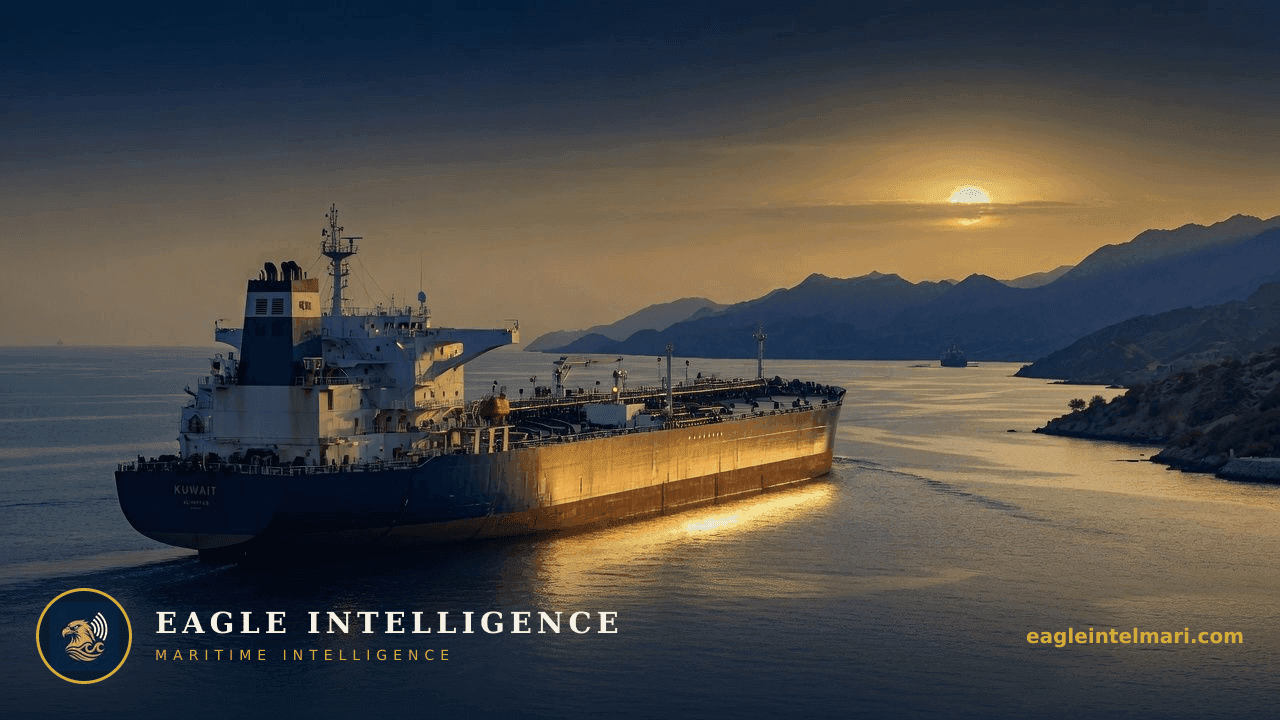
Kuwait’s first post-war offers to Asian buyers mark the clearest sign yet that crude volumes through the Strait of Hormuz are recovering, with immediate consequences for tanker demand, insurance pricing and refinery feedstock choices.
Advertisement
Advertisement
Kuwait’s decision to market its crude directly to Asian refiners for the first time since the Iran conflict began signals that physical oil volumes through the Strait of Hormuz are rising again, easing some of the war-induced supply tightness that had forced buyers toward longer-haul alternatives.
Owners who had diverted VLCCs and Suezmaxes to West African or Brazilian cargoes during the height of Hormuz restrictions are now re-evaluating eastbound ballast legs. A single Kuwait-to-India or Kuwait-to-South Korea fixture removes roughly 35 days of round-voyage time compared with a similar-sized cargo lifted from the Atlantic basin. Charterers report that several vessels previously fixed on cross-Atlantic stems have already been offered for early-July loadings from Mina al-Ahmadi, tightening availability for remaining West African barrels.
Asian complex refiners had shifted toward heavier Western crudes or increased runs of condensate when Kuwaiti exports were curtailed. Reintroduction of Kuwait Export Crude, typically 2.5-2.8 % sulphur, allows desulphurisation units to run closer to design capacity and reduces the need for expensive low-sulphur blendstocks. Margin models at two South Korean majors show a potential $1.80–2.40 per barrel improvement in middle-distillate netbacks once Kuwaiti barrels are processed, assuming current freight levels hold.
War-risk underwriters had maintained Hormuz loadings at 0.75–1.25 % of hull value for most of the conflict period. Early indications from London and Singapore brokers suggest that the first Kuwaiti cargoes since May are being quoted at 0.35–0.45 %, reflecting both reduced Iranian kinetic activity and the reappearance of Kuwaiti state-backed tonnage. Hull insurers are expected to follow within 30 days if no further incidents occur, lowering the all-in cost of eastbound voyages by roughly $180 000 on a standard VLCC.
Kuwaiti-flagged and Kuwaiti-owned vessels had largely avoided the Strait during the acute phase; their return tests whether Oman and the UAE will maintain enhanced inspection regimes introduced in April. So far, no additional delays have been reported at Fujairah or Salalah, but several classification societies are quietly advising masters to retain armed security teams for at least one more rotation. Flag states such as Liberia and Panama, which saw a surge in temporary reflagging requests in March, now face early redelivery notices from owners seeking to restore original registry.
The re-entry of roughly 300 000 b/d of Kuwaiti crude into Asian markets is equivalent to three VLCC loadings per week. This volume alone is sufficient to ease some of the backwardation that had developed in the June–August VLCC TCE curve east of Suez. On the commodity side, the Brent–Dubai spread narrowed 12 cents on the day the first offers surfaced, indicating that paper markets are already incorporating the physical signal.
Sustained de-escalation keeps Hormuz loadings above 18 million b/d and pushes war-risk premiums below 0.25 % by mid-August, allowing full restoration of normal Kuwait–Asia trade lanes. A single kinetic incident involving a non-Iranian vessel would freeze new Kuwaiti fixtures and send at least six VLCCs back into the Atlantic, restoring the earlier freight spike within ten days. Prolonged low-level harassment without major losses keeps premiums in the 0.40–0.60 % band, forcing charterers to maintain war-risk clauses in every eastbound contract and sustaining a two-tier market for Hormuz versus non-Hormuz tonnage.
Advertisement
Advertisement
Indicative Additional War Risk Premium (AWRP) ranges — not a binding insurance quote.
Live Hormuz transit status and war-risk band.
Live 1–5 shipping war-risk level across monitored chokepoints.
⚠️ Intelligence Disclaimer: This analysis is produced by Eagle Intelligence's AI-assisted automated analysis system and is provided for informational purposes only. See our editorial standards. It is not a substitute for official maritime safety advisories from UKMTO, MSCHOA, IMO, or flag state authorities. Operational decisions should always be based on official guidance and professional judgment. Eagle Intelligence accepts no liability for any loss arising from reliance on this content.
Live chokepoint status, war-risk shifts, and the daily maritime wire, straight to your inbox. Free.
Leave a comment
All comments moderated for quality
