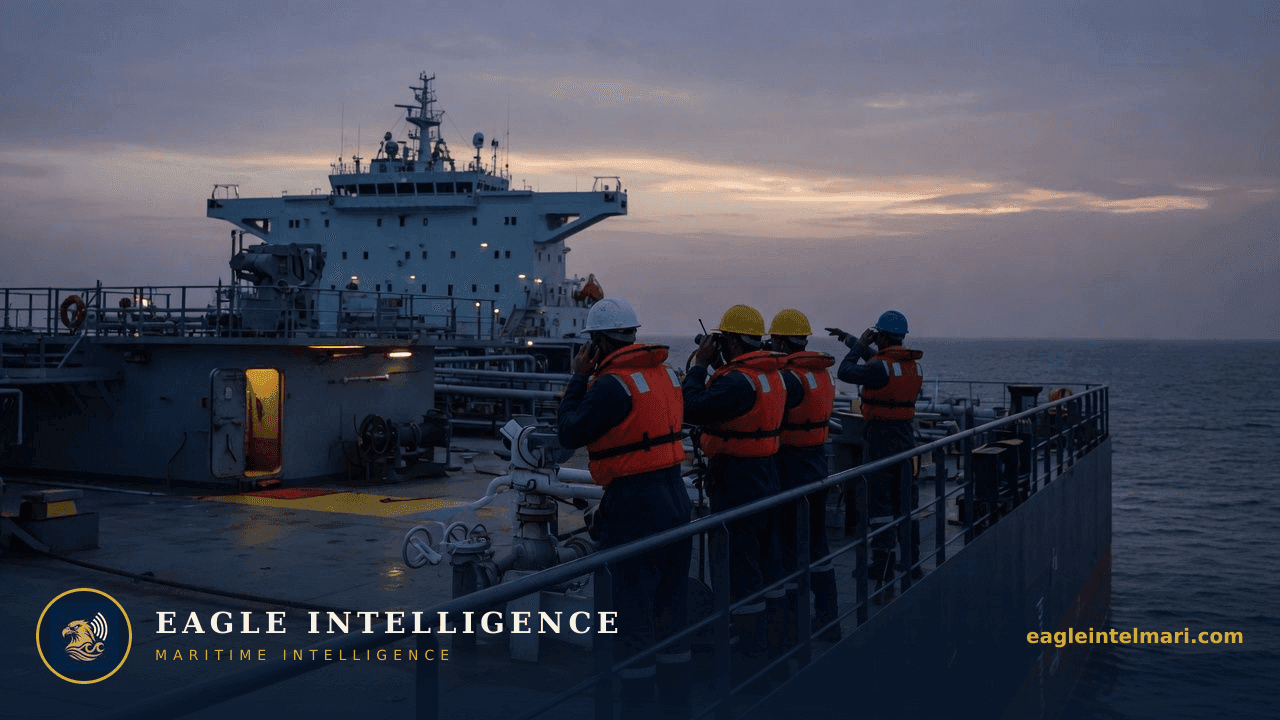
A U.S.-sanctioned product tanker hijacked and diverted toward Somalia this week underscores the operational and human costs of shadow fleet activity amid weak enforcement and rising Somali piracy threats.
Advertisement
Advertisement
A U.S.-sanctioned product tanker was hijacked in the Gulf of Aden on or around 20 August 2026 and redirected toward Somalia after six armed men boarded and seized control, marking the second such incident in recent days. The event places direct costs on crews, who face immediate physical danger and prolonged uncertainty over wages, repatriation and legal status, while exposing the limits of sanctions that continue to allow designated tonnage to trade in high-risk zones. No fresh vessel designations or delistings appeared in the 20 August reporting, yet the hijacking itself demonstrates how enforcement announcements have not translated into operational containment.
The supplied reporting contains no specific tranche of new vessel or entity designations from OFAC, the EU, UK OFSI or the UN on 20 August 2026. Treasury Secretary Scott Bessent stated on 20 August that the United States will impose the toughest sanctions in history on Iran, yet the statement remained prospective and did not enumerate individual ships, owners or managers. SeaLead’s voluntary liquidation in August 2026 is recorded as the final consequence of earlier U.S. sanctions rather than a new action taken this week.
Without fresh lists, compliance teams cannot update screening databases from this week’s material. The absence of numbers means any assessment of tranche patterns must rely on prior cycles, which have typically targeted older tonnage and flag-hopping registries. The lack of concrete additions this week leaves open the possibility that enforcement resources are currently directed toward implementation and interdiction rather than fresh listings.
The SeaLead case illustrates the downstream effect of past designations: the carrier ceased trading and entered liquidation after sanctions pressure accumulated over nearly a year. This pattern suggests that when designations bite, they do so through commercial isolation rather than immediate detention. Observers should therefore treat Bessent’s Iran announcement as a signal of future volume rather than an immediate list.
GPS jamming and spoofing remain the dominant technical layer of evasion, as noted in marine insurance compliance guidance issued on 20 August. Jamming disrupts reliable AIS broadcasts, allowing vessels to operate without consistent positional data that screening tools expect. False flag operations, now extending to Syria-linked movements, add a documentary layer in which vessels present altered identities or registry claims that outpace static screening databases.
Ship-to-ship transfers continue to cluster in areas outside routine port scrutiny, though the supplied items do not specify current locations or volumes. Flag-hopping under pressure from registries facing diplomatic or financial sanctions creates a rolling identity problem; a vessel may change flag multiple times within weeks, rendering any single registry check obsolete. Insurance and P&I attestation fraud occurs when documents are presented that purport to show coverage from entities not actually providing it, a tactic that exploits the gap between paper compliance and actual risk transfer.
Document laundering follows the same logic: bills of lading, certificates of origin and class records are altered or reissued through intermediary entities so that the final recipient sees only the cleaned paperwork. Compliance officers can screen for repeated short-duration flag changes, AIS gaps exceeding normal satellite coverage limits, and STS operations that coincide with known high-risk anchorages. Each of these indicators becomes actionable when cross-checked against the most recent OFAC or EU lists rather than relying on historical data alone.
Charterers and bunker suppliers absorb the first commercial shock when a vessel is designated, because they lose the ability to contract or supply without breaching their own compliance policies. Port agents face detention risk and potential fines if they handle a sanctioned call, while class societies must decide whether to maintain or withdraw certification once ownership links surface. Banks that have issued letters of credit or handled payments tied to the vessel encounter secondary sanctions exposure.
Crews aboard designated tonnage carry the most immediate human burden. The hijacked product tanker carried at least six Indian seafarers among its complement, placing them in the path of armed boarders and an extended diversion toward Somalia. Once a vessel is sanctioned, routine port entry is refused, bunkering becomes impossible through legitimate channels, and wages often go unpaid because owners cannot access banking systems. Repatriation is blocked when flag states or coastal authorities decline to issue necessary clearances. These outcomes are not hypothetical; the current hijacking demonstrates that the same vessels still trade in piracy-prone waters despite prior designation.
The second reported Somali piracy incident within a week, occurring 136 nautical miles east of Al Mukalla, Yemen, further concentrates risk on crews who have already been abandoned by commercial support networks. Families ashore lose contact and income streams while authorities determine whether the vessel remains under the original flag or has been absorbed into informal networks.
Announcements of new sanctions or future Iran measures generate headlines, yet the hijacking of an already-designated tanker shows that operational presence in contested waters persists. UKMTO recorded the incident, but no information appears on whether the vessel was detained, released or boarded by any state authority after the seizure. The gap between designation and physical control therefore remains wide.
Detention figures are not supplied in the 20 August material, preventing any quantitative comparison between listed vessels and those actually held. The resurgence of Somali piracy against shadow fleet targets suggests that interdiction capacity in the Gulf of Aden is stretched, with resources allocated across multiple concurrent threats including Houthi activity and Iranian tensions. Enforcement therefore relies heavily on commercial actors refusing to trade rather than on state forces removing vessels from service.
The second hijacking within seven days indicates that the cost-benefit calculation for operators of designated tonnage still favours continued trading in some segments. Until detention or boarding rates rise measurably, the enforcement signal remains primarily financial and reputational rather than physical.
How many of the vessels currently listed by OFAC or the EU remain actively trading in the Gulf of Aden and Indian Ocean, and what is the most recent verified position for each?
Which registries accepted flag changes for the hijacked tanker in the twelve months before the incident, and have those registries received formal demarches?
What specific wind-down authorisations for Iranian crude or product movements are scheduled to expire in the next thirty days, and which entities hold them?
How are P&I clubs verifying that attested cover on shadow fleet tonnage is not fronted through non-existent or non-compliant insurers?
What data-sharing protocols exist between UKMTO, flag states and crewing agencies to accelerate crew welfare checks once a designated vessel is reported hijacked?
Which class societies have withdrawn certification from the largest number of sanctioned vessels in 2026, and what is the observed lag between withdrawal and the vessel’s next port call?
Next 24 hours: any UKMTO or coalition update confirming whether the hijacked tanker was released, detained or reached Somali waters.
Next seven days: OFAC or EU announcement of new Iran-related designations that follow Bessent’s 20 August statement, with particular attention to product tanker and STS operator names.
Next thirty days: expiry of any documented wind-down periods tied to prior Iran sanctions packages, and any resulting shift in shadow fleet routing through the Strait of Hormuz or Gulf of Aden.
Advertisement
Advertisement
⚠️ Intelligence Disclaimer: This analysis is produced by Eagle Intelligence's AI-assisted automated analysis system and is provided for informational purposes only. See our editorial standards. It is not a substitute for official maritime safety advisories from UKMTO, MSCHOA, IMO, or flag state authorities. Operational decisions should always be based on official guidance and professional judgment. Eagle Intelligence accepts no liability for any loss arising from reliance on this content.
Live chokepoint status, war-risk shifts, and the daily maritime wire, straight to your inbox. Free.
Leave a comment
All comments moderated for quality
