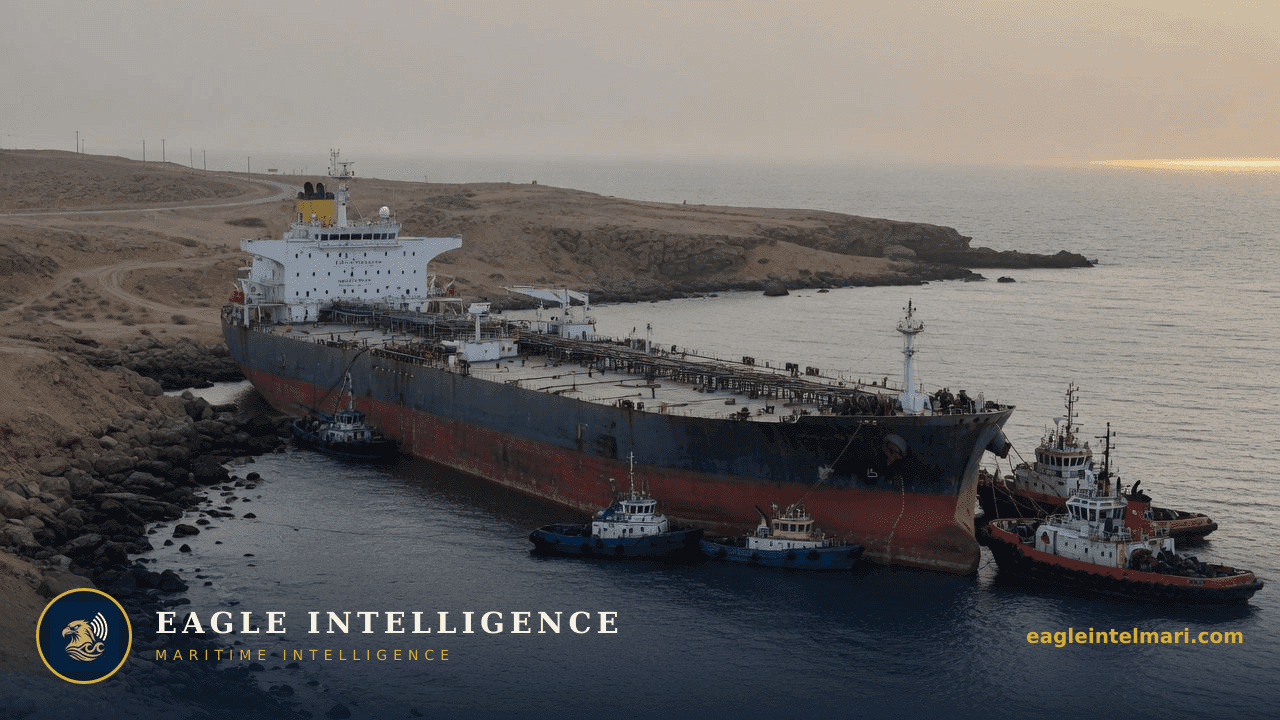
The week's only concrete sanctions development is a sanctioned Russian insurer surfacing in the salvage of the grounded shadow fleet tanker Caroline Bezengi off Oman; with no new OFAC, EU or UK designations reported, the case illustrates how crews and local responders bear immediate costs while broader evasion mechanics remain unaddressed in the evidence.
Advertisement
Advertisement
This week the enforcement picture moved only in the narrow sense that a sanctioned Russian insurer appeared behind the salvage of the grounded tanker Caroline Bezengi off Oman. The development carries direct costs for the vessel’s crew, who face prolonged uncertainty over pay, provisions and repatriation, and for any port agents or salvors required to navigate sanctions compliance in real time. No new vessel or entity designations from OFAC, the EU, UK OFSI or the UN appear in the supplied reporting.
The supplied items contain no reports of fresh designations or delistings by any sanctions authority during the review period ending 14 August 2026. The only sanctions-linked development is the emergence of a sanctioned Russian insurer in the ongoing salvage of the tanker Caroline Bezengi, already described in reporting as a shadow fleet vessel. This fits no observable tranche pattern because no tranche has been announced. Where authorities have previously targeted Russian maritime insurers, the pattern has typically involved successive waves aimed at P&I providers supporting older tonnage; the present evidence supplies no indication that Caroline Bezengi’s case forms part of such a sequence.
The absence of new listings means compliance officers have no updated SDN or EU consolidated list entries to integrate into screening this week. Any assumption that Hormuz-related incidents would trigger immediate sanctions action against additional shadow fleet tonnage finds no support in the material reviewed.
The supplied reporting provides no concrete details on AIS gaps, spoofing, ship-to-ship transfers, flag-hopping, insurance attestation fraud or document laundering connected to Caroline Bezengi or any other vessel. The items note only that the tanker is grounded off Oman and that a sanctioned Russian insurer has become involved in salvage efforts. No locations for STS operations, no registry history, and no description of how the vessel’s insurance documentation was presented to class or port authorities are given.
Without those specifics, it is not possible to extract screening indicators for compliance teams. The evidence does not state whether the vessel maintained AIS during its final voyage, whether it conducted recent STS activity in the Gulf of Oman, or whether any flag change preceded the grounding. Compliance officers therefore cannot derive actionable red flags from the material.
The crew aboard the grounded tanker Caroline Bezengi carries immediate and severe exposure. Once a vessel is linked to a sanctioned insurer and designated status, seafarers frequently lose access to wages, provisions and medical care because bunker suppliers and chandlers refuse service. The items give no crew numbers or nationalities, yet the general mechanism is clear: without functioning P&I cover from a non-sanctioned provider, the vessel cannot easily enter port for repairs or crew change, leaving the seafarers effectively abandoned until a compliant salvor or flag state intervenes.
Charterers, port agents and bunker suppliers in Oman and neighbouring states face secondary exposure. Any entity that provides services to the vessel risks secondary sanctions if the connection to the sanctioned insurer is deemed to confer material benefit. Banks processing payments for salvage or towage must screen both the vessel and the insurer, creating delays that raise operational costs. The evidence supplies no figures for these costs, but the structure of exposure is consistent with prior shadow fleet groundings where local responders absorbed unpaid invoices while waiting for sanctions licences.
What is announced in sanctions policy remains distant from what is detained or immobilised on the water. The supplied items contain no reports of vessel detentions, arrests of operators, or successful interdictions tied to new designations. The Caroline Bezengi salvage is proceeding under the involvement of a sanctioned insurer, indicating that operational continuity can persist even when formal sanctions apply. This gap between public designations and physical enforcement is not quantified in the material; no numbers of detained shadow fleet tankers or successful licence applications are provided.
The practical result is that enforcement pressure falls most heavily on private actors—salvage companies, class societies and flag registries—rather than on coordinated state action visible in the reporting. The evidence does not show whether Oman or any coastal state has issued a notice of detention or required a sanctions-compliant replacement insurer before allowing the vessel to be refloated.
For manning agencies and seafarer families, the Caroline Bezengi case extends the timeline of uncertainty. When a shadow fleet vessel grounds and its insurer is sanctioned, repatriation windows close because replacement crews cannot be placed and wages cannot be guaranteed through normal channels. This produces downstream effects on recruitment pools in labour-supply countries, as seafarers become reluctant to join similar tonnage.
For energy traders and hull insurers, the incident adds friction to any cargo movement that might touch Omani waters or require salvage assets already committed to the grounded tanker. Ports in the region face capacity pressure if the vessel remains aground for weeks, forcing rerouting decisions that increase voyage costs. The items do not quantify these effects, but the mechanism is direct: one immobilised vessel occupies berth space, tugs and specialist personnel that would otherwise serve compliant traffic.
A plausible alternative reading is that the Caroline Bezengi salvage represents routine commercial activity rather than a sanctions enforcement failure. The evidence describes only the emergence of a sanctioned insurer and the launch of salvage; it does not establish that the vessel itself is designated or that the salvage breaches any licence. If the insurer’s involvement is limited to a pre-existing policy and no new benefit is conferred, the case may fall inside permitted wind-down periods rather than demonstrating an enforcement gap. Evidence that would support this view would include an OFAC or EU statement confirming that the salvage is authorised, or a flag-state declaration that the vessel is not on any sanctions list. No such statements appear in the supplied items.
The supplied evidence contains no such guidance.
The items supply no flag information.
No timeline or funding source is reported.
No such preparations are mentioned.
The reporting is silent on crew welfare notifications.
Next 24 hours: any OFAC or EU press release naming additional maritime entities or confirming licence terms for the Caroline Bezengi salvage.
Next seven days: any statement from Oman’s maritime authority on the vessel’s status or requirement for a sanctions-compliant insurer before refloating.
Next thirty days: expiry of any wind-down authorisations previously granted to the sanctioned Russian insurer, and any resulting court filings or detentions tied to continued involvement with the tanker.
Advertisement
Advertisement
Live Hormuz transit status and war-risk band.
⚠️ Intelligence Disclaimer: This analysis is produced by Eagle Intelligence's AI-assisted automated analysis system and is provided for informational purposes only. See our editorial standards. It is not a substitute for official maritime safety advisories from UKMTO, MSCHOA, IMO, or flag state authorities. Operational decisions should always be based on official guidance and professional judgment. Eagle Intelligence accepts no liability for any loss arising from reliance on this content.
Live chokepoint status, war-risk shifts, and the daily maritime wire, straight to your inbox. Free.
Leave a comment
All comments moderated for quality
