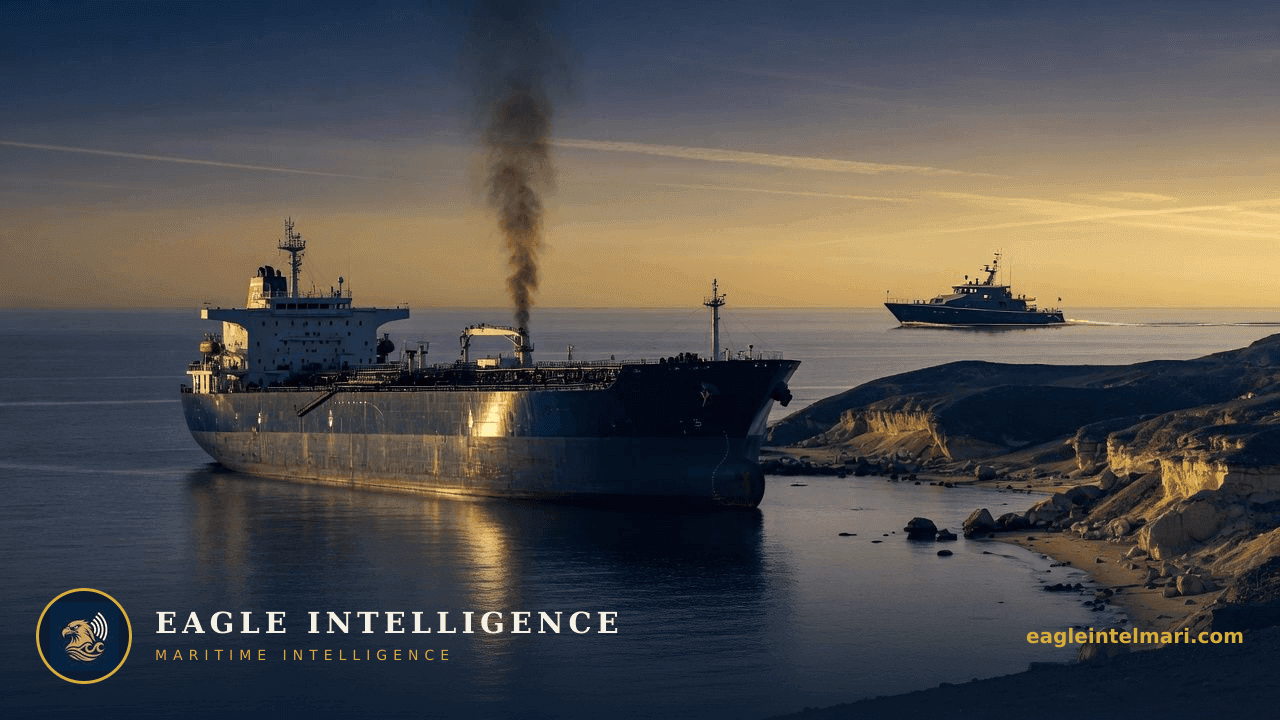
A suspected missile attack on a tanker in Omani waters has left two crew missing and one injured, signalling heightened state-on-state maritime friction that will force rapid reassessment of routing, insurance and crewing decisions across the Gulf of Oman.
Advertisement
Advertisement
A suspected missile attack on a tanker in Omani waters has left two crew missing and one injured, signalling heightened state-on-state maritime friction that will force rapid reassessment of routing, insurance and crewing decisions across the Gulf of Oman.
Maritime officials confirmed only the barest details: two seafarers unaccounted for and a third wounded after the strike. In an industry that moves 21 million barrels of oil daily through the Strait of Hormuz approaches, even sparse casualty information triggers immediate questions about vessel identity, flag, cargo and ownership chain. Owners and managers now face parallel obligations to notify flag states, P&I clubs and next-of-kin while preserving evidence for what will almost certainly become an international investigation.
The location off Oman places the incident inside a corridor used by both laden VLCCs heading east and product tankers returning from Fujairah. Unlike the more crowded Strait of Hormuz itself, these waters have historically offered a buffer zone where vessels could de-escalate speed or alter course. A strike here compresses that margin and raises the practical risk that any vessel lingering near the Omani coast may be misidentified or deliberately targeted in follow-on actions.
Hull and P&I underwriters will treat the event as a potential war-risk activation even before formal attribution. War-risk premiums for Oman-adjacent transits have already traded at elevated levels; this incident supplies the concrete trigger many syndicates need to widen exclusions or impose voyage-specific surcharges. Charterers holding period charters will now test force-majeure clauses, while hull markets will demand fresh AIS and routing data before renewing cover on any vessel that has recently passed through the same coordinates.
Two missing crew members immediately surface the perennial difficulty of recruiting and retaining officers and ratings willing to serve in contested waters. Unions and welfare organisations will press for enhanced danger pay and rapid repatriation options. Managers already struggling with post-pandemic fatigue now confront a new variable: whether experienced Indian, Filipino and Pakistani seafarers will accept assignments that carry a non-zero chance of kinetic engagement. The resulting crewing gap could tighten supply of qualified officers for the very vessels that keep Gulf crude flowing.
First, limited attribution and quiet diplomacy could confine the event to a one-off incident, allowing traffic to resume normal patterns within two weeks once initial insurance adjustments settle. Second, repeated strikes or explicit warnings could push a measurable share of eastbound tonnage onto longer Cape or alternative routing, adding roughly eight days and $1.2–1.8 million in bunker and hire costs per VLCC round voyage. Third, escalation that closes or heavily restricts Omani coastal waters would force a rapid shift toward convoy operations or armed escort, a scenario last seen at scale during the 1980s Tanker War and one that would immediately lift war-risk rates above 1 percent of hull value.
Omani authorities must decide whether to expand naval patrols or request external assistance without appearing to invite further foreign military presence. Flag registries with large tanker fleets will face quiet pressure to issue guidance or temporary detentions. On the commercial side, Brent and Dubai crude futures will embed a modest but persistent risk premium until clearer attribution emerges, while clean-product traders supplying East Africa and the Indian subcontinent will accelerate chartering of vessels already positioned east of the incident zone to avoid any secondary disruption.
Advertisement
Advertisement
Live Hormuz transit status and war-risk band.
Live 1–5 shipping war-risk level across monitored chokepoints.
⚠️ Intelligence Disclaimer: This analysis is produced by Eagle Intelligence's AI-assisted automated analysis system and is provided for informational purposes only. See our editorial standards. It is not a substitute for official maritime safety advisories from UKMTO, MSCHOA, IMO, or flag state authorities. Operational decisions should always be based on official guidance and professional judgment. Eagle Intelligence accepts no liability for any loss arising from reliance on this content.
Live chokepoint status, war-risk shifts, and the daily maritime wire, straight to your inbox. Free.
Leave a comment
All comments moderated for quality
