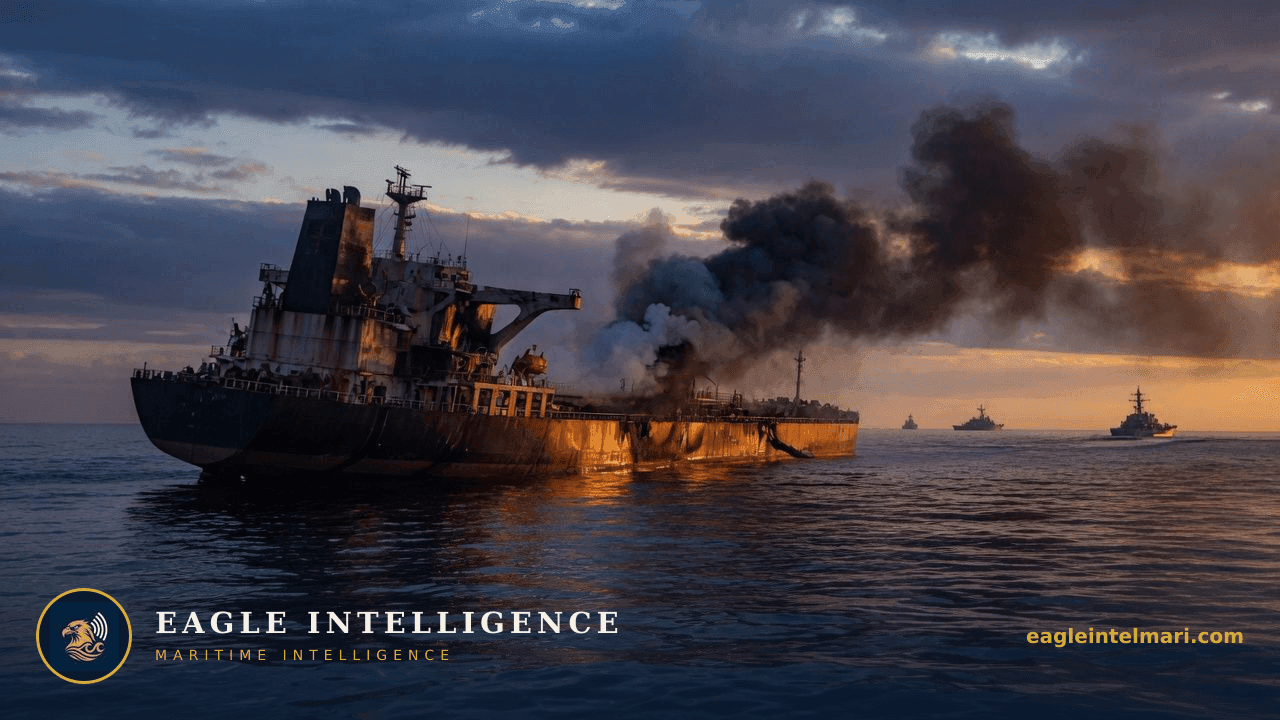
U.S. forces disabling a tanker late Tuesday left two crew missing and one injured, marking the first human casualties in the expanding blockade campaign and forcing immediate reassessment of transit risk across the Gulf of Oman.
Advertisement
Advertisement
The reported casualties aboard a tanker in the Gulf of Oman late Tuesday represent the moment a sanctions enforcement operation crossed into direct kinetic effect on merchant mariners, altering exposure for every vessel still moving through the strait.
U.S. forces disabled the vessel, resulting in two crew reported missing and one injured. No flag, owner, or cargo details have been released, yet the location places the event squarely on the main eastbound lane used by laden crude carriers departing the Gulf.
Hull and P&I underwriters have already begun marking the Gulf of Oman as an area where standard war-risk clauses may trigger higher additional premiums or outright refusal. Charterers fixing tonnage for Basra or Kharg loadings now face the choice of absorbing those surcharges or rerouting via longer Cape voyages that add roughly twelve days and $1.8 million in fuel and hire for a VLCC.
Unions and manning agencies are already fielding calls from officers and ratings unwilling to sign on for passages east of Fujairah. This mirrors the 2019-2020 Hormuz spike when refusal rates climbed above 30 percent on certain registries; the difference now is that the threat is kinetic rather than solely mine or missile based.
Open registries that have accepted Iranian-linked tonnage may face rapid delisting pressure if any of their vessels are next. Oman, as the nearest neutral port of refuge, must decide whether to accept damaged vessels and injured crew or risk being drawn into the enforcement chain itself.
During the Iran-Iraq conflict, attacks on tankers produced 546 confirmed seafarer fatalities over eight years and drove war-risk premiums to 3 percent of hull value per transit. Today's environment differs because the enforcing power is a global navy rather than two regional belligerents, yet the effect on insurance markets and crewing willingness is likely to follow the same curve once casualty lists lengthen.
Stakeholders must now treat every eastbound laden transit as carrying an explicit human-life premium that no prior sanctions regime has yet imposed.
Advertisement
Advertisement
Live Hormuz transit status and war-risk band.
Live 1–5 shipping war-risk level across monitored chokepoints.
⚠️ Intelligence Disclaimer: This analysis is produced by Eagle Intelligence's AI-assisted automated analysis system and is provided for informational purposes only. See our editorial standards. It is not a substitute for official maritime safety advisories from UKMTO, MSCHOA, IMO, or flag state authorities. Operational decisions should always be based on official guidance and professional judgment. Eagle Intelligence accepts no liability for any loss arising from reliance on this content.
Live chokepoint status, war-risk shifts, and the daily maritime wire, straight to your inbox. Free.
Leave a comment
All comments moderated for quality
