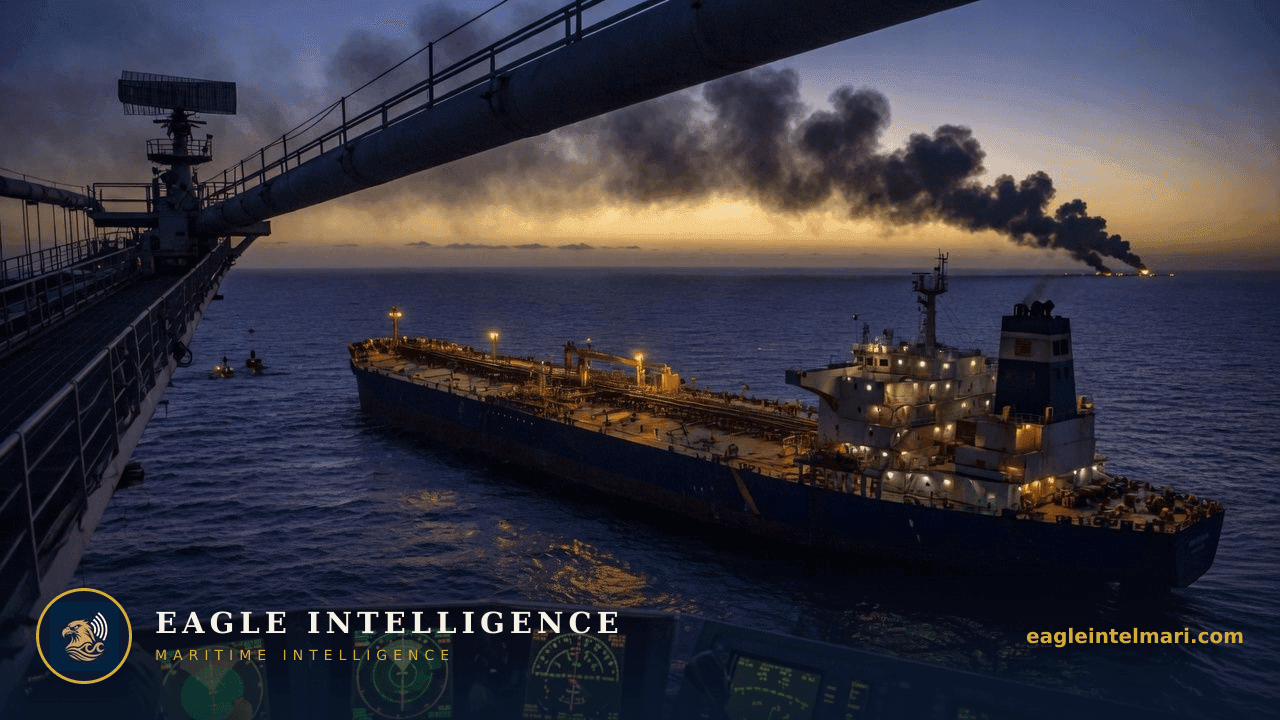
Owners and charterers routing crude carriers through the Strait of Hormuz must now decide on immediate re-routing or sharply higher war-risk cover after Washington struck Iran in response to the reported attack on a vessel inside the chokepoint.
Advertisement
Advertisement
Owners and charterers routing crude carriers through the Strait of Hormuz must now decide on immediate re-routing or sharply higher war-risk cover after Washington struck Iran in response to the reported attack on a vessel inside the chokepoint.
The US action follows an Iranian strike on a ship transiting the Strait, the 21-mile-wide bottleneck that carries roughly one-fifth of global oil trade. Any closure or sustained threat here forces vessels into longer Cape routes that add 12 to 15 days and several hundred thousand dollars in fuel and hire costs per voyage. For a VLCC on a Ras Tanura to Europe run, the extra distance alone erases typical spot margins and triggers force-majeure clauses already embedded in many charters.
Hull and P&I underwriters will receive notices of deviation within hours. Standard Persian Gulf war-risk premiums, already elevated, are expected to jump again as syndicates reassess exposure after a kinetic exchange inside Hormuz. Operators with vessels still eastbound must choose between accepting the new quoted rate or diverting; those already committed face potential additional premium calls mid-voyage. Insurers will also scrutinise whether the original Iranian attack constitutes a separate covered event or merges into the broader US-Iran exchange.
Seafarers and their unions have long treated Hormuz transits as high-risk. After the latest strikes, crewing managers report rising numbers of officers and ratings declining assignments or demanding hazard pay surcharges. For companies rotating crews through ports such as Fujairah or Jebel Ali, delays in crew changes could compound if relief vessels also hesitate to enter the Gulf. Flag states that have historically accepted Hormuz sailings may now require updated risk assessments before endorsing further voyages.
European and Asian refiners reliant on Gulf crude are already canvassing West African and US Gulf coast barrels to fill potential gaps. Any sustained rerouting of tonnage tightens available ship supply on those longer hauls, pushing freight rates higher across multiple basins. Charterers with COAs that specify Hormuz discharge now weigh whether to invoke deviation clauses or absorb the cost of a longer voyage while the ceasefire remains fragile.
Ports inside the Gulf are assessing whether to impose additional security protocols or temporary berthing restrictions. Flag registries that have tolerated Hormuz traffic may demand enhanced AIS reporting or convoy arrangements. Owners whose vessels are already committed to Iranian or Omani terminals must monitor whether those calls remain commercially viable once the immediate military picture clarifies.
Track any public statement from major classification societies or the Joint War Committee on revised listed areas; a formal expansion would trigger automatic premium adjustments for all Gulf traffic.
Advertisement
Advertisement
Indicative Additional War Risk Premium (AWRP) ranges — not a binding insurance quote.
Live Hormuz transit status and war-risk band.
Live 1–5 shipping war-risk level across monitored chokepoints.
⚠️ Intelligence Disclaimer: This analysis is produced by Eagle Intelligence's AI-assisted automated analysis system and is provided for informational purposes only. See our editorial standards. It is not a substitute for official maritime safety advisories from UKMTO, MSCHOA, IMO, or flag state authorities. Operational decisions should always be based on official guidance and professional judgment. Eagle Intelligence accepts no liability for any loss arising from reliance on this content.
Live chokepoint status, war-risk shifts, and the daily maritime wire, straight to your inbox. Free.
Leave a comment
All comments moderated for quality
