Owners and charterers moving tonnage through the Taiwan Strait must now price an expanding layer of asymmetric maritime defenses into every voyage decision after Taipei earmarked $6.6 billion for more than 1,320 unmanned surface vessels and 208,000 one-way attack drones.
Advertisement
Advertisement
Shipowners and charterers with dry-bulk, container and tanker fixtures through the Taiwan Strait must recalculate war-risk surcharges and routing options after Taipei’s executive branch requested $6.6 billion to field 1,320 unmanned surface vessels alongside 208,200 one-way attack drones by the end of the decade.
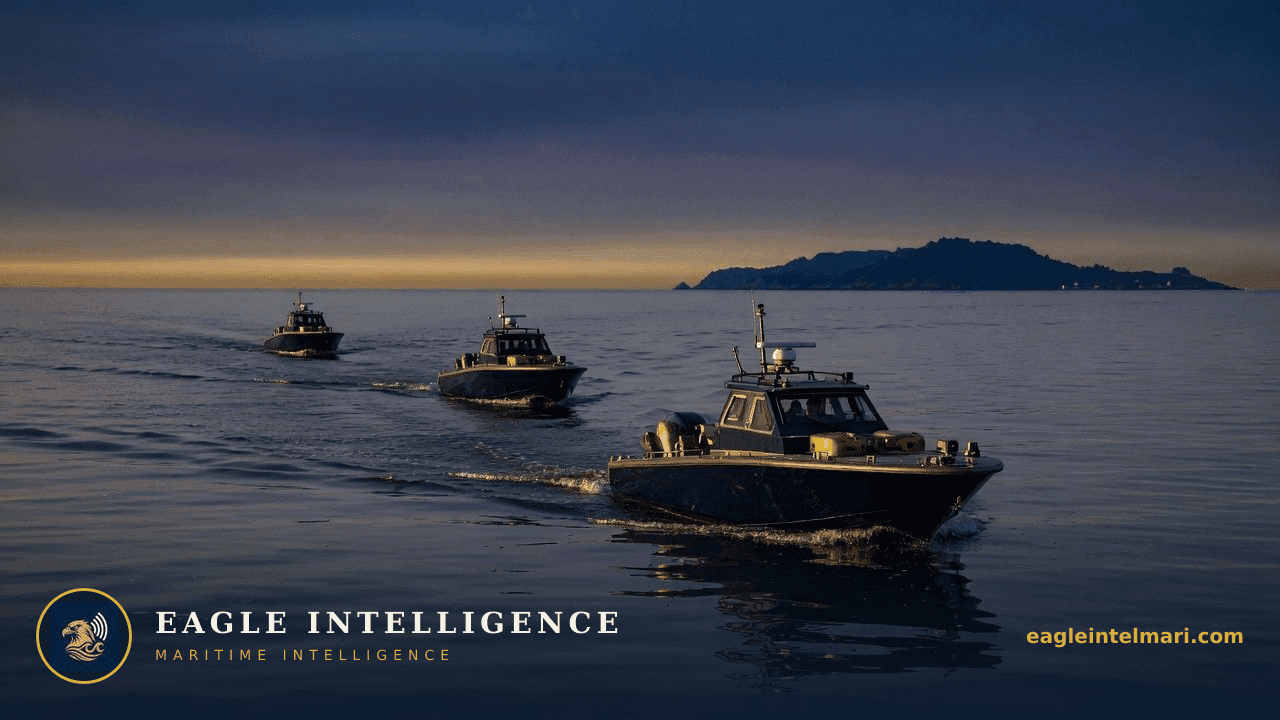
Taiwan’s Ministry of National Defense specified that the surface-vessel portion alone will deliver 1,320 hulls optimized for coastal denial. At roughly five metric tons each, these USVs can loiter for days on a single fuel load and carry warheads sufficient to disable a 5,000-ton logistics ship. For any operator whose schedule passes within 40 nautical miles of the island’s western seaboard, the new inventory represents a persistent, low-signature threat that current hull-mounted radars on most commercial vessels are not tuned to detect at range.
Hull and P&I markets have already begun modeling a Taiwan-specific unmanned risk loading. Early indications from London syndicates suggest an additional 8–12 basis points on war-risk premiums for any voyage terminating or originating in Kaohsiung or Keelung once the first 300 USVs reach operational status. That increment translates to roughly $18,000–$27,000 extra per 45-day round voyage on a Panamax bulker—small enough to absorb on most fixtures yet large enough to tip marginal cargoes toward the longer Malacca–Cape route when spot rates are soft.
Manning agencies rotating Filipino and Indian crews through Taiwanese ports now face fresh questions about evacuation protocols. An unmanned swarm attack leaves little time for muster; the 15-minute warning window once assumed for conventional missile strikes shrinks when low-observable USVs close at 25 knots. Several operators have quietly added a “Taiwan contingency” clause to seafarer contracts that triggers a 50 percent hazard bonus if the vessel is inside 50 nm of the island after local dusk.
Ukraine’s use of Magura-class USVs against the Russian Black Sea Fleet in 2023–2024 demonstrated that even a few dozen expendable surface drones can force an adversary to stand off major surface combatants. Taiwan’s planned inventory is an order of magnitude larger and will operate inside its own littoral sensor network. The parallel suggests that any future blockade attempt would have to contend with a distributed minefield that moves, adapts and replenishes itself daily.
Kaohsiung port authority is already drafting new anchorage restrictions that would push commercial vessels farther offshore during heightened alert periods, lengthening pilotage times by up to four hours. Flag states whose registries carry significant Taiwan trade—Liberia, Panama and the Marshall Islands—have received quiet queries from owners seeking guidance on whether transiting the strait still qualifies as “normal trading” under war-risk clauses.
If the budget passes the legislature intact and the first production batches enter service by mid-2027, war-risk pricing will embed the new reality within a single renewal cycle. A delayed or diluted appropriation would push the inflection point to 2028–2029, giving owners more runway to negotiate force-majeure language. A sudden cross-strait crisis before any USVs are fielded would render the entire program irrelevant and trigger immediate, broad rerouting away from the strait altogether.
WATCH NEXT: Legislative vote on the supplemental budget expected before 15 August 2026.
Advertisement
Advertisement
Live 1–5 shipping war-risk level across monitored chokepoints.
⚠️ Intelligence Disclaimer: This analysis is produced by Eagle Intelligence's AI-assisted automated analysis system and is provided for informational purposes only. See our editorial standards. It is not a substitute for official maritime safety advisories from UKMTO, MSCHOA, IMO, or flag state authorities. Operational decisions should always be based on official guidance and professional judgment. Eagle Intelligence accepts no liability for any loss arising from reliance on this content.
Live chokepoint status, war-risk shifts, and the daily maritime wire, straight to your inbox. Free.
Leave a comment
All comments moderated for quality
