Tanker owners and crude traders routing through the Strait of Hormuz must decide whether to maintain schedules or lock in war-risk cover after Iran's unfulfilled closure announcement left millions of barrels still moving.
Advertisement
Advertisement
Tanker owners and crude traders routing through the Strait of Hormuz must decide whether to maintain schedules or lock in war-risk cover after Iran's unfulfilled closure announcement left millions of barrels still moving.
Flow Data Shows No Interruption
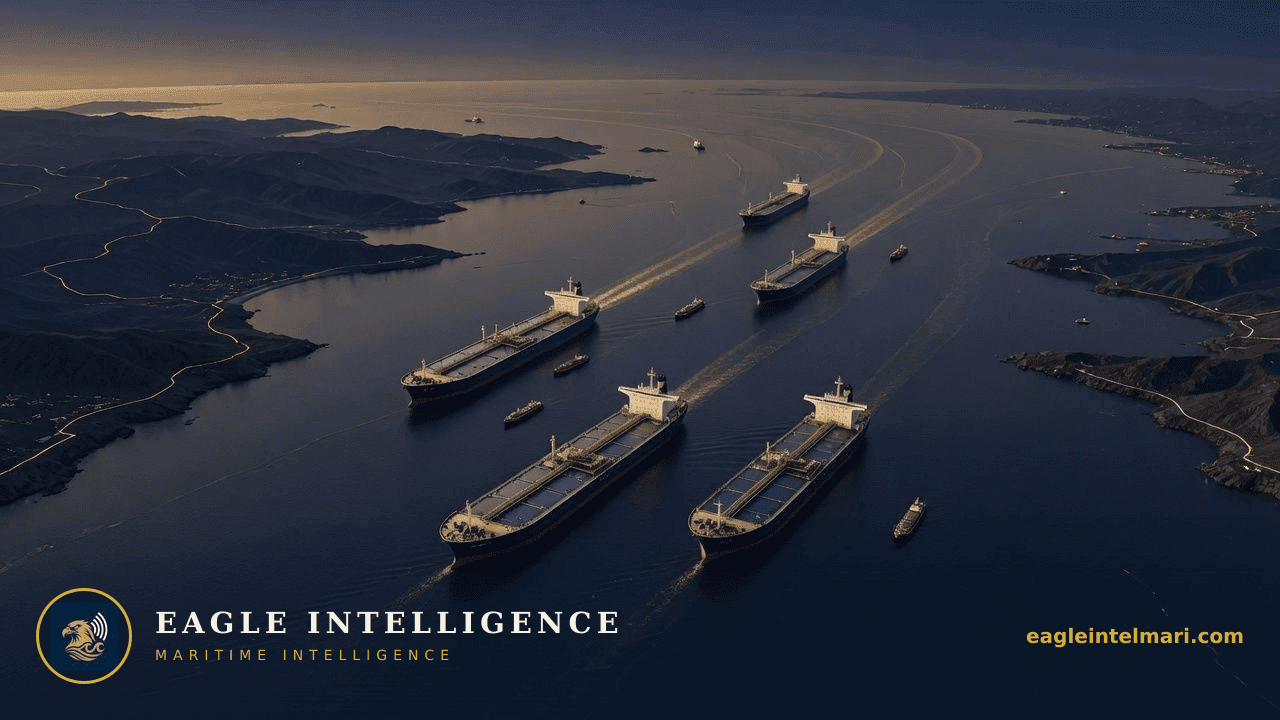
Bloomberg tracking recorded sustained loadings from Gulf terminals over the weekend, with VLCCs continuing eastbound passages at rates comparable to the prior week. The absence of any physical blockage or naval interference means that, for now, the 21-mile-wide shipping lanes remain open despite the public statement from Tehran. This continuity matters directly to charterers who have already fixed June and July cargoes on the assumption of normal transit times.
Insurers Signal Early Premium Pressure
Hull and war-risk underwriters are monitoring the next 48 hours for any Iranian naval activity that could justify a quick adjustment to Hormuz loadings. A modest uptick in additional premiums, even if only 0.05 percent of hull value, would add roughly $40,000–$60,000 per transit for a typical Suezmax, a cost that charterers will immediately attempt to pass downstream. Owners with tonnage already in the Gulf are therefore watching London market indications closely before accepting new fixtures.
Flag States and Manning Agencies Face Crew Questions
Masters on vessels flagged in open registries have begun receiving queries from seafarers' families concerned about potential escalation. While no formal advisories have been issued by major flag states, manning agencies rotating Filipino and Indian crews through Fujairah and Khor Fakkan are preparing contingency messaging that stresses current traffic data rather than political statements. Any sustained Iranian naval presence near the traffic separation scheme would likely trigger accelerated crew-change planning and higher hardship allowances.
Charterer Rerouting Math Remains Unattractive
The alternative Cape route around Africa adds 12–18 days and roughly $1.8 million in extra fuel and time-charter hire for a laden VLCC. With June Brent already priced above $80, most charterers view that detour as a last-resort option rather than a commercial hedge. Energy traders holding paper positions are therefore treating the Iranian announcement as noise until physical evidence appears.
Tehran's Pattern of Calibrated Warnings
Similar public declarations in 2019 and 2023 produced brief insurance spikes followed by rapid normalization once traffic data confirmed continued passage. The current episode fits the same pattern: a rhetorical signal aimed at domestic and regional audiences without immediate operational follow-through. Market participants who remember those earlier episodes are pricing the risk accordingly rather than assuming imminent closure.
What to Watch Next
Monitor daily AIS-derived transit counts published by commercial intelligence platforms; a drop below 18 eastbound VLCCs in any 24-hour window would be the clearest trigger for renewed premium and routing discussions.
Advertisement
Advertisement
Live Hormuz transit status and war-risk band.
Live 1–5 shipping war-risk level across monitored chokepoints.
⚠️ Intelligence Disclaimer: This analysis is produced by Eagle Intelligence's AI-assisted automated analysis system and is provided for informational purposes only. See our editorial standards. It is not a substitute for official maritime safety advisories from UKMTO, MSCHOA, IMO, or flag state authorities. Operational decisions should always be based on official guidance and professional judgment. Eagle Intelligence accepts no liability for any loss arising from reliance on this content.
Live chokepoint status, war-risk shifts, and the daily maritime wire, straight to your inbox. Free.
Leave a comment
All comments moderated for quality
