Real-time oil-condition sensors are moving from pilot projects to operational necessity as tighter margins and complex engines leave little room for unplanned downtime.
Advertisement
Advertisement
Shipping operators are drowning in sensor data yet still suffer costly breakdowns. Continuous oil-condition monitoring is emerging as the practical bridge between raw readings and decisions that keep vessels trading.
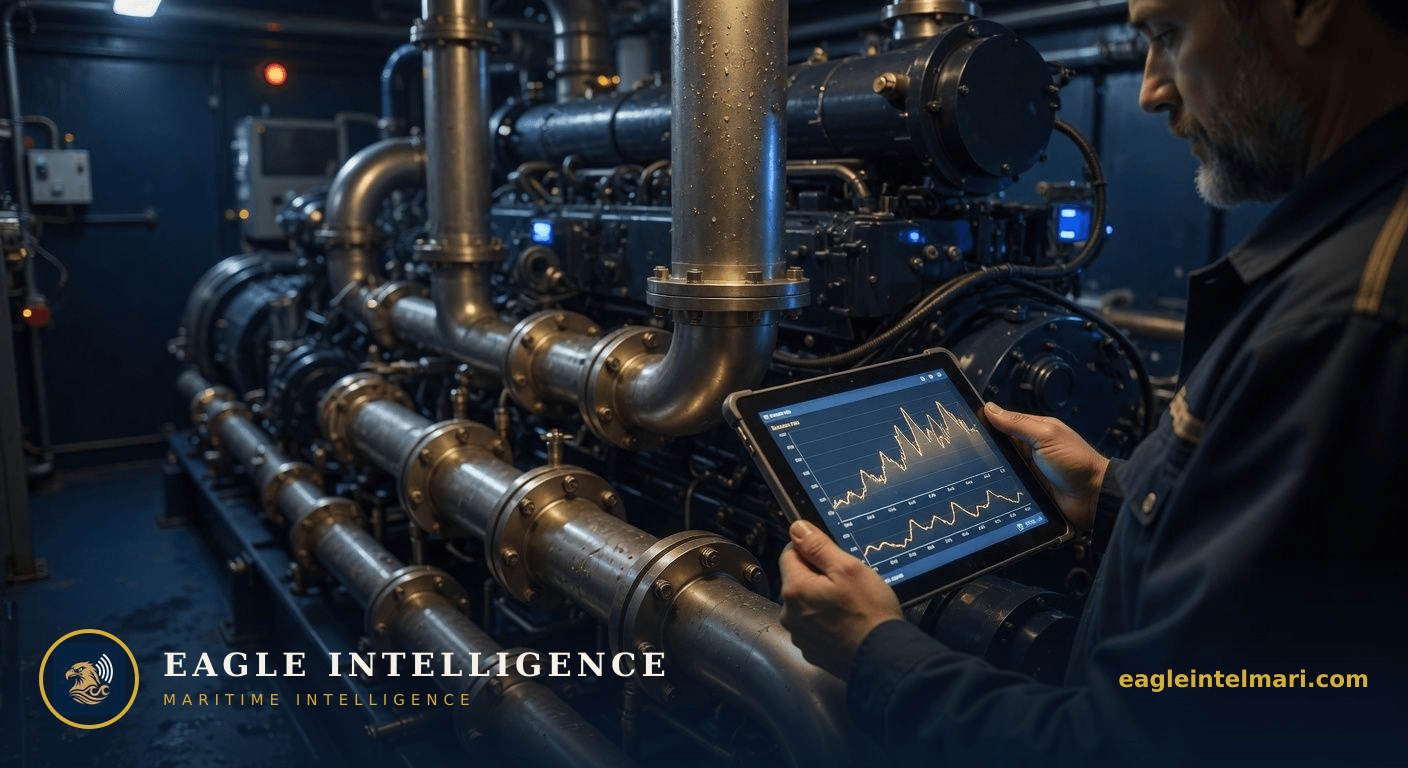
Most fleets still rely on monthly or quarterly oil samples sent ashore for laboratory analysis. By the time results return, a vessel may already be approaching the next port call with degraded lubricant or early-stage bearing wear. Continuous sensors mounted in the main-engine and auxiliary systems stream viscosity, water content, particle count and TAN/TBN values every few minutes, allowing chief engineers to spot trends while the ship is still at sea.
Crews no longer wait for the next sample bottle. Instead, bridge and engine-control-room displays flag deviations against OEM limits and historical baselines for that specific engine. The result is fewer emergency slowdowns and a measurable drop in cylinder-liner scoring incidents, according to operators who have fitted the systems on 2015-built and newer tonnage.
Time-charterers are beginning to insert clauses that require continuous monitoring data to be shared within 24 hours of an alert. Owners who can demonstrate lower breakdown risk are negotiating slightly shorter off-hire periods or reduced performance guarantees. The shift is most visible on handy-size bulkers and MR tankers where daily hire rates leave little margin for a two-day repair stop.
Hull and machinery underwriters have started offering modest premium credits—typically 3-5 percent—for vessels fitted with certified continuous-monitoring systems that transmit data to class-approved shore centres. P&I clubs are more cautious, focusing on whether the data can be used to demonstrate due diligence after a machinery claim. Early adopters report faster claim settlements when logged oil-condition history shows the failure was not the result of neglected maintenance.
Major classification societies now accept continuous-monitoring records as equivalent to traditional sampling for machinery-survey credit, provided the sensor suite carries type approval and data integrity is verified. Flags with large tanker and bulker registries are quietly updating their circulars to encourage the practice, seeing it as a low-cost route to fewer detentions under port-state control.
Widespread adoption by 2028 hinges on sensor cost falling below $8,000 per main-engine installation and class rules becoming fully harmonised. In a high-adoption case, average machinery-related off-hire days could drop 15-20 percent on monitored fleets. A slower scenario sees only newbuilds and vessels above 15 years old retrofitted, leaving a two-tier market where older tonnage faces higher insurance costs. A regulatory push—perhaps linked to CII or future EU emissions rules—could accelerate uptake if monitoring data is accepted as proof of efficient engine operation.
Advertisement
Advertisement
⚠️ Intelligence Disclaimer: This analysis is produced by Eagle Intelligence's AI-assisted automated analysis system and is provided for informational purposes only. See our editorial standards. It is not a substitute for official maritime safety advisories from UKMTO, MSCHOA, IMO, or flag state authorities. Operational decisions should always be based on official guidance and professional judgment. Eagle Intelligence accepts no liability for any loss arising from reliance on this content.
Live chokepoint status, war-risk shifts, and the daily maritime wire, straight to your inbox. Free.
Leave a comment
All comments moderated for quality