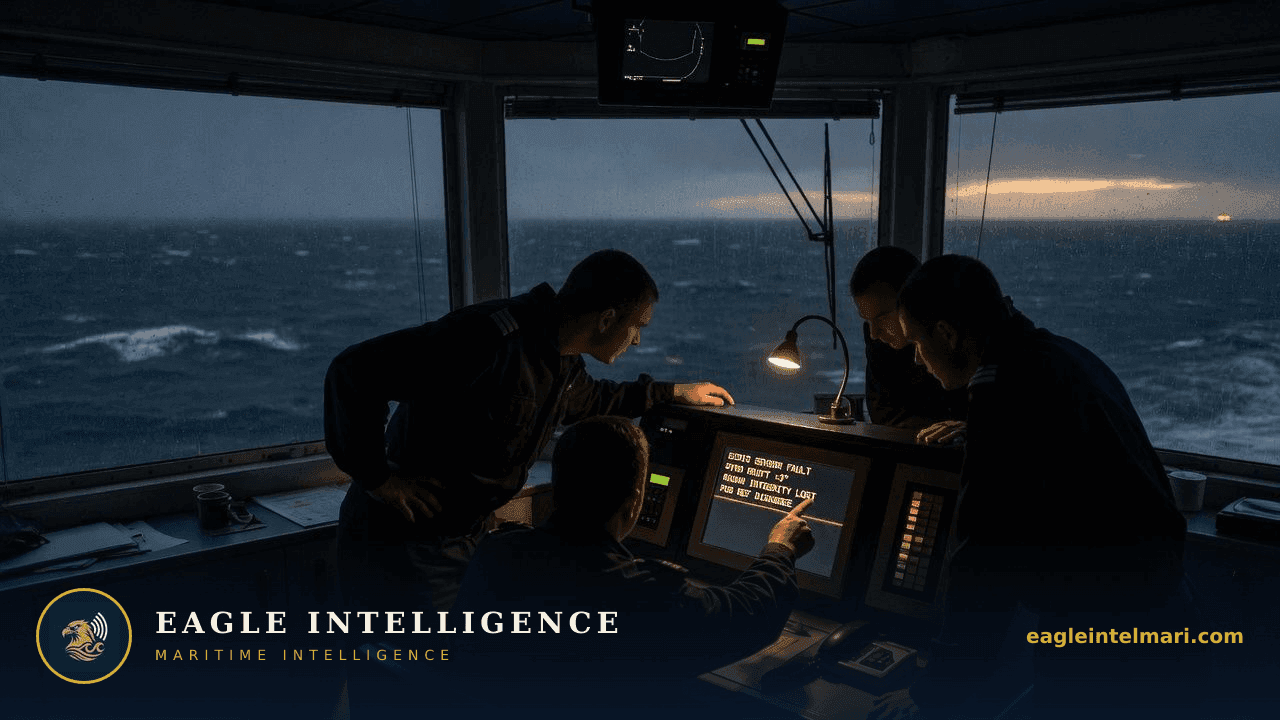
A liquefied natural gas tanker sailing from the United States to Europe suffered a systems failure that its crew attributed to a suspected cyber attack, an incident that stands apart from the day's Hormuz-focused reporting and demands examination of how digital vulnerabilities intersect with physical chokepoint disruptions.
Advertisement
Advertisement
The single most consequential development in the supplied evidence is the reported systems failure on an LNG tanker en route from the United States to Europe that the crew flagged as a suspected cyber attack. This incident receives only a brief mention yet carries outsized implications because it introduces a hybrid dimension—digital interference with energy cargoes—into an environment already strained by physical attacks on tankers, widening insurance zones, and sanctions targeting payment flows. Unlike the repeated coverage of Strait of Hormuz traffic and Houthi activity in the Red Sea, this case points to an attack surface that does not require proximity to any single geographic chokepoint and can affect vessels on transatlantic routes that insurers and operators have treated as relatively lower risk.
The timing matters. The failure occurred while VLCC spot earnings reached one million dollars per day and while London underwriters expanded the Black Sea high-risk zone because of surging attacks tied to the Ukraine-Russia conflict. Energy carriers already face elevated physical threats; any credible cyber element multiplies the exposure because a single successful intrusion can disable navigation, propulsion, or cargo-handling systems without warning shots or visible assailants. The fact that the crew themselves raised the cyber possibility indicates that on-board diagnostics pointed away from mechanical or weather-related causes, even if external confirmation remains absent.
What is verified is narrow but unambiguous: an LNG tanker loaded with fuel from the United States bound for Europe experienced a systems failure; people familiar with the matter stated that the crew reported the incident as a suspected cyber attack. No vessel name, exact position, date of failure, or technical details have been released. No government or classification society has yet attributed the event to any actor.
What remains unknown includes the precise nature of the systems affected, whether the failure propagated through satellite communications, ECDIS, or engine control networks, and whether any data exfiltration occurred alongside the disruption. It is also unknown whether the vessel was under any particular sanctions-related scrutiny or whether its charterer had recently altered routing to avoid other conflict zones.
Eagle Assessment judges the incident medium-confidence as a genuine cyber event rather than misattributed mechanical failure. The crew's direct reporting to shore teams carries weight in an industry where false cyber claims are rare because they trigger costly investigations and insurance notifications. However, absent forensic logs or independent verification, the possibility of sensor error or coincidence with another fault cannot be ruled out. The broader context of state-linked cyber activity against energy infrastructure supplies a plausible motive but does not constitute proof for this specific case.
An LNG carrier sailing the North Atlantic route typically operates with lean crewing and heavy reliance on integrated bridge and machinery control systems. A failure that the crew classifies as cyber immediately raises questions about redundancy: whether manual overrides functioned, how long the vessel remained dead in the water, and whether cargo boil-off or pressure management systems were compromised. Delays on such voyages translate directly into missed delivery windows for European regasification terminals already competing for cargoes rerouted away from the Red Sea and Hormuz.
Charter parties and bills of lading rarely contain explicit cyber-force-majeure clauses calibrated to this scenario. Owners may face claims for off-hire while investigators determine the cause; underwriters may reserve rights under war-risk or cyber endorsements. The vessel's next port of call will likely trigger enhanced scrutiny from port-state control, particularly if the flag state or classification society has issued recent cyber-security circulars. Crew fatigue and training gaps become immediate variables: seafarers trained primarily for collision avoidance and pollution response now confront the additional task of preserving digital evidence after an incident.
No international convention yet imposes clear duties on flag states to investigate crew-reported cyber incidents on the high seas. The ISM Code requires safety-management systems to address cyber risk, yet enforcement remains uneven across flags. If the failure is later confirmed as malicious, questions arise over which state's criminal law applies and whether the incident meets the threshold for an armed attack under the UN Charter—issues that directly affect war-risk cover and potential government compensation schemes.
Sanctions compliance adds another layer. The same evidence package shows the United States sanctioning an Iranian cryptocurrency exchange used to process Hormuz transit payments. A cyber intrusion on an LNG tanker could serve parallel objectives: disrupting Western energy supply while avoiding kinetic escalation. Owners and charterers must now weigh whether their cyber-insurance policies respond to state-sponsored acts and whether P&I clubs will cover resulting cargo claims or environmental liabilities if systems controlling inert gas or ballast fail.
VLCC earnings at one million dollars per day already reflect physical constraints on crude and product movements. A confirmed cyber incident on an LNG carrier would transmit differently: it would widen the risk premium applied to all gas carriers regardless of route, because the vulnerability is systemic rather than geographic. Charterers may accelerate the shift toward vessels with air-gapped or heavily segmented networks, increasing demand for newer tonnage and further supporting second-hand asset values. Container lines, already reporting record Far East to US freight rates, would face indirect pressure if LNG feedstock prices spike and industrial demand softens.
Insurers that have just expanded the Black Sea high-risk zone may now consider whether cyber add-ons or separate cyber war-risk products require repricing. The precedent of three tanker attacks in Hormuz and Houthi strikes on the Saudi Petroline pipeline demonstrates that physical and digital threats can converge; a single vessel suffering both would collapse the remaining analytical separation between the two categories.
Shipowners with large LNG fleets face immediate decisions on whether to accelerate dry-dock cyber hardening or accept higher deductibles. Seafarers and their families confront added uncertainty: a cyber incident may keep a vessel in port longer for forensic examination, extending time away from home and complicating crew-change logistics already disrupted by Red Sea diversions. European utilities dependent on US LNG cargoes must model the probability of further delays and the cost of spot-market replacement molecules.
Classification societies and flag administrations will likely receive confidential reports that never reach public view; the absence of transparent data sharing itself becomes a market distortion, because only the largest operators possess the internal resources to benchmark their own exposure. Regulators in the United States and European Union may accelerate proposals for mandatory cyber-incident reporting timelines that currently exist only in draft form.
The strongest alternative reading is that the reported systems failure was mechanical or sensor-related and that the crew's cyber attribution reflects heightened anxiety rather than diagnostic certainty. In an environment saturated with war-risk advisories, seafarers may default to cyber explanations for any unexplained alarm. If subsequent investigation reveals a faulty fuel-control valve or contaminated lubricant, the incident would drop out of the hybrid-threat category entirely and become a routine maintenance or equipment-reliability matter.
Evidence that would confirm this counter-scenario includes public release of the vessel's alarm logs showing no anomalous network traffic, confirmation that similar failures have occurred on sister vessels without cyber indicators, and an absence of any intelligence reporting linking the specific ship to known threat actors. Until such data appears, however, the crew's initial classification remains the only on-record assessment and justifies treating the case as a credible cyber signal.
How many other LNG and tanker operators have experienced unreported systems anomalies on the same transatlantic corridor in the past thirty days, and are classification societies aggregating these reports?
What specific technical mitigations—segmented networks, offline navigation backups, or enhanced logging—do leading LNG owners now require before accepting charters on vessels that previously relied on integrated control systems?
Will London market underwriters apply an automatic cyber loading to war-risk premiums for gas carriers following this incident, or will they demand vessel-specific surveys first?
How should charter-party clauses governing off-hire and cyber events be redrafted when the next fixture round begins, given that current forms were written before crew-reported cyber failures on energy routes became plausible?
Does the US Coast Guard or European Maritime Safety Agency intend to issue a marine safety information bulletin requiring masters to preserve volatile memory and network logs after any unexplained systems failure?
What threshold of confirmed cyber interference on a commercial vessel would trigger a coordinated NATO or EU response beyond the existing Italian warship deployment to the Red Sea?
Next 24 hours: any classification society or flag-state circular referencing an LNG carrier systems failure, or any statement from the vessel's owner confirming or denying the cyber attribution.
Next seven days: London market joint war committee circular expanding or qualifying cyber endorsements, or the appearance of the incident in US Treasury or State Department sanctions-related press releases.
Next thirty days: first reported chartering differential between LNG carriers with documented cyber-hardening upgrades and those without, or the first port-state detention explicitly citing inadequate cyber-safety management under the ISM Code.
Advertisement
Advertisement
Live Hormuz transit status and war-risk band.
Live 1–5 shipping war-risk level across monitored chokepoints.
⚠️ Intelligence Disclaimer: This analysis is produced by Eagle Intelligence's AI-assisted automated analysis system and is provided for informational purposes only. See our editorial standards. It is not a substitute for official maritime safety advisories from UKMTO, MSCHOA, IMO, or flag state authorities. Operational decisions should always be based on official guidance and professional judgment. Eagle Intelligence accepts no liability for any loss arising from reliance on this content.
Live chokepoint status, war-risk shifts, and the daily maritime wire, straight to your inbox. Free.
Leave a comment
All comments moderated for quality
