A drone attack on LNG facilities at Egypt’s Damietta port on 29 July 2026 has opened a new operational front that directly threatens Suez Canal transits; this development, paired with Saudi Arabia’s coalition proposal, forces shipowners and insurers to reassess routing, war-risk premiums and crew exposure across the Mediterranean-Red Sea corridor.
Advertisement
Advertisement
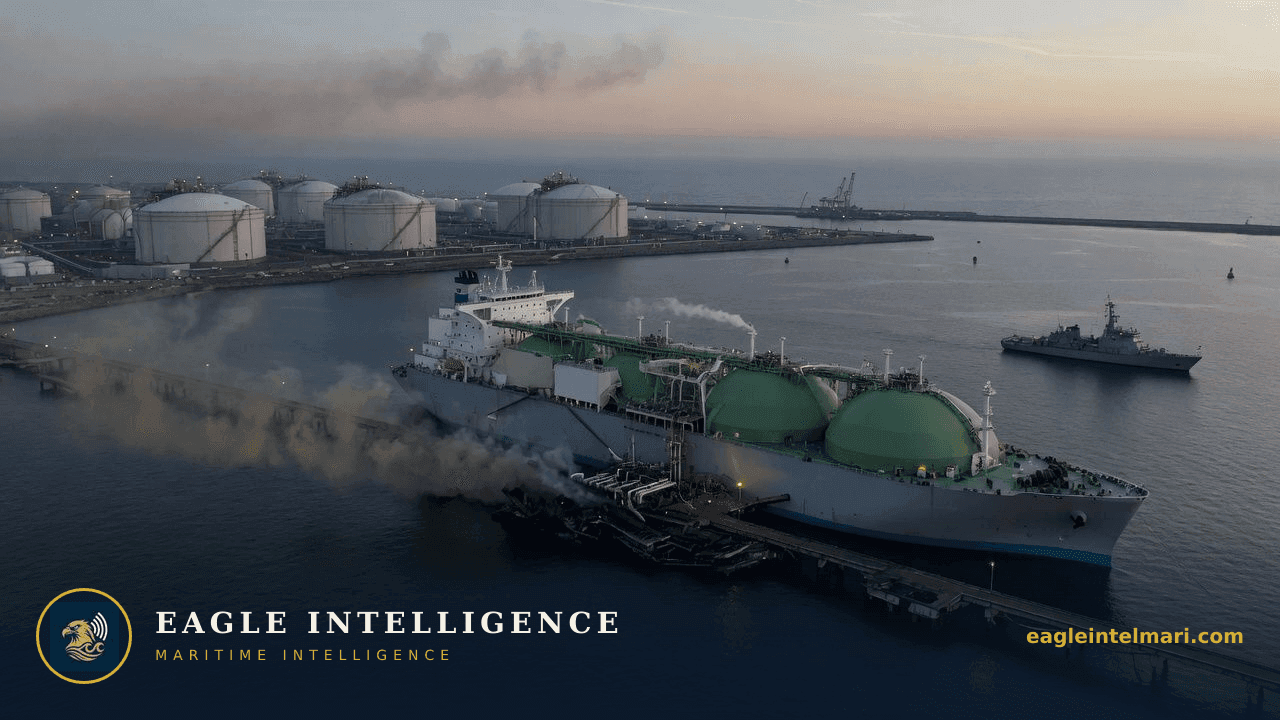
The single most consequential development on 30 July 2026 is the confirmed drone strike on gas vessels and storage at Egypt’s Mediterranean port of Damietta. This incident sits outside the Bab al Mandab and Hormuz theatres that have dominated recent coverage. It directly implicates the northern entrance to the Suez Canal, a chokepoint handling roughly 12 percent of global trade and a growing share of LNG movements rerouted from the Persian Gulf. The attack occurred on 29 July local time, involved an unidentified unmanned aircraft, and produced a fire at an LNG storage and transport facility. British maritime security firm reports and Reuters confirm the event, while Egyptian authorities have not yet released an official attribution.
This location matters because it lies 200 nautical miles north of the canal’s Mediterranean entrance and inside Egyptian territorial waters. Any sustained threat here forces vessels to weigh whether approaching Port Said or Damietta now carries war-risk exposure previously reserved for the southern Red Sea. The timing coincides with Saudi Arabia’s public announcement of a multinational maritime defence coalition aimed at Red Sea and energy routes, suggesting regional powers are already treating the threat as systemic rather than isolated.
Known facts are narrow but unambiguous. On 29 July an unidentified drone struck infrastructure at Damietta, igniting a fire on or near LNG vessels. No casualties have been reported in open sources. The same day, Saudi Arabia unveiled plans for a coalition to protect shipping after Houthi attacks disrupted Red Sea corridors. A 21 July Congressional Research Service report already noted the Bab al Mandab’s rising importance as Hormuz flows were curtailed by 2026 regional conflict. No public evidence yet links the Damietta drone to Houthis, Iran or any other actor; Egyptian and Saudi statements have not named perpetrators.
Vessels bound for the Suez Canal from the western Mediterranean or Atlantic must now decide whether to anchor at Damietta for bunkering or canal transit slotting. The port sits inside the same radar and air-defence envelope that failed to prevent the 29 July strike. Routing alternatives include the Cape of Good Hope for east-west traffic, adding 10–14 days and roughly $1.2–1.8 million in fuel and charter costs for a typical VLCC or large container ship. Operators already rerouting around the Red Sea will face compounded exposure if Mediterranean approaches also require war-risk routing.
Crew implications are immediate. Manning agencies must now brief masters on potential drone loitering near Egyptian anchorages. Fatigue and morale effects compound when vessels steam at higher speeds or adopt zigzag patterns inside confined waters. Port-state control in Egypt has not yet issued new security protocols, leaving a gap between the incident and enforceable guidance.
Egypt is not a declared war zone under most hull war-risk wordings, yet the incident creates a factual trigger for additional premium calls. Underwriters will examine whether the strike constitutes “hostilities” or “piracy” under Institute War Clauses. Flag states of affected vessels hold primary duty to investigate; Egyptian authorities retain coastal-state enforcement rights but have not declared a restricted navigation area. Sanctions exposure remains secondary unless attribution points to Iranian Revolutionary Guard Corps assets already under U.S. or EU designations.
The proposed Saudi coalition raises questions of collective self-defence under UNCLOS Article 111 and the right of visit. Participation by non-regional navies would require bilateral agreements with Egypt and Saudi Arabia; current U.S. naval posture in the region, already stretched by Hormuz and Red Sea tasking, limits rapid reinforcement options.
LNG spot rates from the U.S. Gulf and West Africa into the Mediterranean tightened within 24 hours of the strike as charterers priced in rerouting risk. VLCC earnings on the Ras Tanura–Suez route, already elevated, face further upside if Mediterranean loadings shift to alternative ports such as Alexandria or even Gibraltar. Container spot rates, already falling for a third week on east-west lanes, could see selective spikes on Mediterranean–Asia services if operators avoid Suez altogether. Scorpio Tankers’ July decision to take stakes in eight VLCC newbuildings now carries heightened execution risk if shipyard deliveries in China face financing or insurance hurdles tied to the widening conflict.
Second-order effects reach insurance markets. War-risk deductibles on Suez transits may rise 15–25 percent for vessels calling Egyptian Mediterranean ports, according to broker indications. Hull values for modern LNG carriers could soften if charterers demand lower war-risk exposure, accelerating older tonnage into lay-up.
Saudi Arabia’s coalition announcement serves two purposes: it signals to Washington that Riyadh will not accept indefinite Houthi disruption of its energy exports, and it positions the kingdom as the security provider of last resort for Red Sea and Suez traffic. Egypt, economically dependent on canal revenues, has strong incentive to downplay the Damietta incident to avoid further traffic loss. Iran’s interest lies in demonstrating reach beyond the Strait of Hormuz without triggering direct U.S. retaliation on its territory. The U.S. Navy’s simultaneous decommissioning of USS Georgia and LCS Fort Worth reduces available strike and patrol assets at a moment when two additional theatres require coverage.
No crew injuries have been confirmed, yet the psychological impact on seafarers transiting the region is measurable. Manning agents report increased requests for hazard pay and shorter contracts among officers with recent Red Sea experience. Families of ratings on vessels scheduled for Damietta or Port Said calls face uncertainty over port-call duration and security protocols. Abandonment risk remains low but rises if insurers decline cover for Egyptian Mediterranean calls, stranding vessels in safe-haven ports.
MarineTraffic’s July updates include a new “dark port call” risk flag and daily Strait of Hormuz crossing monitor, yet no equivalent real-time layer exists for Damietta approaches. AIS gaps around the incident site limit attribution; open-source imagery has not yet surfaced showing launch platforms or damage assessment. This data asymmetry favours attackers who can operate below the threshold of persistent surveillance.
We know a drone struck Damietta LNG infrastructure on 29 July, that Saudi Arabia proposed a multinational coalition the following day, and that no casualties or attribution have been released. We do not know the drone’s origin, whether the attack was a one-off or the start of a campaign, or how Egypt will adjust canal security procedures. Eagle Assessment judges with medium confidence that the incident represents a deliberate widening of the conflict rather than an isolated event; the absence of rapid Egyptian or Saudi attribution suggests political sensitivity rather than operational surprise.
Shipowners face immediate charter-party disputes over safe-port warranties and deviation rights. Charterers must decide whether to absorb higher war-risk premiums or accept longer Cape voyages that erode just-in-time supply chains for European refiners. P&I clubs will likely issue circulars within seven days clarifying whether Damietta calls now trigger war-risk exclusions. Regulators in the EU and U.S. must weigh whether to designate the Mediterranean approaches a high-risk area for seafarer welfare reporting. Energy traders holding LNG cargoes for European winter storage now price in both physical delay and potential force-majeure declarations.
The strongest counterargument holds that the Damietta strike was a singular probe or false-flag operation with low probability of repetition. Evidence supporting this view includes the lack of follow-on attacks in the 48 hours after 29 July, Egypt’s continued canal operations, and the absence of Houthi or Iranian public claims. If Egyptian air defences demonstrate credible interception within the next 30 days and no additional strikes occur at Alexandria or Port Said, the incident would remain an outlier rather than a systemic shift. Confirmation that the drone originated from non-state actors inside Libya or Sinai would further isolate the event from the Iran–U.S. confrontation.
How will war-risk underwriters adjust rates for Suez transits calling Egyptian Mediterranean ports within the next 14 days, and what evidence threshold would trigger a formal high-risk area declaration?
What specific rules of engagement and information-sharing protocols will the proposed Saudi coalition require from participating navies before vessels can rely on its protection?
Which alternative bunkering and transit-slot ports (Alexandria, Gibraltar, or Cape routing) have spare capacity if Damietta and Port Said together handle 15 percent fewer calls over the next quarter?
How are manning agencies revising fatigue-management plans for crews on vessels that may now face 20–30 percent longer passages or heightened alert states in confined waters?
What satellite or coastal surveillance gaps must be closed before operators can treat Damietta approaches as low-risk for dark-port-call exposure?
Next 24 hours: Any Egyptian government statement attributing the drone or imposing new anchorage restrictions at Damietta.
Next seven days: Publication of war-risk circulars by major London and Scandinavian clubs; first formal expressions of interest or refusals from potential Saudi coalition members.
Next thirty days: Sustained absence or recurrence of drone activity near Egyptian Mediterranean ports; volume data showing percentage shift of LNG and container traffic from Suez to Cape routes; outcome of Fincantieri and U.S. Navy discussions on accelerated surface-combatant availability for Red Sea–Mediterranean tasking.
Advertisement
Advertisement
Indicative Additional War Risk Premium (AWRP) ranges — not a binding insurance quote.
Live 1–5 shipping war-risk level across monitored chokepoints.
⚠️ Intelligence Disclaimer: This analysis is produced by Eagle Intelligence's AI-assisted automated analysis system and is provided for informational purposes only. See our editorial standards. It is not a substitute for official maritime safety advisories from UKMTO, MSCHOA, IMO, or flag state authorities. Operational decisions should always be based on official guidance and professional judgment. Eagle Intelligence accepts no liability for any loss arising from reliance on this content.
Live chokepoint status, war-risk shifts, and the daily maritime wire, straight to your inbox. Free.
Leave a comment
All comments moderated for quality
