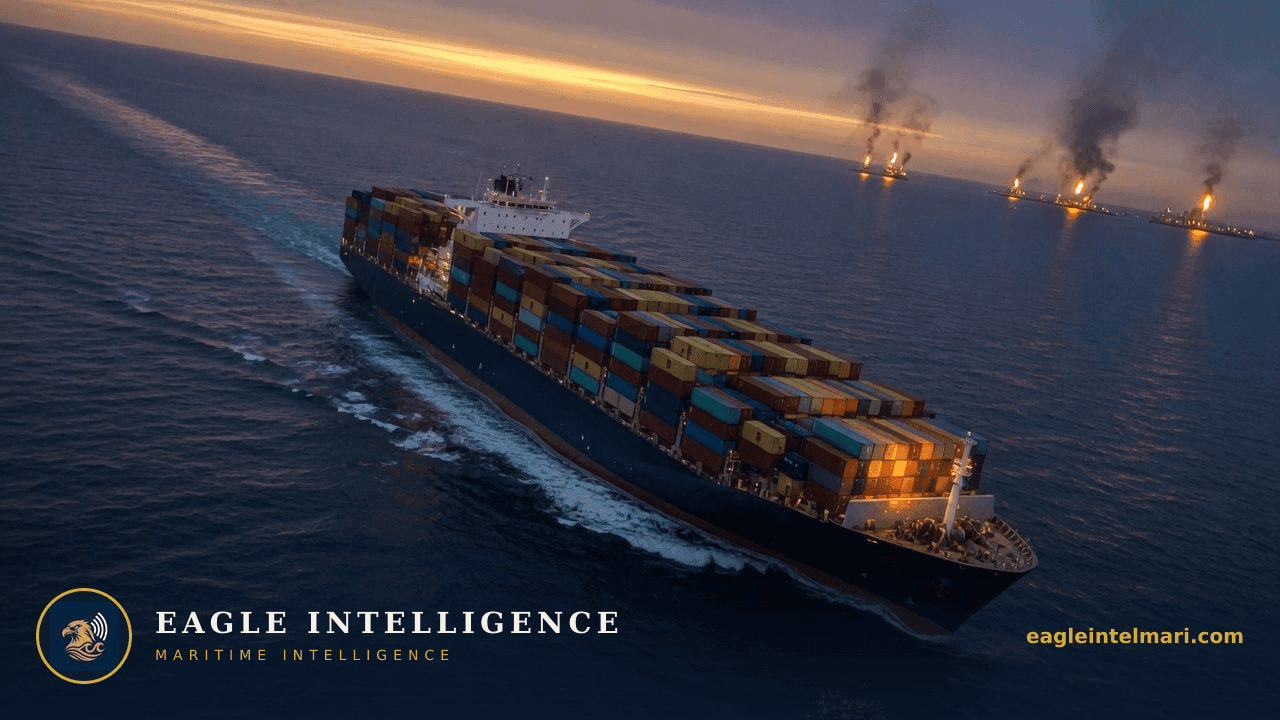
Container freight rates from Asia to the US have surged 109 percent in a single week since open hostilities with Iran began, propelled by bunker price spikes and emerging congestion that is already forcing charterers to absorb sharp cost increases.
Advertisement
Advertisement
Container freight rates from Asia to the US have more than doubled in the week since open conflict with Iran erupted, exposing how quickly a regional war can transmit into global liner economics through fuel and logistics choke points.
The immediate driver is the sharp rise in marine fuel. With Iranian crude and product flows threatened, Rotterdam and Singapore bunker quotes climbed 18-22 percent in five trading days. Carriers operating Asia-US West Coast services typically consume 120-140 tonnes of VLSFO per day at sea; at current spot levels that adds roughly $28,000-$35,000 per voyage in extra fuel cost. Most contracts allow bunker adjustment factors to pass the increase to cargo interests within seven to ten days, explaining why spot rates moved so violently.
Higher fuel is not the only variable. Several major Asian hubs are reporting berth delays as carriers scramble to re-bunker or switch to more expensive low-sulphur grades before trans-Pacific legs. Ningbo and Busan each added 1.5-2 days of average waiting time this week, according to port community systems. The resulting schedule slippage has forced some services to omit calls, tightening effective supply exactly as retailers begin seasonal inventory builds ahead of the US back-to-school cycle.
Time-charterers and forwarders are absorbing the largest initial impact. A 4,500-TEU vessel fixed on a 60-90 day Asia-US round voyage now carries an implied daily fuel surcharge that exceeds the 2025 average TCE by 40 percent. Several mid-sized forwarders have already issued customer advisories warning of peak-season surcharges layered on top of the published rate increase. Those without bunker clauses in their service contracts are negotiating emergency amendments or risk margin compression that could wipe out second-quarter profits.
Hull and machinery underwriters are watching the situation closely but have not yet imposed blanket exclusions. However, war-risk premium quotes for vessels calling Iranian-adjacent waters or transiting the Strait of Hormuz have risen 250-300 basis points since the first strikes. P&I clubs are advising members to review deviation clauses and to consider routing options via the Cape of Good Hope for any Iran-flagged or Iran-owned tonnage—an expensive detour that would add 12-15 days and roughly $180,000 in extra fuel and charter hire for a typical 13,000-TEU vessel.
The trajectory hinges on three variables: duration of Iranian export disruptions, speed of US demand response, and carrier capacity discipline. In a containment scenario (conflict de-escalates within 30 days), rates could retrace 35-45 percent by mid-July as bunker prices ease and congestion clears. A prolonged stalemate scenario keeps Hormuz risk elevated, sustaining rates 60-80 percent above pre-conflict levels through August and prompting some carriers to accelerate newbuilding deliveries or reactivate idle tonnage. The most severe tail-risk scenario—extended closure or repeated attacks on regional chokepoints—would force a structural re-rating of Asia-US freight, with carriers likely to push annual contracts 25-30 percent higher at the next negotiation window.
Although no attacks on commercial vessels have been reported, several operators have instructed masters to maintain heightened security postures and to avoid Iranian territorial waters. Extended voyages and uncertainty over crew-change ports are already surfacing in seafarer welfare channels. Unions have requested expedited discussions on hazard pay and mental-health support for crews on vessels that may be diverted around Africa.
Advertisement
Advertisement
Live 1–5 shipping war-risk level across monitored chokepoints.
⚠️ Intelligence Disclaimer: This analysis is produced by Eagle Intelligence's AI-assisted automated analysis system and is provided for informational purposes only. See our editorial standards. It is not a substitute for official maritime safety advisories from UKMTO, MSCHOA, IMO, or flag state authorities. Operational decisions should always be based on official guidance and professional judgment. Eagle Intelligence accepts no liability for any loss arising from reliance on this content.
Live chokepoint status, war-risk shifts, and the daily maritime wire, straight to your inbox. Free.
Leave a comment
All comments moderated for quality
