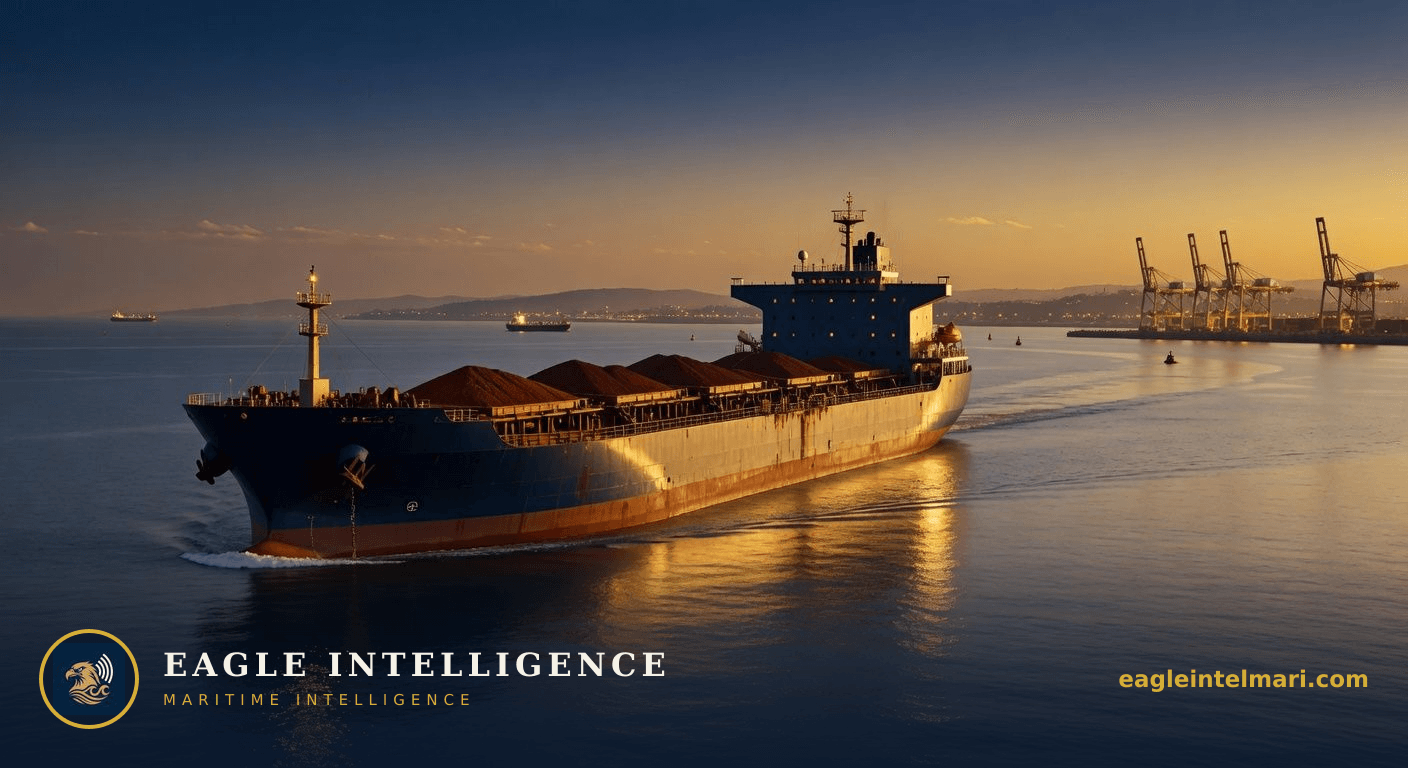
Resilient Chinese iron ore imports continue to anchor C3 and C5 rates while India's growing intake lengthens voyages and lifts overall dry-bulk demand, positioning the Baltic Dry Index for its strongest first-half finish since 2023.
Advertisement
Advertisement
Resilient Chinese iron ore imports continue to anchor C3 and C5 rates while India's growing intake lengthens voyages and lifts overall dry-bulk demand, positioning the Baltic Dry Index for its strongest first-half finish since 2023.
The first-half performance places the Baltic Dry Index on course for levels not seen since the post-pandemic rebound year of 2023. Capesize earnings have been the primary driver, with the C3 Brazil–China route and the C5 West Australia–Qingdao route both holding above seasonal averages. This strength has occurred despite visibly weaker Chinese steel output, underscoring how import volumes alone—not mill utilisation—now dictate near-term freight pricing.
Market focus is shifting from the familiar Brazil–China pendulum to India’s evolving import profile. Indian steelmakers are absorbing larger volumes of both Brazilian and Australian ore, adding thousands of extra nautical miles to each fixture compared with the shorter China hauls. The resulting tonne-mile expansion is absorbing available capesize capacity faster than simple voyage counts would suggest, tightening the spot market even when Chinese steel margins remain thin.
Shipowners with modern tonnage are securing period cover at rates that embed the India premium, reducing prompt availability for spot operators. Charterers, particularly those moving ore to Indian east-coast ports, face a widening bid–offer spread and are increasingly turning to forward freight agreements to cap exposure through the southwest monsoon season. The divergence between period and spot levels is now the widest recorded in the current cycle.
Deeper-draft capesize calls at Indian terminals such as Paradip and Krishnapatnam are rising, prompting port authorities to accelerate dredging schedules and night-navigation protocols. Congestion windows remain short but are lengthening at facilities still geared toward smaller panamax and supramax vessels. Stevedoring and inland logistics chains are reporting higher utilisation, translating into modest but sustained increases in discharge costs that ultimately feed back into the freight equation.
If Indian steel output maintains its current trajectory and Brazilian export availability stays firm, C3 and C5 rates could add another 15–20 percent by September, pushing the BDI toward 2,200–2,400. A sharper contraction in Chinese construction activity would instead redirect more Australian ore toward India, flattening the rate curve but still supporting tonne miles. The third scenario hinges on monsoon-related port delays in India: a prolonged weather disruption would temporarily ease prompt tonnage and cap upside, yet any subsequent catch-up surge would amplify fourth-quarter earnings beyond current futures pricing.
Hull and P&I underwriters view the current demand pattern as credit-positive for owners, with no immediate shift in war-risk or piracy loadings. Crewing managers note steady demand for experienced capesize officers on the extended India runs, yet no acute shortage has emerged. The principal risk flagged internally remains fatigue on vessels completing repeated long-haul cycles without adequate rotation.
Advertisement
Advertisement
⚠️ Intelligence Disclaimer: This analysis is produced by Eagle Intelligence's AI-assisted automated analysis system and is provided for informational purposes only. See our editorial standards. It is not a substitute for official maritime safety advisories from UKMTO, MSCHOA, IMO, or flag state authorities. Operational decisions should always be based on official guidance and professional judgment. Eagle Intelligence accepts no liability for any loss arising from reliance on this content.
Live chokepoint status, war-risk shifts, and the daily maritime wire, straight to your inbox. Free.
Leave a comment
All comments moderated for quality
