London and Paris have locked in plans to lead a multinational mine-sweeping operation in the Strait of Hormuz days after any US-Iran agreement restores commercial traffic through the waterway.
Advertisement
Advertisement
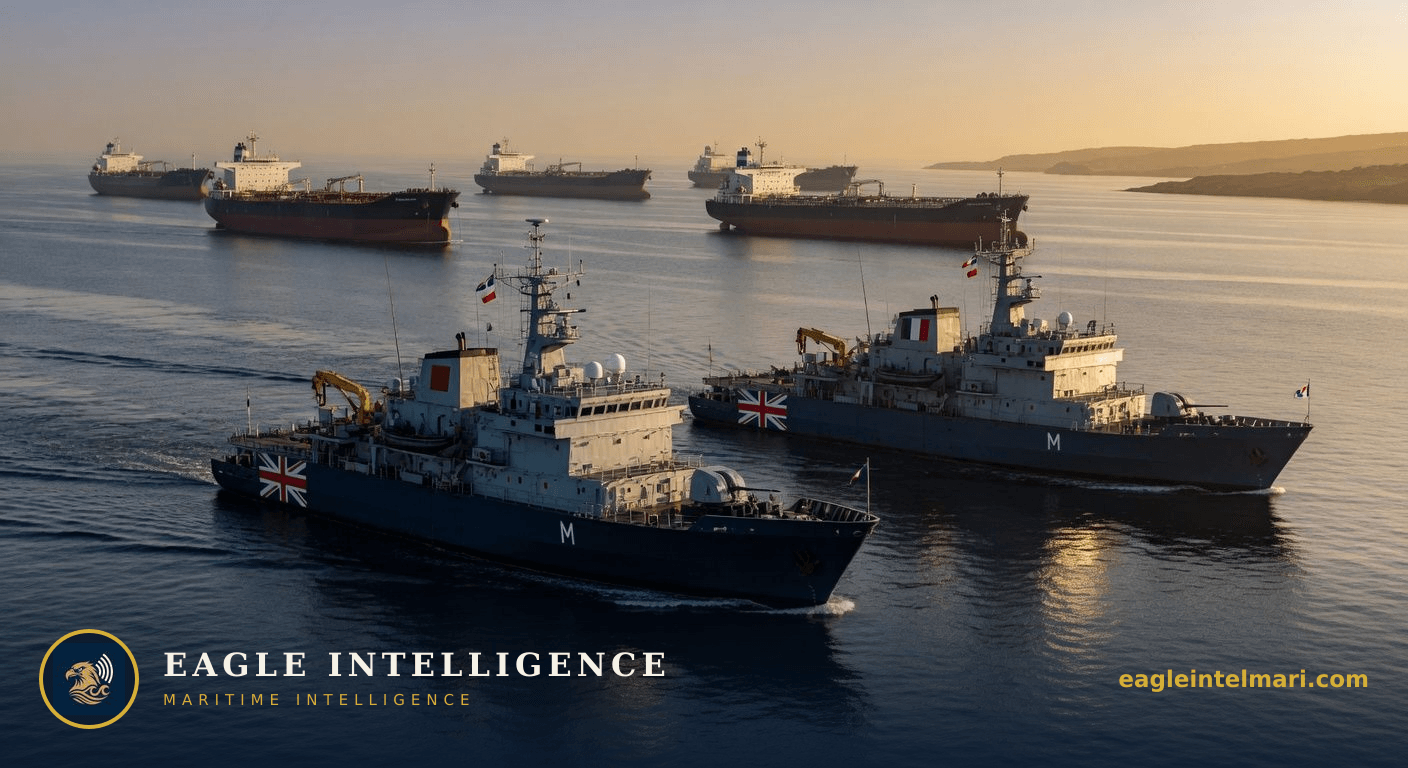
The United Kingdom and France have moved from contingency planning to operational readiness for a multinational mine-clearance campaign in the Strait of Hormuz, timed to begin within days of any Washington-Tehran understanding that reopens the strait to normal shipping.
Any reopening of Hormuz after conflict will be gated by demonstrable proof that the 21-mile-wide strait is free of mines. Even a handful of uncharted mines can deter VLCCs and LNG carriers for weeks, because hull underwriters and masters will not accept residual risk in a chokepoint where a single strike can block 20 percent of global oil trade. Historical precedent from the 1980s Tanker War shows that partial clearance produces uneven risk pricing and patchy traffic recovery.
The Royal Navy’s Hunt-class and the Marine Nationale’s Éridan-class minehunters, together with autonomous underwater vehicles already forward-positioned in the Gulf, give both nations the technical edge to lead the initial sweep. Their combined flotilla can operate under existing Combined Maritime Forces tasking without requiring new UN mandates, shortening the political lead time. Other NATO partners are expected to contribute ROV support and logistics once the core corridor is declared safe.
Hull and P&I syndicates in London are already modeling three premium tiers: pre-clearance, post-partial clearance, and full certification. A rapid UK-French sweep could compress the highest-risk window from months to weeks, cutting additional premiums that have layered onto Hormuz transits since the latest round of tensions. Charterers of crude and clean products will watch the Joint War Committee’s next bulletin for the first signal that rates can be walked back.
Owners with vessels idled outside the Gulf will face rapid redeployment decisions once clearance begins. A certified channel would allow Saudi, Iraqi and Emirati barrels to reach Asia and Europe without the long Cape or longer Cape-plus-canal routings that have absorbed excess tonnage. The resulting compression in voyage times would tighten the VLCC supply-demand balance faster than most fleet analysts currently forecast.
If the US-Iran deal is announced within the next fortnight and mines prove limited, a narrow safe corridor could be certified inside three weeks, triggering an immediate surge in spot fixtures. A larger minefield or political delays in task-force assembly would stretch the process to six-to-eight weeks, keeping war-risk premiums elevated and some charterers on alternative routings. In a worst-case scenario of renewed skirmishing before clearance completes, the entire operation would be paused, returning the strait to de-facto closure and forcing P&I clubs to re-extend additional premiums for another quarter.
Advertisement
Advertisement
Live Hormuz transit status and war-risk band.
Live 1–5 shipping war-risk level across monitored chokepoints.
⚠️ Intelligence Disclaimer: This analysis is produced by Eagle Intelligence's AI-assisted automated analysis system and is provided for informational purposes only. See our editorial standards. It is not a substitute for official maritime safety advisories from UKMTO, MSCHOA, IMO, or flag state authorities. Operational decisions should always be based on official guidance and professional judgment. Eagle Intelligence accepts no liability for any loss arising from reliance on this content.
Live chokepoint status, war-risk shifts, and the daily maritime wire, straight to your inbox. Free.
Leave a comment
All comments moderated for quality
