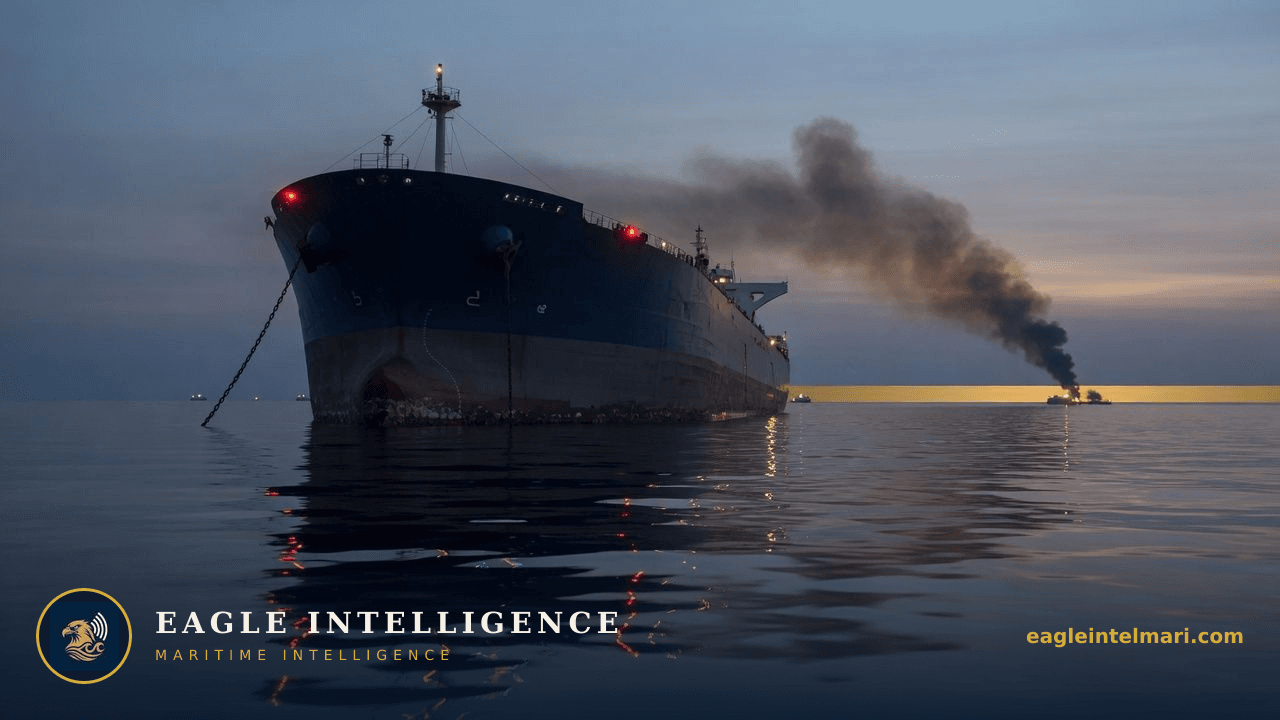
Charterers and owners still holding tonnage inside the Persian Gulf must now plan for prolonged exposure after an attack on a merchant ship in the Gulf of Oman forced the IMO to suspend its coordinated evacuation.
Advertisement
Advertisement
Charterers and owners still holding tonnage inside the Persian Gulf must now plan for prolonged exposure after an attack on a merchant ship in the Gulf of Oman forced the IMO to suspend its coordinated evacuation.
The strike occurred outside the Strait itself, yet it was enough to halt the IMO’s convoy-based exit scheme. Without the protection of a neutral, internationally coordinated movement, vessels that had been queued for departure now sit exposed at anchorages or inside the Gulf. For any operator whose ship is among them, the immediate decision is whether to wait for a revised plan or attempt an independent transit that carries higher war-risk exposure.
With the evacuation paused, daily costs compound quickly. A typical 300,000 dwt VLCC at anchor burns roughly $25,000–$30,000 a day in fuel, crew wages and insurance. Multiply that across even a modest cluster of tankers and product carriers and the figure quickly reaches several hundred thousand dollars daily. Charterers on period contracts absorb part of the hit through off-hire clauses, but owners ultimately carry the capital cost of an idled asset whose next employment window is now uncertain.
Underwriters had already priced a narrow window for the IMO-led movement. The latest incident widens the risk window and will push additional premium or outright refusal on new declarations for Gulf transits. Clubs that extended discretionary cover for the evacuation now face the prospect of claims arising from vessels that remain inside contested waters longer than anticipated. Renewal negotiations opening in the coming weeks will reflect this fresh data point.
Seafarers aboard the affected vessels face extended tours and uncertain relief schedules. Manning agencies that normally rotate crews through ports such as Fujairah or Jebel Ali must now identify alternative hand-over points outside the immediate risk area. Any delay also increases fatigue-related operational risk on vessels that remain at anchor in a high-traffic zone.
Product and crude traders who had counted on the evacuation to free up tonnage are already seeing paper barrels re-priced. A prolonged blockage of even a portion of the 21 million barrels per day that normally exit Hormuz tightens prompt availability in Asia and Europe. Forward curves for July and August loadings will likely steepen until clearer passage options emerge.
Monitor whether the IMO can reconstitute a revised convoy within ten days; any announcement after that threshold will signal that independent transits or extended lay-up have become the default options for most operators still inside the Gulf.
Advertisement
Advertisement
Live Hormuz transit status and war-risk band.
Live 1–5 shipping war-risk level across monitored chokepoints.
⚠️ Intelligence Disclaimer: This analysis is produced by Eagle Intelligence's AI-assisted automated analysis system and is provided for informational purposes only. See our editorial standards. It is not a substitute for official maritime safety advisories from UKMTO, MSCHOA, IMO, or flag state authorities. Operational decisions should always be based on official guidance and professional judgment. Eagle Intelligence accepts no liability for any loss arising from reliance on this content.
Live chokepoint status, war-risk shifts, and the daily maritime wire, straight to your inbox. Free.
Leave a comment
All comments moderated for quality
