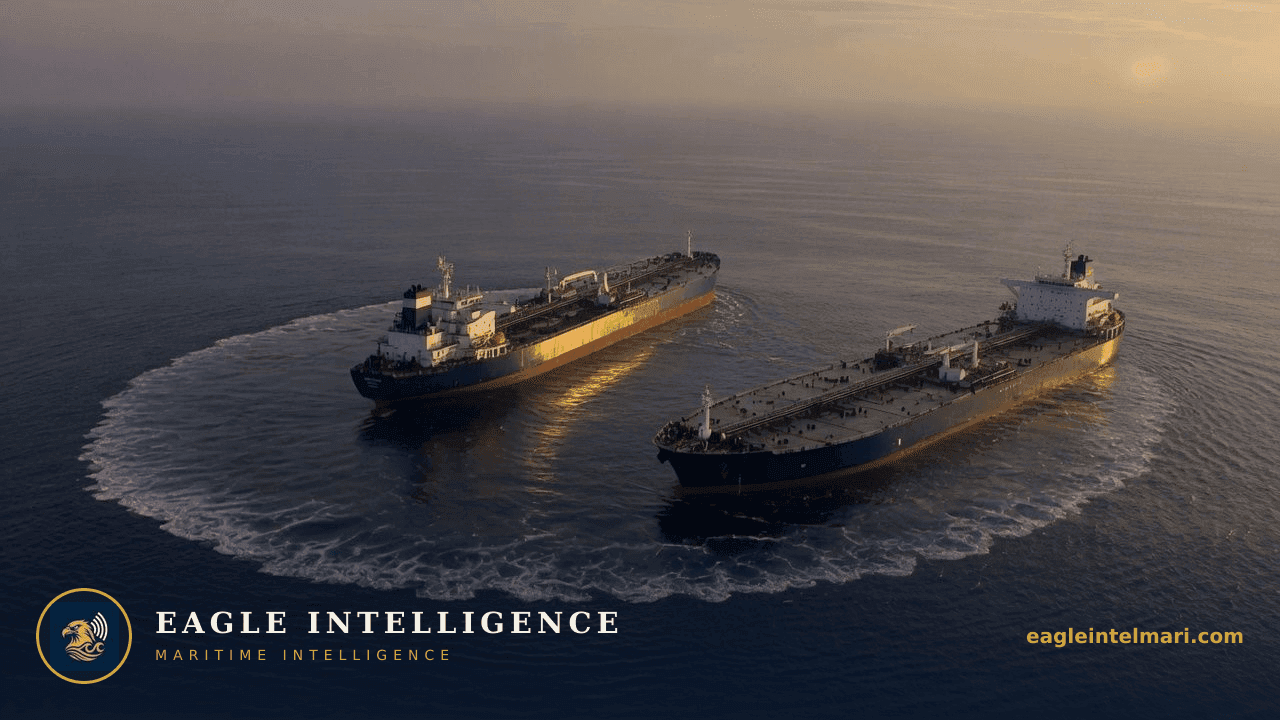
At least two oil tankers bound for African discharge have reversed course in the Indian Ocean this week, repositioning for Gulf loadings ahead of any Strait of Hormuz reopening.
Advertisement
Advertisement
Shipowners are executing rapid course reversals on laden and ballast tankers in the Indian Ocean, redirecting vessels back toward the Gulf in anticipation that the Strait of Hormuz may soon reopen to commercial traffic.
The two recorded u-turns involve vessels that had already committed significant bunker fuel and time steaming southward. Owners appear to have concluded that any reopening window will be brief and that securing early loading slots inside the Gulf outweighs the cost of the about-turn. Such decisions are taken at the highest commercial level because daily TCE differentials between a Gulf loading and an African discharge can swing by $25,000–$40,000 on VLCCs once Hormuz access is restored.
Each reversal adds roughly 1,200–1,500 nautical miles of extra steaming plus the associated fuel burn at current VLSFO prices near $520 per tonne. Charterers who fixed the original African voyages now face off-hire or deviation claims, while owners weigh whether to declare the reversals as legitimate mitigation under frustration or liberty clauses. The moves also compress the available tonnage pool for West African crude stems scheduled for July liftings.
War-risk underwriters active on the Hormuz exclusion zone are monitoring the repositioning activity closely. Any vessel that re-enters the Gulf before formal reopening will likely trigger additional premium loadings or outright coverage refusal. Hull syndicates are already repricing 30-day Hormuz transits at 0.35–0.45 percent of insured value, levels not seen since the 2019 tanker attacks. P&I clubs have issued quiet circulars reminding members that deviation into a still-closed strait may void certain coverages unless prior club consent is obtained.
The reversals are concentrated among larger crude carriers, but the knock-on effect is already visible in the Aframax and Suezmax segments that feed regional storage and floating storage plays. Charterers seeking prompt tonnage for short-haul Gulf-to-India or Gulf-to-Singapore voyages report fewer ballasters available east of Socotra, pushing spot rates up $4,000–$6,000 per day in the last 72 hours. Smaller operators without long-term storage options are the first to feel the squeeze.
If Hormuz reopens within ten days under a limited technical arrangement, the reversing vessels will capture premium loadings and the wider fleet will see a short-lived earnings spike before rates normalise. Should reopening be delayed beyond 20 July, owners who reversed course will face mounting bunker and opportunity costs and may divert again toward the Cape, flooding the Atlantic basin with unwanted tonnage. A third scenario sees partial reopening only for non-Iranian flagged vessels; in that case the two tankers now heading north will compete for limited slots while Iranian crude remains bottled up, sustaining elevated war-risk premiums through the summer.
Crews on the reversing tankers are largely Filipino and Indian nationals whose contracts contain explicit war-zone refusal clauses. Several owners have already sought flag-state guidance on whether a Hormuz transit remains voluntary. Should reopening occur under continued Iranian missile or drone threat, flag registries may impose fresh restrictions that further reduce the effective supply of willing tonnage.
Advertisement
Advertisement
Live Hormuz transit status and war-risk band.
Live 1–5 shipping war-risk level across monitored chokepoints.
⚠️ Intelligence Disclaimer: This analysis is produced by Eagle Intelligence's AI-assisted automated analysis system and is provided for informational purposes only. See our editorial standards. It is not a substitute for official maritime safety advisories from UKMTO, MSCHOA, IMO, or flag state authorities. Operational decisions should always be based on official guidance and professional judgment. Eagle Intelligence accepts no liability for any loss arising from reliance on this content.
Live chokepoint status, war-risk shifts, and the daily maritime wire, straight to your inbox. Free.
Leave a comment
All comments moderated for quality
