Chinese operator NewNew Shipping Line’s first container delivery to Murmansk via the Northern Sea Route, occurring as a Russian frigate escorts a Gazprom LNG carrier along the Norwegian coast, raises the central question of whether commercial container traffic can scale on the NSR without accepting permanent military oversight and sanctions entanglement.
Advertisement
Advertisement
On 21 August 2026, NewNew Shipping Line completed the first known delivery of containerized cargo to Murmansk using the Northern Sea Route. The move marks the carrier’s deliberate expansion beyond its established Russian Far East and Baltic services into a corridor previously dominated by LNG and bulk carriers. The company is positioning itself for a sustained role while South Korea and India also signal growing interest in the same seasonal window.
Murmansk’s ice-free port status gives it an edge over eastern Russian terminals for year-round container handling, yet the route still requires ice-class tonnage and precise scheduling around the brief summer navigation window. The arrival demonstrates that container operators now view the NSR not merely as a theoretical shortcut but as a viable operational lane for time-sensitive cargoes that can absorb the higher insurance and ice-breaker fees.
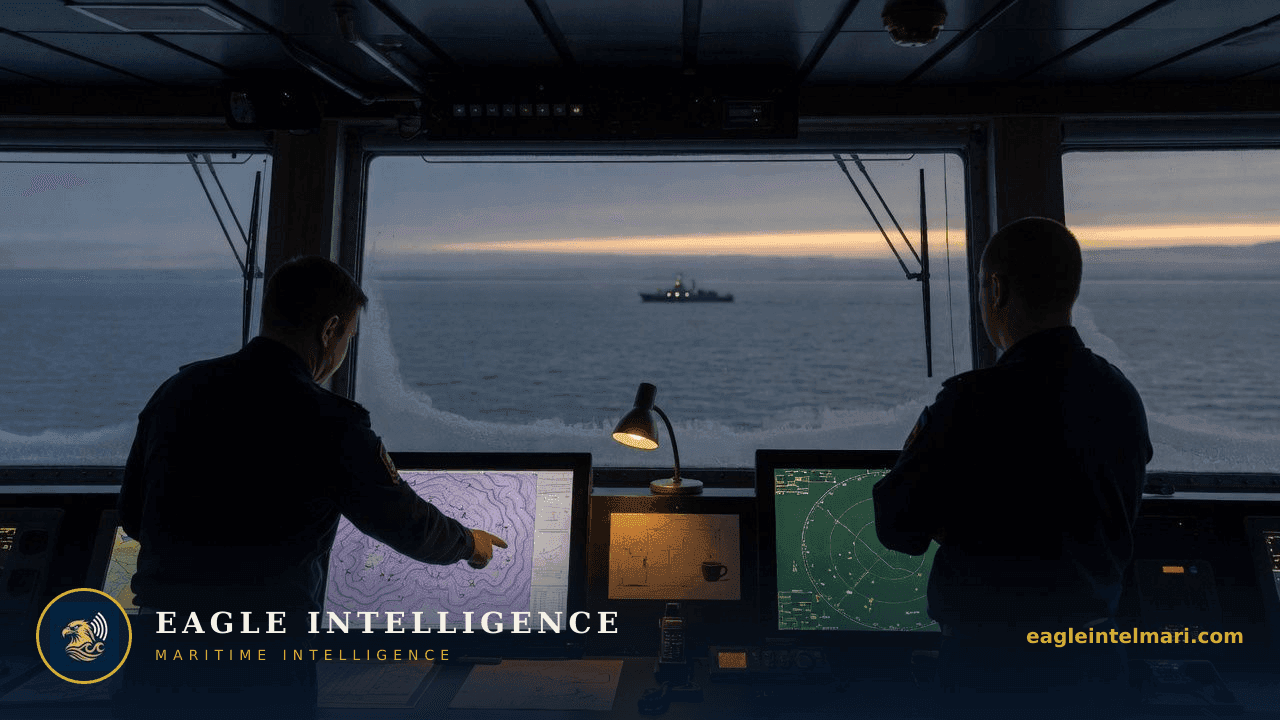
The same week, the Russian frigate Admiral Kasatonov escorted the Gazprom LNG carrier Portovyy after it departed the Portovaya plant. The transit along the Norwegian coast occurred at the height of the 2026 Arctic shipping season. Moscow has framed such deployments as protection for energy exports, yet the presence of a surface combatant alongside commercial hulls creates a new operational template for any vessel using the same waters.
Container operators such as NewNew must now decide whether to accept similar close escort arrangements or to transit without them. The distinction matters for insurance wording: hull policies typically exclude losses arising from military action, and the presence of a warship raises the factual question of whether a voyage has entered a war-risk zone even in the absence of declared hostilities.
Crewing departments face parallel questions. Indian and Filipino officers and ratings, already present on many Chinese-managed vessels, would operate under the same Russian naval umbrella that has drawn Western sanctions scrutiny since 2022. Manning agencies will need to update voyage risk assessments and crew consent procedures before the next seasonal window opens in 2027.
NewNew’s Murmansk call occurs against the backdrop of ongoing US and EU restrictions on Russian energy and port infrastructure. While the company itself is Chinese-owned, any vessel that calls Murmansk after loading in a sanctioned Russian terminal risks secondary sanctions exposure if cargo documentation shows a link to Gazprom or other designated entities. Western hull and P&I clubs have already tightened wording on Northern Sea Route voyages; some now require explicit disclosure of Russian port calls within the preceding 90 days.
The involvement of South Korean and Indian interests adds another layer. Both governments maintain formal sanctions alignment with Washington on certain Russian sectors. A container line headquartered in Seoul or Mumbai that joins NewNew on the NSR could trigger compliance reviews that the purely Chinese operator has so far avoided.
Arctic container services carry higher base premiums than Suez or Panama routings. The addition of Russian naval escorts may push war-risk rates further upward once underwriters classify the area as “enhanced military presence.” Xeneta’s weekly market note for the same period already records shippers shifting volumes from the US East Coast to the West Coast to avoid congestion and cost volatility; an Arctic option priced at a 15–25 percent premium over traditional lanes would compete only for the highest-value, time-sensitive boxes.
Port agents in Murmansk will also face new documentation burdens. Each container discharge now requires proof that the cargo has not originated from or is not destined for entities on the US SDN list. Delays at the gate translate directly into demurrage and detention charges that erode the theoretical distance savings of the NSR.
Shipowners committed to Arctic container services will need to budget for ice-class upgrades or charters, additional war-risk cover, and possible Russian escort coordination fees. Charterers of reefer or project cargo may accept the route for summer-only shipments, but liner services requiring year-round reliability will continue to treat the NSR as a supplementary rather than core string.
Coastal states Norway and Canada watch the precedent closely. Any expansion of Russian naval activity near their exclusive economic zones could prompt new transit regulations or mandatory reporting that adds administrative cost. Seafarers’ unions in India and the Philippines have already begun requesting voyage-specific risk briefings for crews assigned to vessels routing north of the Arctic Circle.
Energy traders gain a parallel export lane for LNG that bypasses the Turkish Straits and Suez chokepoints, yet they inherit the same military escort requirement that now appears standard. The net effect is a gradual bifurcation of Arctic shipping into an escorted, Russia-aligned segment and a non-escorted, higher-insurance segment that may prove uneconomic for most container operators.
The strongest alternative reading is that NewNew’s Murmansk call remains a one-off demonstration rather than the start of regular container services. The Northern Sea Route navigation season lasts only four to five months even in favorable ice years, and container lines require schedule integrity that ice and escort constraints undermine. Historical data show that most NSR cargo has been bulk or energy; container volumes have stayed below 1 percent of global east-west trade. If Western sanctions tighten further or insurance markets withdraw cover, the economics collapse and the corridor reverts to its pre-2022 profile of sporadic, state-supported energy shipments.
Evidence that would support this view includes the absence of announced 2027 container schedules by NewNew or any competitor, continued low container freight rates on the Asia-Europe trade that remove urgency for Arctic alternatives, and any public statement from a major P&I club withdrawing cover for Russian Arctic ports. Until such schedules or withdrawals appear, the Murmansk call can be read as political signaling rather than commercial commitment.
We know that NewNew completed the first containerized delivery to Murmansk via the NSR on or before 21 August 2026 and that the Admiral Kasatonov escorted a Gazprom LNG carrier along the Norwegian coast during the same seasonal peak. We do not know the cargo volumes involved, the exact insurance terms applied, or whether NewNew intends to repeat the voyage in 2027. We also lack confirmation that any non-Chinese container operator has committed tonnage.
Our assessment is that the combination of commercial container entry and routine naval escort establishes a new operational baseline for the NSR. The route is no longer solely an energy corridor; it now carries an implicit security overlay that raises costs and compliance exposure for any operator that follows NewNew’s lead. Confidence in this assessment is medium because the evidence rests on two contemporaneous but separate events rather than an integrated policy statement from Moscow or Beijing.
How will hull and P&I underwriters adjust war-risk wording once Russian naval escorts become a documented feature of NSR container voyages?
What due-diligence steps must a South Korean or Indian container line complete before announcing its own Murmansk service without triggering secondary sanctions?
Will Norway impose mandatory reporting or pilotage requirements on vessels transiting within 200 nautical miles of its Arctic coastline when Russian surface combatants are present?
Which crewing agencies have updated their risk matrices to cover Indian and Filipino ratings on vessels accepting Russian naval escort in the Barents Sea?
At what container volume threshold does the Northern Sea Route begin to divert measurable cargo from the Suez routing during the summer window?
Next 24 hours: any public statement from NewNew or its parent on 2027 NSR container schedules.
Next seven days: release of updated war-risk circulars by major P&I clubs covering Russian Arctic ports after 1 September 2026.
Next thirty days: announcement of at least one non-Chinese container operator declaring intent to call Murmansk before the 2027 navigation season closes, or formal withdrawal of cover by a Western insurer for NSR voyages involving Russian escorts.
Advertisement
Advertisement
Live 1–5 shipping war-risk level across monitored chokepoints.
⚠️ Intelligence Disclaimer: This analysis is produced by Eagle Intelligence's AI-assisted automated analysis system and is provided for informational purposes only. See our editorial standards. It is not a substitute for official maritime safety advisories from UKMTO, MSCHOA, IMO, or flag state authorities. Operational decisions should always be based on official guidance and professional judgment. Eagle Intelligence accepts no liability for any loss arising from reliance on this content.
Live chokepoint status, war-risk shifts, and the daily maritime wire, straight to your inbox. Free.
Leave a comment
All comments moderated for quality
