A CMA CGM container ship hit by missile in the Strait of Hormuz in early May now faces likely scrapping while Iran announces service fees payable in Bitcoin and offers China discounted transit, driving eight vessels to reverse course and pushing daily oil flows above 10 million barrels under heightened US naval presence.
Advertisement
Advertisement
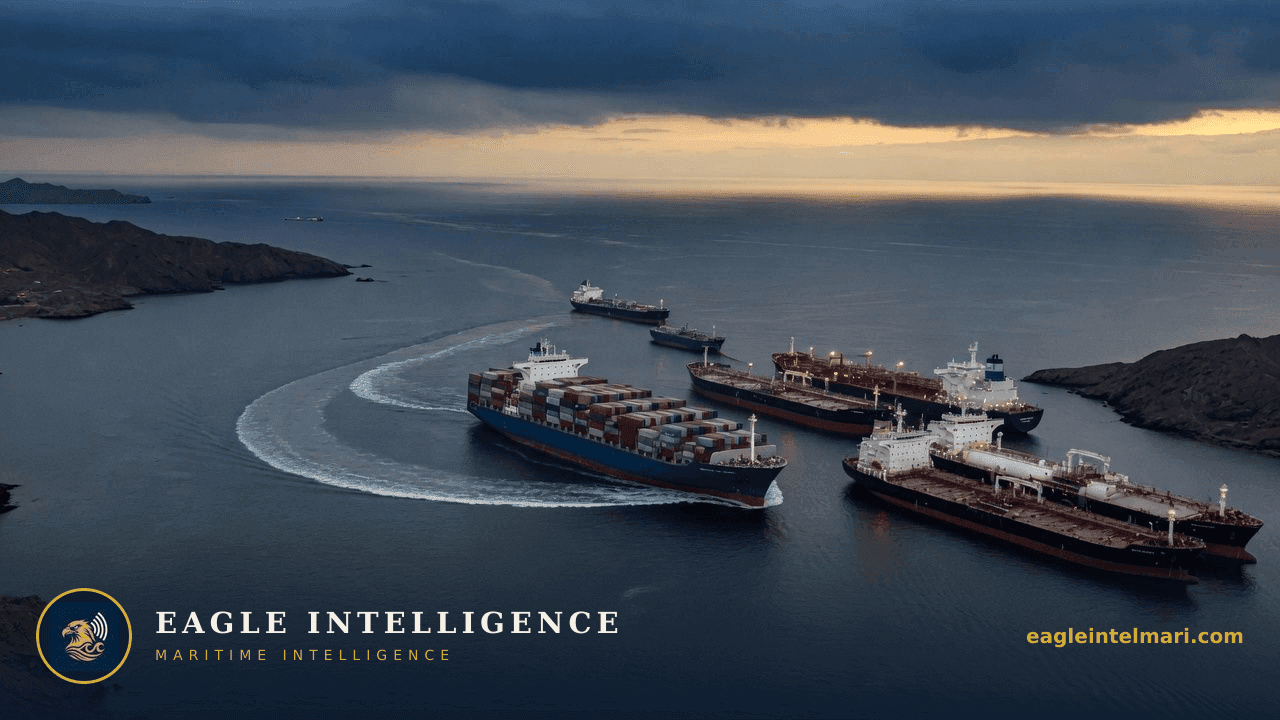
A CMA CGM container ship struck by a missile in the Strait of Hormuz in early May is now so severely damaged that the owner is weighing scrapping, crystallising the first major hull loss from the latest round of chokepoint attacks and forcing every owner and hull insurer with tonnage on the 21-mile-wide transit lane to recalculate war-risk exposure.
The vessel, hit weeks ago, has sustained structural harm beyond economical repair according to CMA CGM’s assessment. For hull underwriters this is the first concrete total-loss candidate since the current Hormuz incidents began, translating into immediate claims negotiations and a likely rise in deductibles for any container tonnage still routing through the strait. Charterers who had fixtures on the ship face cargo re-handling costs and potential delays measured in weeks rather than days while replacement tonnage is found.
Tehran has declared it will levy service fees on Hormuz transits, accepting Bitcoin and USDT while granting China reduced rates and other “friendly” nations sliding discounts. The move directly affects cash-flow planning for operators who must now decide whether to absorb the new levy, pass it through under charter terms, or divert. For P&I clubs the fee structure adds a fresh contractual layer to war-risk declarations; clubs that already exclude certain Iranian waters may face member queries on whether paying the toll constitutes compliance with sanctions.
Azeri monitoring recorded eight vessels reversing course near the strait on 4 July, the clearest operational signal yet that masters and owners are exercising the right to refuse the passage when threats escalate. Each reversal adds roughly 12–18 days to voyages that would otherwise have used the shorter route, raising bunker consumption and exposing crews to extended fatigue under rest-hour rules. Charterers reliant on just-in-time arrivals into the Gulf or Indian Ocean ports now confront demurrage exposure and alternative routing costs that the market has not priced for months.
Paradoxically, Hormuz crude and condensate shipments have climbed past 10 million barrels per day even as the security environment tightens. The United States has responded by reinforcing maritime patrols, a deployment that owners with VLCCs and Suezmaxes on the route will view as partial mitigation but not a guarantee against further missile or drone incidents. Energy traders must weigh the higher physical volumes against the widening war-risk premium curve; any sustained closure would immediately tighten paper markets already showing surplus pricing signals.
Separately, Ukrainian drones struck St Petersburg’s oil terminal and surrounding infrastructure overnight on 3–4 July, damaging Russian export capacity at a second major outlet. Owners and insurers with tonnage fixed into the Baltic now face a dual-theatre risk picture: Hormuz volatility on one side and potential retaliatory or reciprocal disruptions in northern waters on the other. Manning agencies with Russian-crewed vessels in either region are already fielding family welfare calls.
In a quieter corner of the ledger, OOCL Wisdom completed the first green methanol bunkering at Qingdao before departing on its maiden Asia–North Europe loop. The 24,168-TEU dual-fuel newbuild offers owners a concrete data point on lower-carbon operations, yet the commercial relevance remains limited while Hormuz risk dominates fixture discussions. Charterers seeking ESG-compliant tonnage still have to solve the immediate routing and insurance questions first.
Underwriters are already circulating revised wording that treats the strait as a conditional area; owners with July fixtures should expect higher deductibles or outright exclusions unless escorted by coalition forces.
Most existing charter parties lack a mechanism for cryptocurrency settlement; owners and charterers will likely negotiate amendments or invoke force-majeure clauses rather than absorb unbudgeted digital-currency exposure.
Extended voyages breach original sign-off dates and rest-hour planning; manning agencies report increased requests for contract extensions and hardship allowances from families concerned about fatigue and route safety.
The Iranian offer is explicitly bilateral; third-flag operators attempting to use Chinese intermediaries risk sanctions scrutiny and potential denial of passage, creating a two-tier transit market.
No formal notices have been issued yet, but Finnish and Estonian ports are already monitoring traffic; owners should watch for sudden pilot or berth restrictions that could cascade into further delays.
Watch for any formal Iranian NOTMAR expanding the service-fee zone beyond the existing territorial waters; any new missile or drone incident inside the 21-mile strait; and the next US Central Command transit escort schedule. Return tomorrow for the next assessment.
Advertisement
Advertisement
Live Hormuz transit status and war-risk band.
Live 1–5 shipping war-risk level across monitored chokepoints.
⚠️ Intelligence Disclaimer: This analysis is produced by Eagle Intelligence's AI-assisted automated analysis system and is provided for informational purposes only. See our editorial standards. It is not a substitute for official maritime safety advisories from UKMTO, MSCHOA, IMO, or flag state authorities. Operational decisions should always be based on official guidance and professional judgment. Eagle Intelligence accepts no liability for any loss arising from reliance on this content.
Live chokepoint status, war-risk shifts, and the daily maritime wire, straight to your inbox. Free.
Leave a comment
All comments moderated for quality
