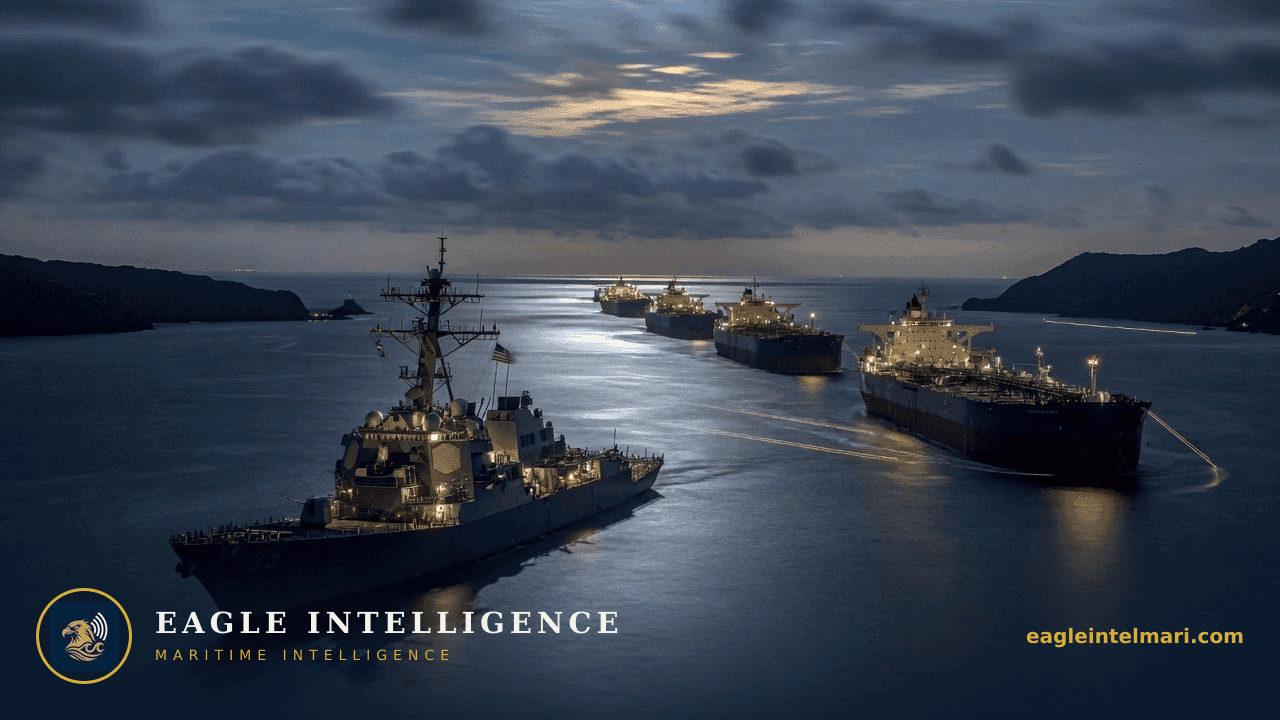
U.S. Navy escorts have expanded to routine multi-ship night transits of more than 20 tankers, moving millions of barrels under cover of darkness, according to new details from Burgum.
Advertisement
Advertisement
The latest disclosure adds concrete operational scale to the earlier advisory on U.S. escorts in the Strait of Hormuz: nighttime convoys are now routinely handling more than twenty laden tankers per passage, shifting the pattern from occasional protection to a standing throughput mechanism.
Energy Secretary Doug Burgum’s remarks supplied the first public tally, confirming that U.S. surface units are moving several million barrels nightly through the chokepoint. The figure exceeds previous unconfirmed estimates and indicates the escort operation has matured into a predictable schedule rather than ad-hoc interventions.
Night transits reduce visual signature and limit the window for shore-based targeting or drone observation. By concentrating departures after sunset, the Navy compresses the high-risk segment of the 21-mile-wide strait into fewer daylight hours, forcing any adversary to recalibrate surveillance and reaction timelines.
Owners and operators have already begun layering night-transit premiums into fixtures, with reports of $0.8–1.2 million added to round-trip economics for vessels accepting escorted slots. Charterers of Middle East crude are accelerating cargo nominations to align with the protected windows, tightening availability for unescorted or daylight-only tonnage.
London and Scandinavian underwriters have signaled they will refresh Hormuz additional-premium schedules within days. The confirmed volume of escorted tonnage supplies fresh loss data, likely compressing rates for escorted vessels while widening the differential for those electing independent transit. Clubs are also reviewing crew clauses, given the higher tempo of night formation steaming.
Marshall Islands and Liberian flagged VLCCs dominate the escorted cohorts. Their administrations now face pressure to issue updated guidance on master authority during convoy operations. Seafarers report compressed rest periods and heightened bridge manning, raising fatigue-management questions that unions are already flagging to classification societies.
If Iranian rhetoric stays below kinetic thresholds, the convoy rhythm could settle into a de-facto protected lane, supporting a 15–20 % lift in Hormuz sailings by late July. A single successful interdiction or mine sighting would trigger an immediate spike in additional premiums and possible daytime suspension. Sustained escalation, by contrast, would push the Navy toward larger surface-group escorts or wider exclusion zones, compressing available export capacity from Gulf terminals within weeks.
Advertisement
Advertisement
Indicative Additional War Risk Premium (AWRP) ranges — not a binding insurance quote.
Live Hormuz transit status and war-risk band.
Live 1–5 shipping war-risk level across monitored chokepoints.
⚠️ Intelligence Disclaimer: This analysis is produced by Eagle Intelligence's AI-assisted automated analysis system and is provided for informational purposes only. See our editorial standards. It is not a substitute for official maritime safety advisories from UKMTO, MSCHOA, IMO, or flag state authorities. Operational decisions should always be based on official guidance and professional judgment. Eagle Intelligence accepts no liability for any loss arising from reliance on this content.
Live chokepoint status, war-risk shifts, and the daily maritime wire, straight to your inbox. Free.
Leave a comment
All comments moderated for quality