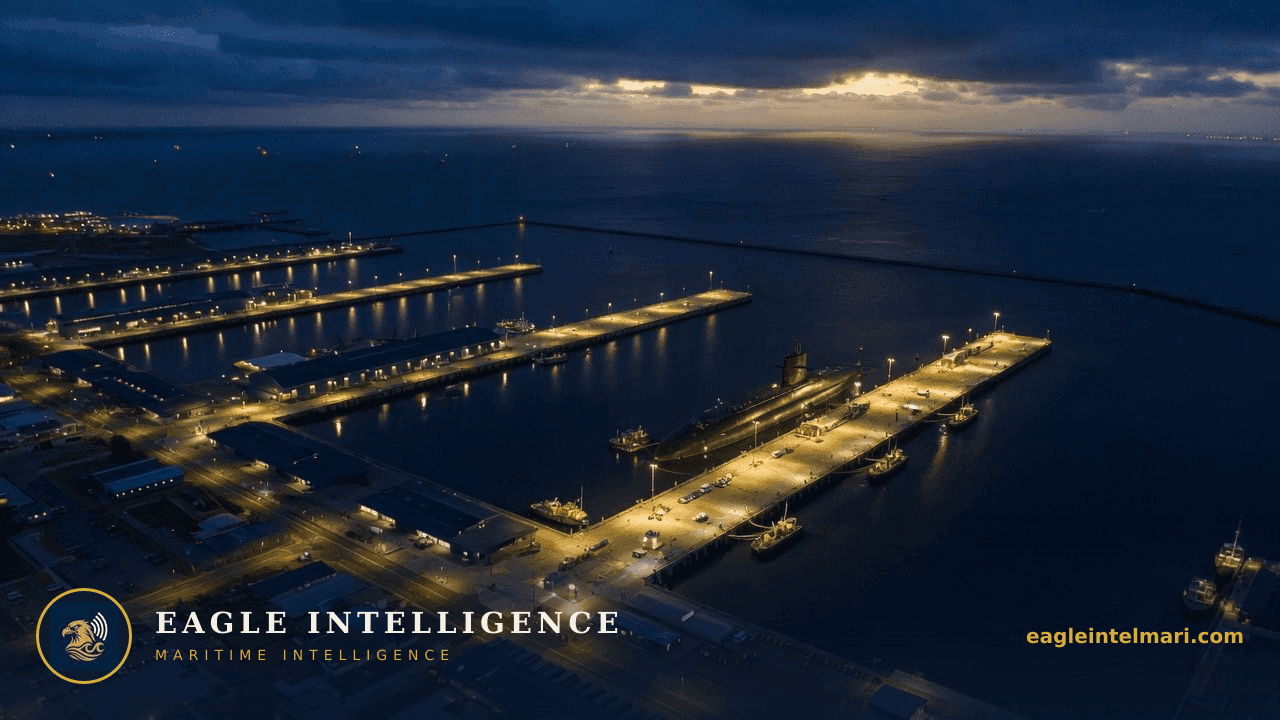
U.S. Navy establishment of CSS-3 and NSA Stirling at HMAS Stirling signals the operational start of Submarine Rotational Force-West, anchoring nuclear-powered boats from America and Britain in Western Australia.
Advertisement
Advertisement
The relocation of Submarine Squadron 3 to HMAS Stirling and the activation of Naval Support Activity Stirling convert a long-planned AUKUS concept into a functioning forward operating node, placing U.S. and U.K. nuclear attack submarines on sustained rotation out of Perth by late 2026.
HMAS Stirling already hosts the Royal Australian Navy’s Collins-class fleet and offers deep-water access with minimal commercial traffic interference. Its position on the Indian Ocean rim shortens transit times to the South China Sea by roughly four days compared with Hawaii-based boats, while existing fuel, weapons and dry-dock infrastructure reduces the capital outlay required for nuclear support. The base’s relative isolation also limits public scrutiny and simplifies security cordons around classified reactor maintenance.
CSS-3 will manage intermediate-level repairs, spare-parts warehousing and crew rotation for up to four U.S. and two U.K. submarines on six-month cycles. Early planning documents indicate the squadron will rely on mobile maintenance teams and pre-positioned modules rather than a full nuclear shipyard, limiting Australian regulatory exposure while still enabling quick-turn repairs that keep boats on patrol rather than returning to Guam or Pearl Harbor. NSA Stirling’s May 30 stand-up supplies the contracting and base-services backbone for these teams, including classified communications and radiological support.
Owners routing tankers and bulk carriers through the Lombok and Sunda Straits now operate under a denser U.S.-U.K. submarine presence. P&I clubs have already begun modeling a 15-25 basis-point war-risk surcharge for hulls transiting within 200 nautical miles of the Perth approaches during major exercises. Charterers of LNG vessels out of Dampier and Barrow Island face tighter slot coordination as naval movements take priority in the same waters. Hull underwriters are watching for any formal declaration of “enhanced risk zones” that could trigger automatic premium adjustments.
Australian port authorities must now accommodate a steady flow of U.S. and U.K. nuclear-certified technicians alongside commercial crews, raising training and radiation-monitoring requirements for local stevedores. Flag states of vessels calling at Fremantle will receive updated naval movement advisories to avoid submerged transit lanes. Seafarers’ unions have flagged concerns over potential radiation-safety protocols and the risk of sudden port closures during classified submarine arrivals.
The nearest precedent is the U.S. Navy’s expansion of Diego Garcia as a logistics hub during the late Cold War. Within three years of initial squadron activation, commercial war-risk rates in the northern Indian Ocean rose 40 percent during peak Soviet submarine surges. Perth’s greater commercial integration suggests a milder but still measurable premium effect, concentrated on energy cargoes rather than the broader container trade seen in the Arabian Sea.
If Australian domestic politics remain supportive and U.S. Congress sustains funding, SRF-West will expand to eight boats by mid-2028, anchoring a persistent intelligence and strike presence that deters major Chinese surface deployments south of the equator. A funding shortfall or base-access dispute could cap the force at four boats, forcing greater reliance on Guam and lengthening response times to Southeast Asian contingencies. Escalation between Beijing and Taipei would likely accelerate Australian approvals for full nuclear submarine home-porting, pushing war-risk loadings above 100 basis points for all vessels west of 120°E.
Advertisement
Advertisement
Live 1–5 shipping war-risk level across monitored chokepoints.
⚠️ Intelligence Disclaimer: This analysis is produced by Eagle Intelligence's AI-assisted automated analysis system and is provided for informational purposes only. See our editorial standards. It is not a substitute for official maritime safety advisories from UKMTO, MSCHOA, IMO, or flag state authorities. Operational decisions should always be based on official guidance and professional judgment. Eagle Intelligence accepts no liability for any loss arising from reliance on this content.
Live chokepoint status, war-risk shifts, and the daily maritime wire, straight to your inbox. Free.
Leave a comment
All comments moderated for quality
