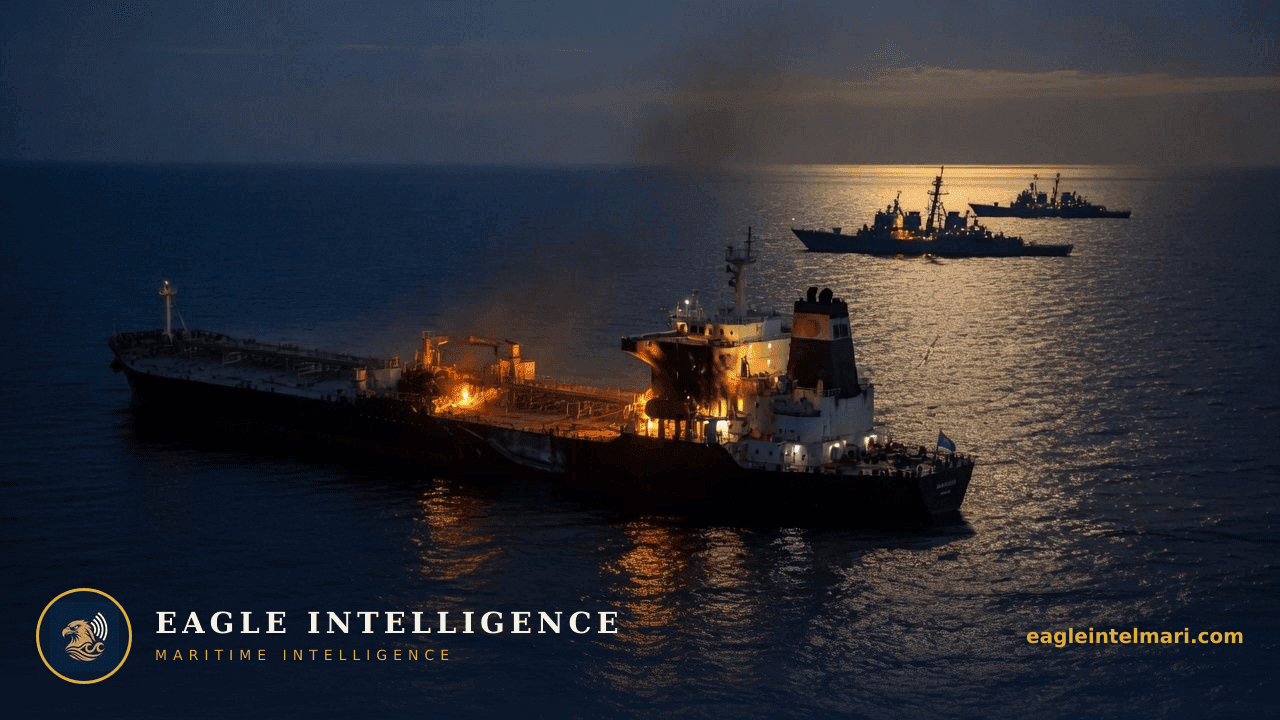
American forces have disabled three tankers violating a naval blockade of Iran, with Tuesday’s engine-room strike on the Palau-flagged MT Settebello claiming three Indian lives and sharpening the lethal edge of sanctions enforcement at sea.
Advertisement
Advertisement
US Central Command’s strikes have turned a sanctions blockade into a live-fire zone, killing three Indian mariners on the MT Settebello and disabling two additional tankers in the Gulf of Oman.
US forces placed a single precision munition into the Settebello’s machinery space at 2315 local time, a tactic that disables propulsion while minimizing risk of total loss or major pollution. The same method was applied to the other two vessels earlier in the week, indicating a deliberate doctrine of surgical disablement rather than sinking. Owners now face a binary choice: comply with diversion orders or risk permanent loss of the hull and criminal liability for their crews.
The three deceased mariners were Indian nationals, highlighting how the world’s largest supplier of seafarers absorbs the human cost of great-power sanctions enforcement. Their union has already demanded repatriation of remains and compensation, setting up potential claims against both the shipowner and flag state under the Maritime Labour Convention. Recruitment agencies in Mumbai and Chennai are likely to see war-risk refusals rise sharply for Gulf voyages.
The Settebello’s Palau registry and Panamanian beneficial owner, Aqua Aurora Shipping Lines Inc., expose the thin layers of anonymity that sanctions-busting operators rely upon. Palau’s maritime authority will face diplomatic pressure to delist the vessel, while Panama may initiate corporate investigations. Both flag states risk broader blacklisting by Western port authorities if they are seen to tolerate blockade violations.
Hull and P&I underwriters will almost certainly reclassify the entire Gulf of Oman as an active war-risk zone within days. Premiums that were already elevated are expected to jump another 150–300 basis points for tankers transiting between 22°–26° N, forcing charterers to decide whether to absorb the cost or reroute via longer Cape or Suez alternatives. War-risk clauses in existing charters will be triggered, shifting the burden of delay and deviation onto cargo interests.
Any sustained blockade enforcement directly constrains Iranian crude loadings and raises the specter of retaliatory mining or missile threats in the Strait of Hormuz. Even a 10 % reduction in daily Hormuz transits would tighten global distillate balances, pushing VLCC and Suezmax rates higher on the AG–East route. European and Asian refiners dependent on Iranian or Iraqi barrels will accelerate alternative sourcing from West Africa and the US Gulf, lengthening tonne-mile demand.
If Washington sustains selective strikes without Iranian retaliation, the blockade could settle into a managed choke on illicit trade, with compliant owners quietly diverting. A single Iranian response—such as mining or drone attack on a neutral tanker—would trigger broader carrier withdrawals and a spike in global freight rates. Full escalation, involving Iranian closure attempts on the Strait, would shift the conflict into a regional war footing, forcing governments to organize escorted convoys and redraw insurance maps for months.
Advertisement
Advertisement
Indicative Additional War Risk Premium (AWRP) ranges — not a binding insurance quote.
Live Hormuz transit status and war-risk band.
Live 1–5 shipping war-risk level across monitored chokepoints.
⚠️ Intelligence Disclaimer: This analysis is produced by Eagle Intelligence's AI-assisted automated analysis system and is provided for informational purposes only. See our editorial standards. It is not a substitute for official maritime safety advisories from UKMTO, MSCHOA, IMO, or flag state authorities. Operational decisions should always be based on official guidance and professional judgment. Eagle Intelligence accepts no liability for any loss arising from reliance on this content.
Live chokepoint status, war-risk shifts, and the daily maritime wire, straight to your inbox. Free.
Leave a comment
All comments moderated for quality
