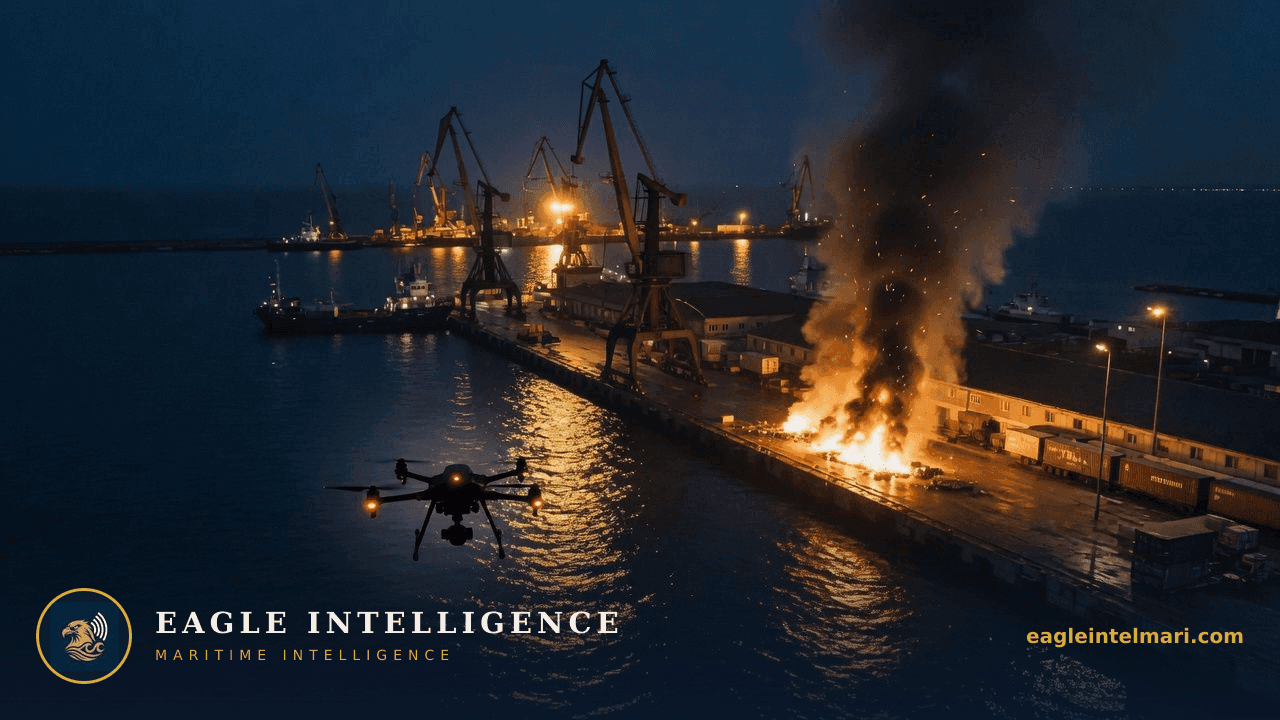
A Ukrainian drone killed one worker and ignited a fire at Temryuk's sea terminal, exposing how even secondary Russian ports now sit inside the war's operational envelope and forcing rapid recalibration of insurance, routing and cargo planning.
Advertisement
Advertisement
A single Ukrainian drone penetrated Russian air defenses over the Azov-Black Sea coast on 13 June, striking the commercial sea terminal at Temryuk, killing one person and starting a fire that local authorities are still fighting. The incident widens the geography of maritime risk beyond the obvious targets of Novorossiysk and Sevastopol and compels every participant in southern Russian trade to reassess exposure.
Temryuk handles breakbulk, grain, fertilizers and small volumes of petroleum products that larger Black Sea ports cannot or will not accept under current Western restrictions. Its shallow drafts and regional status have allowed it to absorb cargoes diverted from sanctioned facilities, keeping Russian agricultural and chemical exports moving even as primary outlets face tighter scrutiny. The strike therefore hits not only physical infrastructure but also one of Moscow's remaining low-profile outlets.
Hull and war-risk underwriters have already widened the Azov-Black Sea high-risk zone; this attack supplies fresh evidence that the zone must expand inland to include Krasnodar terminals previously treated as lower-threat. Expect premium surcharges of 0.15–0.25 percent of hull value to appear within days for any vessel calling Temryuk or nearby ports, with P&I clubs likely to follow by tightening conditions on crew safety and cargo declarations.
Operators carrying Russian-origin grain or fertilizer now face three unpalatable choices: accept sharply higher war-risk premiums, shift to even smaller, less efficient terminals further east, or absorb longer transit times via rail to more distant Baltic or Far Eastern outlets. Time-charter contracts written before the strike contain no clear language for such rapid changes in risk, setting up disputes over off-hire, deviation and frustration clauses that lawyers are already preparing to litigate.
The fatality at Temryuk underscores that shore workers and visiting crews now operate inside a contested battlespace. Filipino, Indian and Turkish seafarers, who dominate crews on vessels trading to southern Russia, will press for hazard pay or outright refusal to call, accelerating an already visible tightening of the seafarer market in the region. Flag states are likely to issue fresh advisories within 72 hours.
If Ukrainian forces repeat strikes at weekly intervals, Temryuk's throughput could fall 40 percent by September, pushing additional volumes onto rail to Novorossiysk and raising congestion surcharges across the Kuban corridor. Should Russia reinforce local air defenses and achieve a visible lull of two weeks or more, some risk-averse owners may test the port again, capping premium increases. A third scenario sees Moscow retaliate against Ukrainian Danube or Odessa facilities, widening the conflict zone and triggering a blanket war-risk declaration for the entire northern Black Sea that would effectively halt commercial traffic for weeks.
The 2022 strikes on Odessa and the subsequent Black Sea Grain Initiative demonstrated how quickly a single port's disablement cascades into global food-price spikes and forces improvised rerouting via rail and smaller harbors. Temryuk's smaller scale limits the global price impact but amplifies the precedent that no Russian coastal facility, regardless of size or declared civilian status, remains off-limits.
Advertisement
Advertisement
Live 1–5 shipping war-risk level across monitored chokepoints.
⚠️ Intelligence Disclaimer: This analysis is produced by Eagle Intelligence's AI-assisted automated analysis system and is provided for informational purposes only. See our editorial standards. It is not a substitute for official maritime safety advisories from UKMTO, MSCHOA, IMO, or flag state authorities. Operational decisions should always be based on official guidance and professional judgment. Eagle Intelligence accepts no liability for any loss arising from reliance on this content.
Live chokepoint status, war-risk shifts, and the daily maritime wire, straight to your inbox. Free.
Leave a comment
All comments moderated for quality
