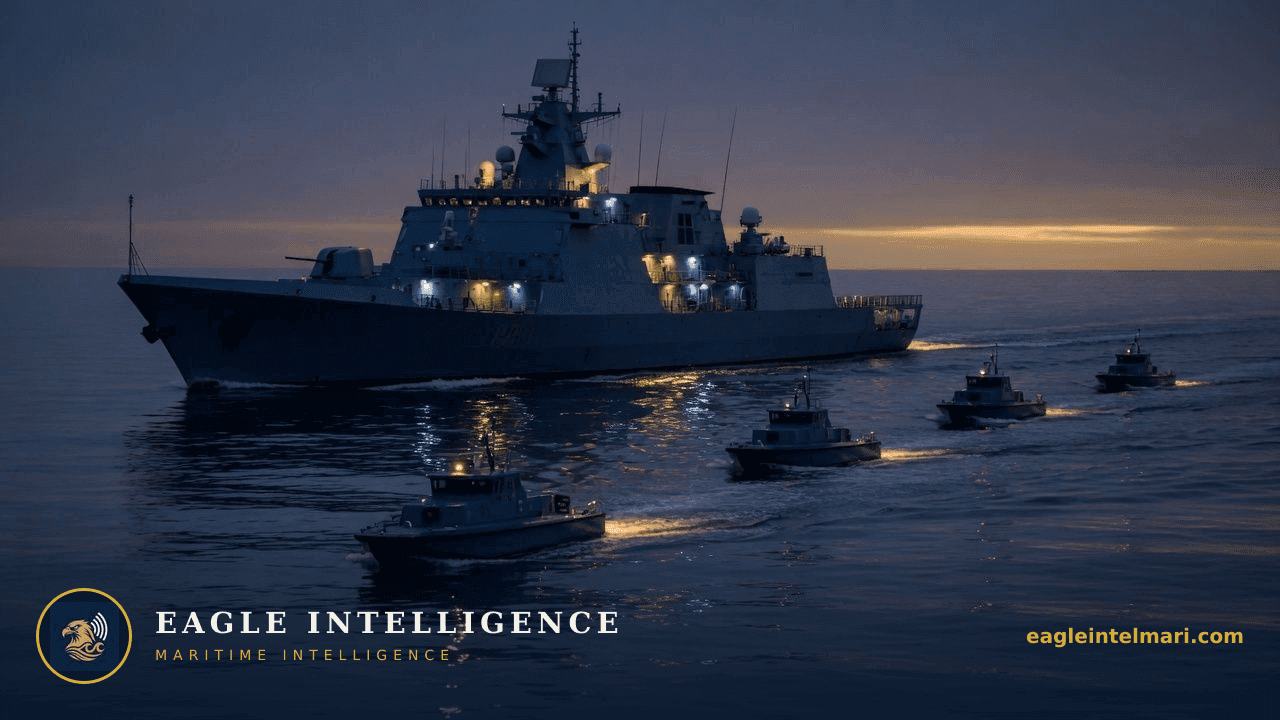
Owners and charterers routing through high-threat zones now face a UK surface fleet that will trade traditional destroyer numbers for six Common Combat Vessels optimised as motherships for uncrewed systems.
Advertisement
Advertisement
For owners fixing tonnage through the Strait of Hormuz or the Bab el-Mandeb, Britain’s decision to abandon a direct Type 45 replacement and instead order at least six Common Combat Vessels rewrites the availability of crewed escorts that insurers still price into war-risk cover.
The Royal Navy currently operates six Type 45 destroyers whose Sea Viper air-defence systems have been stretched by Houthi drone and missile salvos since late 2023. Rather than build another six large, crew-heavy destroyers, the Ministry of Defence has redirected funds toward smaller Common Combat Vessels that function primarily as command nodes for swarms of uncrewed surface and subsurface craft. Internal planning documents indicate each new hull will embark roughly 40 percent fewer sailors than a Type 45 while controlling up to eight remote platforms simultaneously.
NATO’s Operation Sea Guardian and the US-led coalition in the Red Sea have relied on UK destroyers for high-value transits. With the new vessels optimised for stand-off drone operations, the number of hulls physically able to close and escort a laden tanker may fall by two or three at any given time. Charterers who have grown accustomed to requesting a Type 45 within 48 hours of a threat spike will instead receive a mixed package that includes uncrewed surface vessels whose rules of engagement against small boat swarms remain untested at scale.
Hull war-risk underwriters at Lloyd’s have already begun modelling a two-tier rating structure: lower additional premiums for convoys accompanied by a conventional destroyer, higher loadings where only drone-enabled escorts are available. Early indications suggest an extra $12,000–18,000 per transit for tankers if the first Common Combat Vessel enters service in 2029 with reduced close-in gunfire support. P&I clubs are watching crew contracts; owners may face higher retention bonuses for masters willing to operate near drone motherships whose own defensive armament is still classified.
The smaller crew complement on the new vessels will reduce overall RN billets, yet the remaining sailors will require new qualifications in drone mission planning. Manning agencies supplying officers to UK-flagged or NATO-chartered auxiliaries are already fielding queries about cross-training. For seafarers on commercial vessels, the change means fewer opportunities to embark armed guards coordinated directly with a destroyer’s operations room, shifting more responsibility onto private maritime security companies.
Norway and the Netherlands, both operating Type 45 derivatives, have been invited to join the Common Combat Vessel programme. A decision to co-fund would spread costs but also lock those navies into the same drone-centric doctrine. Flag states such as Liberia and Panama, whose vessels frequently request UK naval cover, may need to update guidance to masters on how to interpret drone-only escort signals and hand-off procedures.
The first concrete trigger is the 2026 Defence Command Paper update, due before Parliament rises in July, which will name the prime contractor and confirm whether the Common Combat Vessels will carry a 5-inch gun or rely entirely on directed-energy and remote weapons stations.
Advertisement
Advertisement
Indicative Additional War Risk Premium (AWRP) ranges — not a binding insurance quote.
Live 1–5 shipping war-risk level across monitored chokepoints.
⚠️ Intelligence Disclaimer: This analysis is produced by Eagle Intelligence's AI-assisted automated analysis system and is provided for informational purposes only. See our editorial standards. It is not a substitute for official maritime safety advisories from UKMTO, MSCHOA, IMO, or flag state authorities. Operational decisions should always be based on official guidance and professional judgment. Eagle Intelligence accepts no liability for any loss arising from reliance on this content.
Live chokepoint status, war-risk shifts, and the daily maritime wire, straight to your inbox. Free.
Leave a comment
All comments moderated for quality
