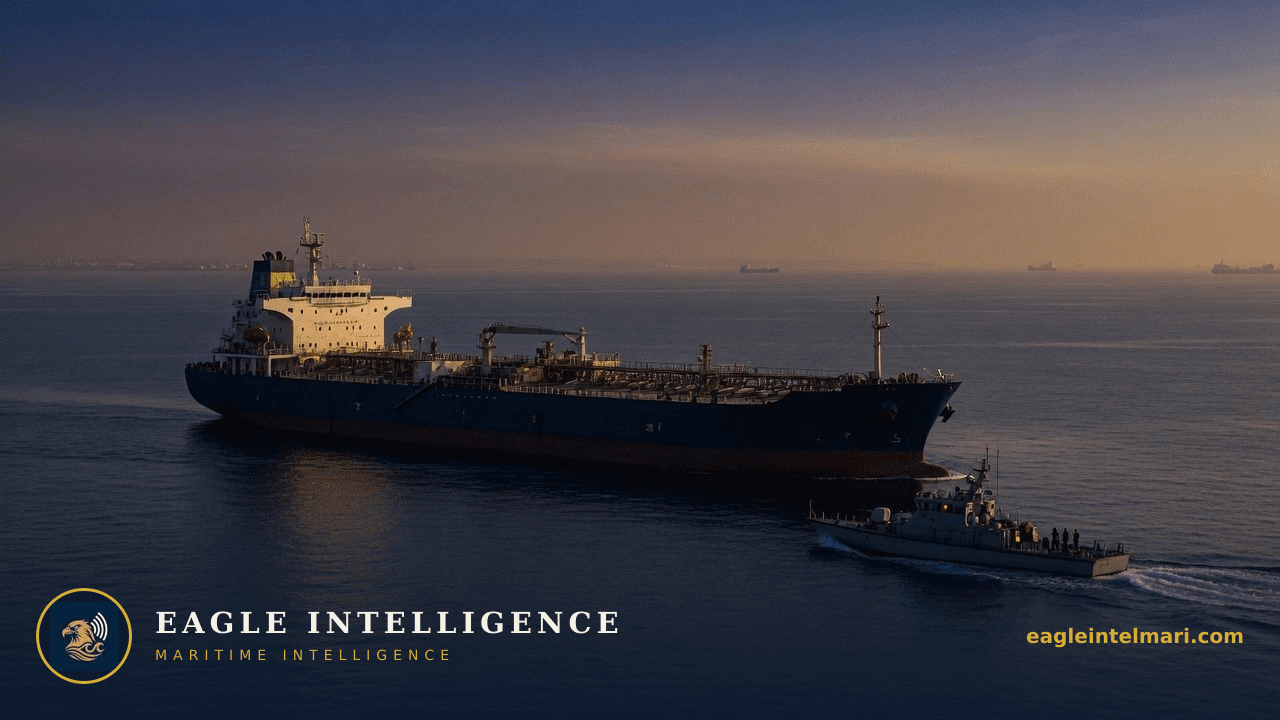
US forces have now disabled a third tanker in a week during Gulf of Oman blockade operations, with the latest incident stranding twenty Indian seafarers aboard MT Jalveer before their evacuation.
Advertisement
Advertisement
US enforcement actions in the Gulf of Oman have now disabled three tankers in rapid succession, the latest being the MT Jalveer whose entire Indian complement of twenty was removed to shore on Thursday.
The pattern of three disablements inside seven days places Indian seafarers at the centre of operational exposure. Most owners of mid-sized product and crude carriers trading the Gulf route continue to rely on Indian officers and ratings for cost and competence reasons. When a vessel is stopped by naval gunfire or boarding teams, the crew becomes the immediate humanitarian and diplomatic file. Flag states and owners must now weigh whether continuing to crew these hulls with Indian nationals increases the likelihood of rapid repatriation demands or protracted consular involvement.
Shore authorities in Oman and the UAE absorbed the Jalveer complement without reported incident, yet three such events inside a week test reception capacity. Medical checks, temporary accommodation, flight bookings and wage settlements all fall on the receiving port and the seafarers’ welfare organisations. When multiple crews arrive simultaneously, the administrative load shifts from routine to surge. Ports that normally handle one or two distressed vessels per quarter are being asked to process three in days, raising the prospect of delays in crew changeovers and increased hotel and medical costs passed to P&I clubs.
Voyage and time-charter parties written before the current enforcement wave contain standard war-risk and blockade clauses, yet few anticipate three successive disablements. Charterers are already querying whether the vessels remain on-hire once naval forces have taken control. Owners argue force majeure; charterers counter that the trade was known to be sensitive. The result is a growing stack of off-hire disputes that will reach arbitration months after the vessels themselves are released or sold.
Hull and P&I underwriters have priced this trade on the assumption that single incidents are outliers. Three disablements suggest a sustained campaign rather than sporadic interdiction. War-risk premiums for Gulf of Oman transits are therefore likely to widen again within days, with additional deductibles applied to Indian-crewed tonnage. Clubs will also examine whether owners have adequate contingency plans for mass repatriation; those that do not may face coverage reservations on future claims.
The 2019 seizure of the Stena Impero and the 1980s reflagging operations during the Iran-Iraq tanker war both demonstrated that naval disablement creates prolonged crew and cargo limbo. In each case Indian and Filipino ratings became bargaining chips in diplomatic exchanges lasting weeks. Today’s operators remember those episodes when deciding whether to reroute via the Cape or accept the shorter but now higher-risk passage.
If enforcement remains limited to vessels already under sanction designation, Indian-crewed traffic may continue with only premium and routing adjustments. Should the campaign expand to any tanker whose last port call raises suspicion, a rapid exodus of Indian officers from the Gulf trade becomes probable, forcing owners to source higher-cost Filipino or Eastern European replacements. A third scenario sees Oman or the UAE impose temporary crew-change restrictions on all tankers arriving from the enforcement zone, lengthening voyage times and pushing more cargoes onto larger vessels able to carry their own armed security.
Owners, charterers and clubs now operate inside a compressed decision window measured in days rather than quarters.
Advertisement
Advertisement
Live Hormuz transit status and war-risk band.
Live 1–5 shipping war-risk level across monitored chokepoints.
⚠️ Intelligence Disclaimer: This analysis is produced by Eagle Intelligence's AI-assisted automated analysis system and is provided for informational purposes only. See our editorial standards. It is not a substitute for official maritime safety advisories from UKMTO, MSCHOA, IMO, or flag state authorities. Operational decisions should always be based on official guidance and professional judgment. Eagle Intelligence accepts no liability for any loss arising from reliance on this content.
Live chokepoint status, war-risk shifts, and the daily maritime wire, straight to your inbox. Free.
Leave a comment
All comments moderated for quality
