Britain and France are knitting together a 15-nation naval coalition to hunt and destroy mines in the Strait of Hormuz, opening with the Royal Navy’s new underwater drone system on RFA Lyme Bay.
Advertisement
Advertisement
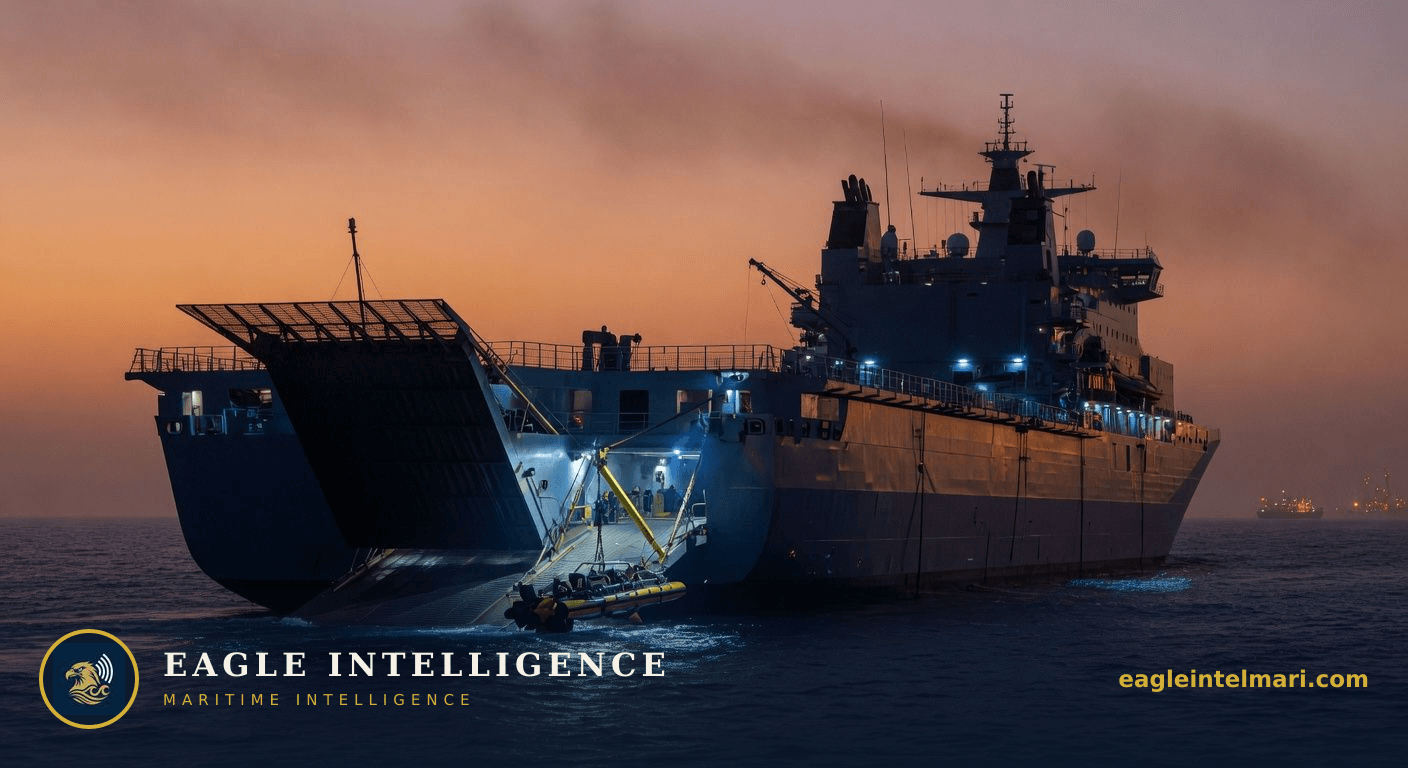
The Royal Navy’s decision to embark an advanced mine-disposal drone on RFA Lyme Bay is the first visible hardware move inside a rapidly coalescing 15-nation effort to neutralise underwater threats in the Strait of Hormuz.
RFA Lyme Bay, a Bay-class auxiliary landing ship, now carries an unmanned underwater vehicle optimised for rapid detection and neutralisation of moored and bottom mines. The system’s endurance and real-time data link allow the mothership to remain outside the most dangerous arcs while the drone conducts the initial search pattern. Early integration trials suggest clearance rates could rise by a factor of two compared with earlier REMUS-type vehicles previously used in the Gulf.
London and Paris have already secured commitments from thirteen additional partners, spanning European NATO members, Gulf Cooperation Council states and several Indo-Pacific navies. The resulting task group will operate under a standing mine-countermeasures framework rather than ad-hoc coalitions, reducing the diplomatic friction that slowed responses during the 1980s Tanker War. Command rotation and shared logistics nodes are reportedly being negotiated in Bahrain and Duqm.
Owners and charterers of very large crude carriers and product tankers must now weigh the probability of temporary channel closures against the added expense of routing around the Cape. Even a short disruption at Hormuz adds roughly 12 days and $1.8 million in fuel and hire costs for a typical VLCC voyage from Ras Tanura to Rotterdam. War-risk underwriters have already begun quoting supplemental premiums for vessels declaring Hormuz transits after 1 July.
Protection-and-indemnity clubs are circulating updated circulars that treat mine risk as an insurable peril rather than an excluded war risk in certain Hormuz approaches. Hull syndicates at Lloyd’s are modelling a 15–25 basis-point increase in annual premiums for tonnage exceeding 50,000 dwt that calls Gulf terminals more than twice per quarter. Reinsurance treaties are also being stress-tested against a scenario in which two or more laden tankers suffer mine strikes within a 30-day window.
Masters and chief officers with recent Hormuz experience are now in high demand, pushing daily master rates for VLCCs above $1,200. Several large operators have introduced hazard pay clauses that trigger automatically once a vessel enters the 12-nautical-mile territorial limit of either Oman or Iran. Crew rotation schedules are being compressed to limit cumulative exposure, raising recruitment pressure on Filipino and Indian manning agencies.
If clearance operations proceed without Iranian interference, the coalition could declare the main shipping channel mine-free by October, capping war-risk premiums and returning spot tanker rates to seasonal norms. A limited Iranian mine-laying campaign would extend operations into 2027, sustaining elevated freight levels and forcing more tonnage onto the Cape route. The most disruptive case—an overt attack on a coalition vessel—would likely trigger Article 5 consultations and a sharp spike in global energy prices until additional escort forces arrive.
Advertisement
Advertisement
Live Hormuz transit status and war-risk band.
Live 1–5 shipping war-risk level across monitored chokepoints.
⚠️ Intelligence Disclaimer: This analysis is produced by Eagle Intelligence's AI-assisted automated analysis system and is provided for informational purposes only. See our editorial standards. It is not a substitute for official maritime safety advisories from UKMTO, MSCHOA, IMO, or flag state authorities. Operational decisions should always be based on official guidance and professional judgment. Eagle Intelligence accepts no liability for any loss arising from reliance on this content.
Live chokepoint status, war-risk shifts, and the daily maritime wire, straight to your inbox. Free.
Leave a comment
All comments moderated for quality
