The June 2026 Congressional Research Service report on Taiwan's defense underscores how PRC force options could rapidly constrict one of the world's busiest maritime corridors, directly affecting energy flows, container schedules and hull values across East Asia.
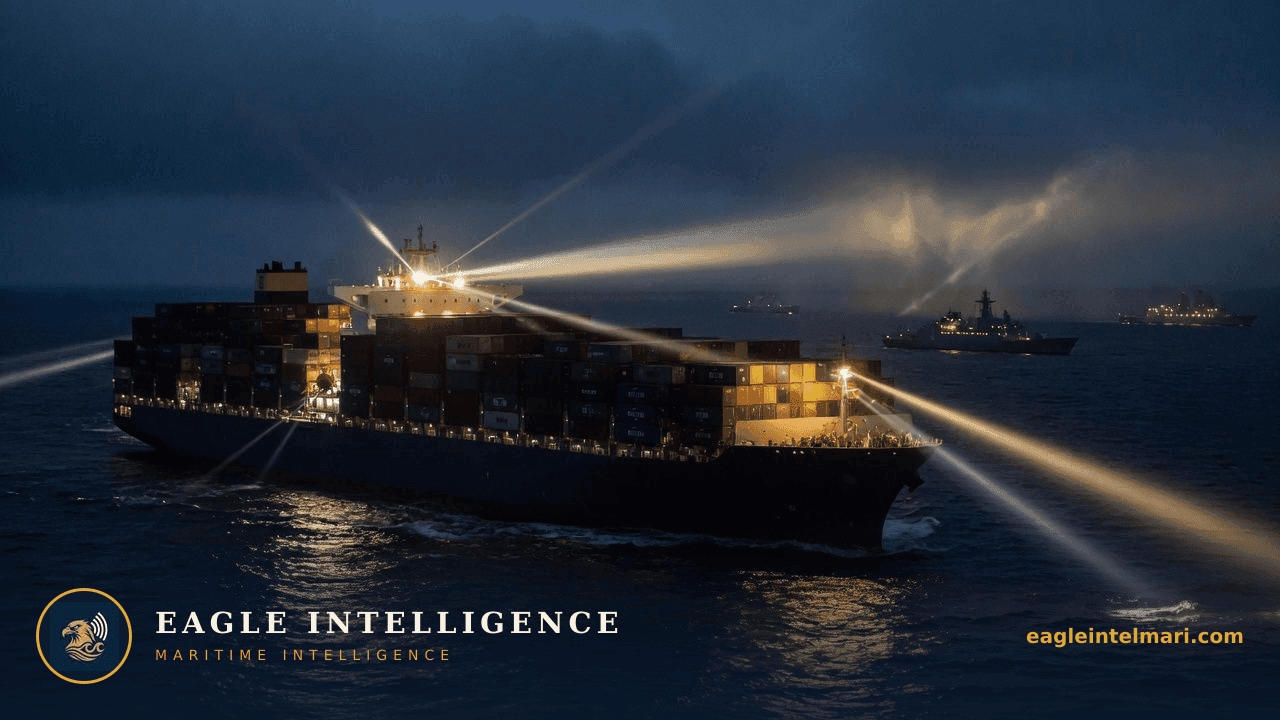
Advertisement
Advertisement
The June 2026 Congressional Research Service report on Taiwan's defense underscores how PRC force options could rapidly constrict one of the world's busiest maritime corridors, directly affecting energy flows, container schedules and hull values across East Asia.
Any PRC attempt to isolate Taiwan would first target the 90-plus daily transits through the Taiwan Strait itself. Roughly 40 percent of China's imported crude and 60 percent of its container exports to Europe and the Americas move within range of shore-based missiles and fast-attack craft. A partial quarantine lasting only two weeks would force eastbound VLCCs and container ships either into longer Pacific arcs or into congested chokepoints around the Philippines, adding 8–12 days and roughly $1.2 million in extra bunker and charter costs per 12,000-TEU vessel.
War-risk underwriters have quietly widened Taiwan Strait loadings by 25–40 basis points since March, according to broker indications. Clubs are now inserting “Taiwan approaches” clauses that exclude crew claims arising from missile or drone incidents. For a 180,000-dwt bulk carrier on a typical China-Australia round voyage, the incremental annual premium now exceeds $180,000—still modest, yet the fastest upward adjustment observed outside declared war zones since 2022.
Filipino, Indian and Chinese seafarers comprise the bulk of officers and ratings on vessels routinely using the strait. Manila and New Delhi have already circulated discreet advisories urging masters to report any unusual PRC naval activity. Panama and Liberia, which together flag nearly half the strait’s dry-bulk traffic, face the prospect of mass re-flagging requests should kinetic events begin; both registries have quietly raised their own risk surcharges for east-Asian trades.
Japanese and South Korean buyers of Australian LNG are exploring force-majeure language that treats a PRC “quarantine declaration” as an event allowing cargo diversion to Singapore or even Europe. Charterers holding period charters are already pressing owners for revised routing warranties. Should the strait close for more than ten days, spot LNG freight from the US Gulf to Northeast Asia is modeled to spike above $180,000 per day—levels last seen in the first quarter of 2023.
The most contained pathway sees continued gray-zone pressure—repeated live-fire drills and inspection demands—without kinetic strikes; strait transits slow by 15 percent but insurance markets absorb the cost. A second pathway involves a short, sharp missile campaign against Taiwanese ports followed by a negotiated stand-down; hull values for tonnage fixed into the region would drop 12–18 percent within a week. The third pathway, a sustained air-sea blockade, would reroute the majority of Japan- and Korea-bound traffic around the Philippines, lifting global container freight rates by an estimated 22 percent and triggering a fresh wave of newbuilding orders for ice-class and long-range tonnage.
US and allied surface groups already maintain a near-continuous presence in the Philippine Sea. The CRS analysis highlights that any formal escort commitment would require at least two carrier strike groups plus forward-deployed submarines—an order of magnitude larger than current Hormuz patrols. European NATO members have begun quiet conversations about contributing a single frigate rotation, primarily for presence rather than combat, yet even symbolic participation would alter war-risk calculations for commercial hulls sailing under the same formation.
Advertisement
Advertisement
Indicative Additional War Risk Premium (AWRP) ranges — not a binding insurance quote.
Live 1–5 shipping war-risk level across monitored chokepoints.
⚠️ Intelligence Disclaimer: This analysis is produced by Eagle Intelligence's AI-assisted automated analysis system and is provided for informational purposes only. See our editorial standards. It is not a substitute for official maritime safety advisories from UKMTO, MSCHOA, IMO, or flag state authorities. Operational decisions should always be based on official guidance and professional judgment. Eagle Intelligence accepts no liability for any loss arising from reliance on this content.
Live chokepoint status, war-risk shifts, and the daily maritime wire, straight to your inbox. Free.
Leave a comment
All comments moderated for quality
