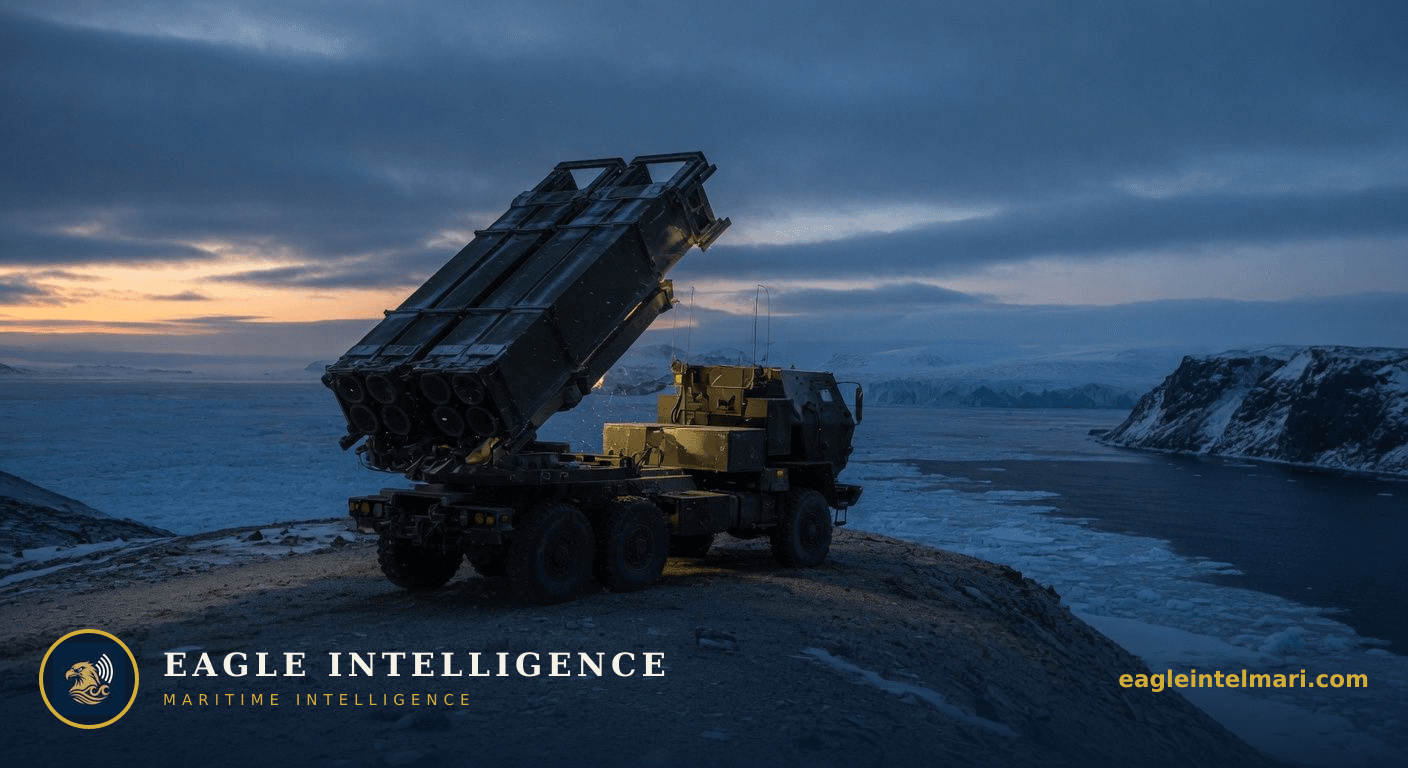
Ottawa’s $1.8 billion purchase of 26 HIMARS launchers with long-range anti-ship munitions will extend Canadian coastal denial out to 300 km, forcing shipowners and insurers to recalculate exposure along the Northwest Passage and Atlantic approaches.
Advertisement
Advertisement
Canada’s acquisition of 26 M142 HIMARS launchers equipped with missiles exceeding 300 km range marks the first time the Canadian Army will hold a credible, mobile anti-ship capability, directly tying ground forces to the defense of sea lanes in the Arctic and North Atlantic.
The systems are explicitly intended to support operations in “global security situations,” with first deliveries expected in 2029. For vessels using the Northwest Passage, this introduces a new layer of state-controlled fires that can reach well beyond visual range from shore. Operators of bulk carriers and LNG tankers will face revised routing decisions during the brief summer ice-free periods, particularly around choke points such as the McClure Strait and Lancaster Sound. P&I clubs are already modeling premium surcharges for hulls transiting above 60° N once the batteries reach initial operational capability.
Canadian ports from Halifax to Vancouver may see increased demand for naval escort or convoy coordination when foreign-flagged vessels call. Flag states that have historically avoided Canadian waters during periods of tension—Russian, Chinese, and some Indian owners—will now weigh the risk of being tracked by mobile launchers that can relocate faster than fixed coastal batteries. This dynamic favors registries perceived as aligned with NATO, tightening the market for neutral tonnage on grain and energy routes that touch Canadian terminals.
Hull underwriters have begun referencing the 300 km envelope in war-risk clauses. The precedent is Norway’s 2023 coastal missile deployments, which produced measurable increases in kidnap-and-ransom and war-risk premiums for vessels within 250 km of the Norwegian coast. Canadian coverage is likely to follow a similar pattern, with London syndicates expected to issue updated circulars by late 2027 once the first training batteries arrive. Owners who maintain hull values above $80 million on Arctic routes are already exploring political-risk extensions.
Finland’s decision to integrate M270 and HIMARS systems with anti-ship munitions after 2014 offers the clearest parallel. Within three years of fielding, Helsinki reported a measurable drop in Russian naval incursions within Finnish exclusive economic waters. Canada’s geography is more expansive, yet the same logic applies: mobile, long-range fires raise the cost of any gray-zone naval presence. Energy traders should therefore treat the Canadian Arctic as a higher-friction zone for shadow-fleet tankers after 2030.
If NATO-Russia friction remains at current levels, the HIMARS batteries will function primarily as a deterrent, producing only modest insurance uplifts and occasional routing adjustments. A second scenario sees U.S.-China tensions spill into the Arctic; in that case Ottawa could forward-deploy two or three launchers to the western Arctic islands, compressing viable transit windows to roughly six weeks per year. The third path—rapid Canadian Arctic militarization triggered by a single high-profile incident—would likely accelerate full operational capability to 2028 and prompt allied navies to request access to Canadian firing ranges, further complicating commercial schedules.
Shipowners and charterers should begin scenario planning now, treating the 2029 delivery date as the firm trigger for revised voyage contracts and war-risk declarations.
Advertisement
Advertisement
Live 1–5 shipping war-risk level across monitored chokepoints.
⚠️ Intelligence Disclaimer: This analysis is produced by Eagle Intelligence's AI-assisted automated analysis system and is provided for informational purposes only. See our editorial standards. It is not a substitute for official maritime safety advisories from UKMTO, MSCHOA, IMO, or flag state authorities. Operational decisions should always be based on official guidance and professional judgment. Eagle Intelligence accepts no liability for any loss arising from reliance on this content.
Live chokepoint status, war-risk shifts, and the daily maritime wire, straight to your inbox. Free.
Leave a comment
All comments moderated for quality
