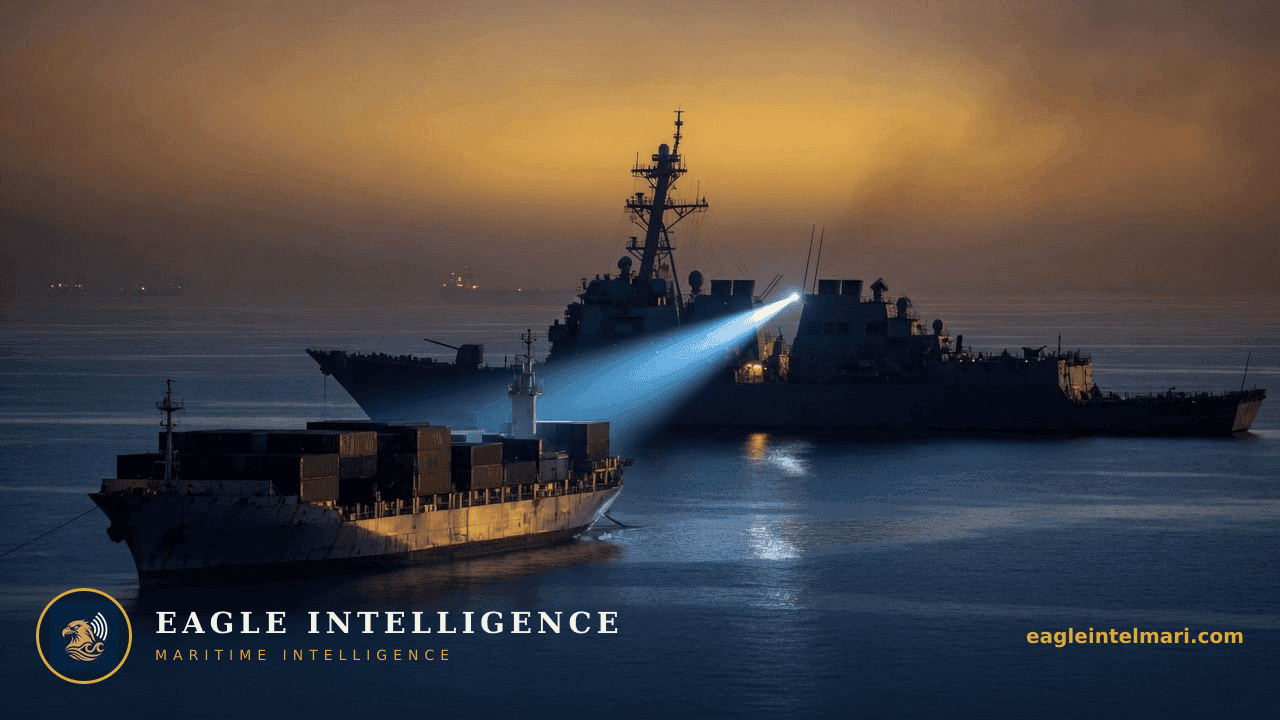
The naval cordon around Iranian ports remains active through Friday despite a Saturday agreement between Washington and Tehran, forcing all inbound commercial traffic to submit to U.S. Navy direction or risk enforcement action.
Advertisement
Advertisement
The U.S. naval blockade of Iranian ports persists until formal signatures close the hostilities agreement on Friday, leaving commercial operators navigating a narrow and closely policed window in the Persian Gulf.
The Joint Maritime Information Center advisory makes clear that vessels attempting Iranian port calls are required to follow explicit orders from U.S. naval units. Non-compliance risks escalation during enforcement actions, with the explicit warning that crews could be endangered by any failure to obey safety and security instructions. Masters now operate under a de-facto requirement to maintain open VHF channels, reduce speed on demand, and accept boarding teams if directed.
Any shipowner or charterer still planning calls to Bandar Abbas, Bushehr or other Iranian terminals must weigh the cost of prolonged loitering outside the blockade line against the risk of proceeding. With only four days until the scheduled signing, most operators are expected to divert cargoes to Fujairah, Jebel Ali or other regional hubs rather than test enforcement. This sudden shift concentrates tonnage in a handful of alternative ports and will compress berthing windows and raise local congestion fees.
War-risk underwriters have already widened premiums for the Strait of Hormuz and Iranian approaches; the four-day extension keeps those elevated rates in force. P&I clubs face the additional question of whether club cover remains intact for vessels that ignore U.S. Navy instructions and sustain damage during enforcement. Most clubs have historically reserved the right to decline claims arising from willful breach of lawful naval orders, creating a direct financial incentive for compliance even when charterers press for Iranian discharge.
The JMIC release singles out crew safety, underscoring that masters must not endanger personnel by resisting blockade procedures. Ratings and officers on vessels already committed to Iranian destinations now confront the practical reality of possible armed boardings, extended anchoring under naval observation, or last-minute diversion. Fatigue management and mental-health protocols become immediate concerns for companies whose crews have already been on heightened alert for weeks.
The current posture echoes the U.S. Navy’s 1987-1988 reflagging and escort operations during the Iran-Iraq conflict, when commercial traffic was likewise funneled through designated corridors under naval supervision. Then, as now, the decisive variable was not the existence of an agreement in principle but the moment formal signatures removed the legal basis for interdiction. Operators who misread that distinction in the 1980s incurred avoidable delays and insurance disputes.
If signatures occur on schedule, the blockade lifts at midnight Friday and traffic reverts to normal routing within 48 hours, though war-risk premiums will decay only gradually. A one- or two-day postponement would keep the cordon intact and force further cargo diversions, with spot tanker rates for clean products rising sharply on the back of canceled Iranian calls. A breakdown in the final text or last-minute Iranian objections would extend the blockade indefinitely, pushing charterers toward longer-haul alternatives and accelerating the use of ship-to-ship transfers outside the Strait of Hormuz.
Advertisement
Advertisement
Live Hormuz transit status and war-risk band.
Live 1–5 shipping war-risk level across monitored chokepoints.
⚠️ Intelligence Disclaimer: This analysis is produced by Eagle Intelligence's AI-assisted automated analysis system and is provided for informational purposes only. See our editorial standards. It is not a substitute for official maritime safety advisories from UKMTO, MSCHOA, IMO, or flag state authorities. Operational decisions should always be based on official guidance and professional judgment. Eagle Intelligence accepts no liability for any loss arising from reliance on this content.
Live chokepoint status, war-risk shifts, and the daily maritime wire, straight to your inbox. Free.
Leave a comment
All comments moderated for quality
