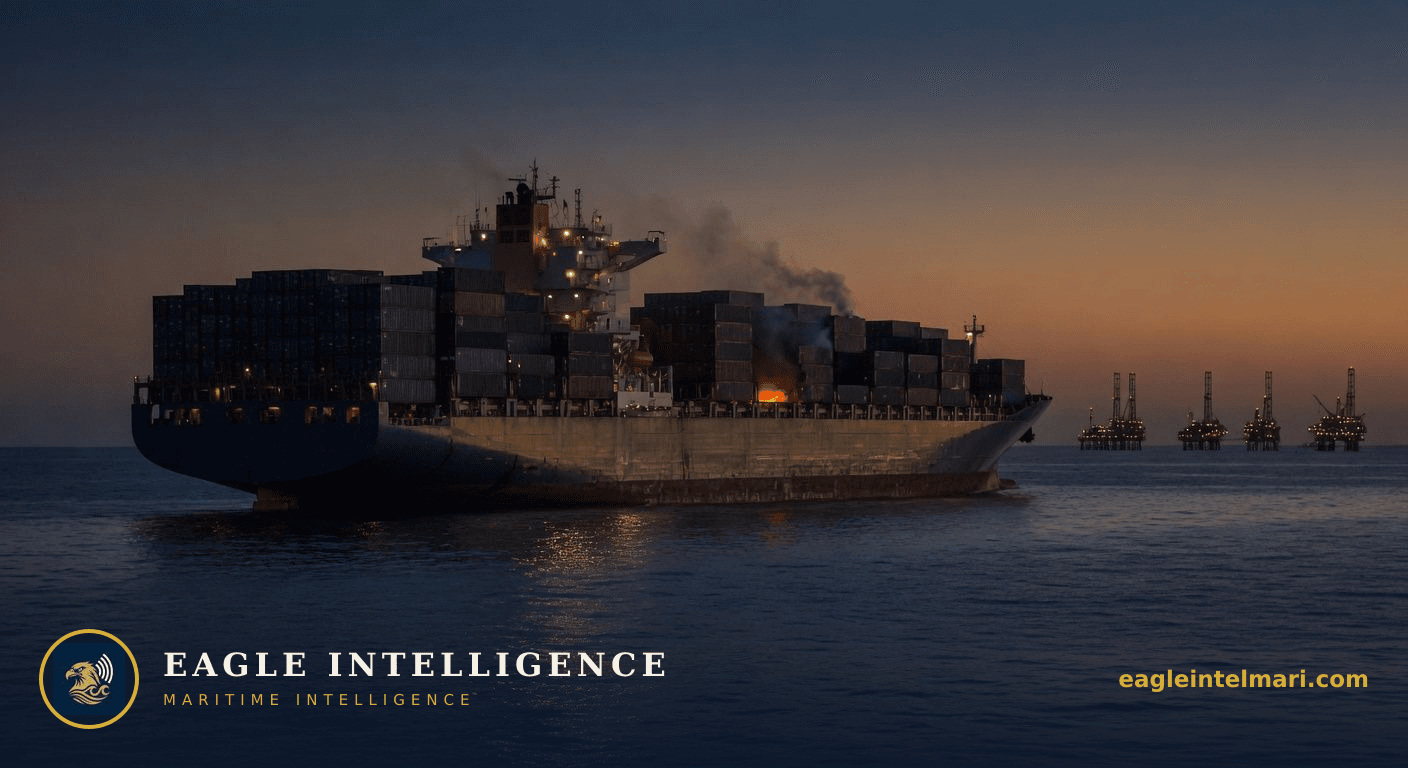
A Panama-flagged MSC containership damaged off Iraq marks the third reported attack in the northern Gulf since the U.S.-Iran conflict began in late February, extending the risk zone well beyond the Strait of Hormuz.
Advertisement
Advertisement
A Panama-flagged MSC containership has sustained damage in the latest apparent attack off Iraq, the third such incident recorded in the northern Gulf since the U.S.-Iran conflict erupted in late February. The strike pushes the maritime front line closer to major Iraqi terminals and forces owners and charterers to recalculate exposure on one of the world’s busiest container corridors.
The location off Iraq places the incident farther north than the tanker and bulk-carrier targets reported earlier this year. Container vessels, with their fixed schedules and high-value reefer and electronics cargoes, present a different risk profile from the crude and product carriers hit previously. Each successive attack has edged closer to the approaches of Umm Qasr and Khor al-Zubair, Iraq’s primary commercial outlets.
Operators now weigh the cost of longer transits via alternative calls in Kuwait or even the UAE against the exposure of maintaining direct Iraq rotations. With vessel values and replacement times already stretched by Red Sea diversions, any sustained threat in the northern Gulf quickly multiplies slot cancellations and blank sailings. Charterers holding COAs with Iraqi oil and petrochemical exporters face the first concrete decisions on force-majeure clauses.
Hull and P&I underwriters have already begun quoting additional northern-Gulf loadings on a case-by-case basis. The pattern of three incidents in roughly three months suggests a low but persistent tempo rather than a single spike, which historically leads to step-wise premium increases rather than outright exclusions. Panama-flagged tonnage is likely to feel the first tightening because the flag has carried a disproportionate share of the affected vessels.
Crew unions are monitoring fatigue and morale on vessels still trading into the area. Many seafarers signed contracts before the February escalation; refusal-to-sail clauses are now being tested in real time. Owners reliant on Filipino and Indian ratings report rising requests for hazard pay and shortened tour lengths, adding another layer of cost to an already expensive routing problem.
Any measurable drop in containership calls will immediately affect time-sensitive reefer exports of Iraqi dates, dairy and pharmaceuticals while also complicating the import of project cargo needed for reconstruction. Neighboring ports in Kuwait and southern Iran stand to gain short-term transshipment volumes, yet they too face capacity and insurance constraints if attacks continue.
If incidents remain isolated and low-casualty, markets will absorb the risk through higher but manageable premiums and selective slow-steaming. A single high-profile sinking or crew fatality would likely trigger broader exclusions and force the handful of remaining direct Iraq services into full suspension. Sustained Iranian or proxy signaling without outright closure of the waterway could produce a hybrid outcome: most lines divert while a small number of risk-tolerant operators stay in for premium rates, creating a two-tier market similar to the early months of the Yemen-related Red Sea crisis.
Advertisement
Advertisement
Live Hormuz transit status and war-risk band.
Live 1–5 shipping war-risk level across monitored chokepoints.
⚠️ Intelligence Disclaimer: This analysis is produced by Eagle Intelligence's AI-assisted automated analysis system and is provided for informational purposes only. See our editorial standards. It is not a substitute for official maritime safety advisories from UKMTO, MSCHOA, IMO, or flag state authorities. Operational decisions should always be based on official guidance and professional judgment. Eagle Intelligence accepts no liability for any loss arising from reliance on this content.
Live chokepoint status, war-risk shifts, and the daily maritime wire, straight to your inbox. Free.
Leave a comment
All comments moderated for quality
