
War Risk
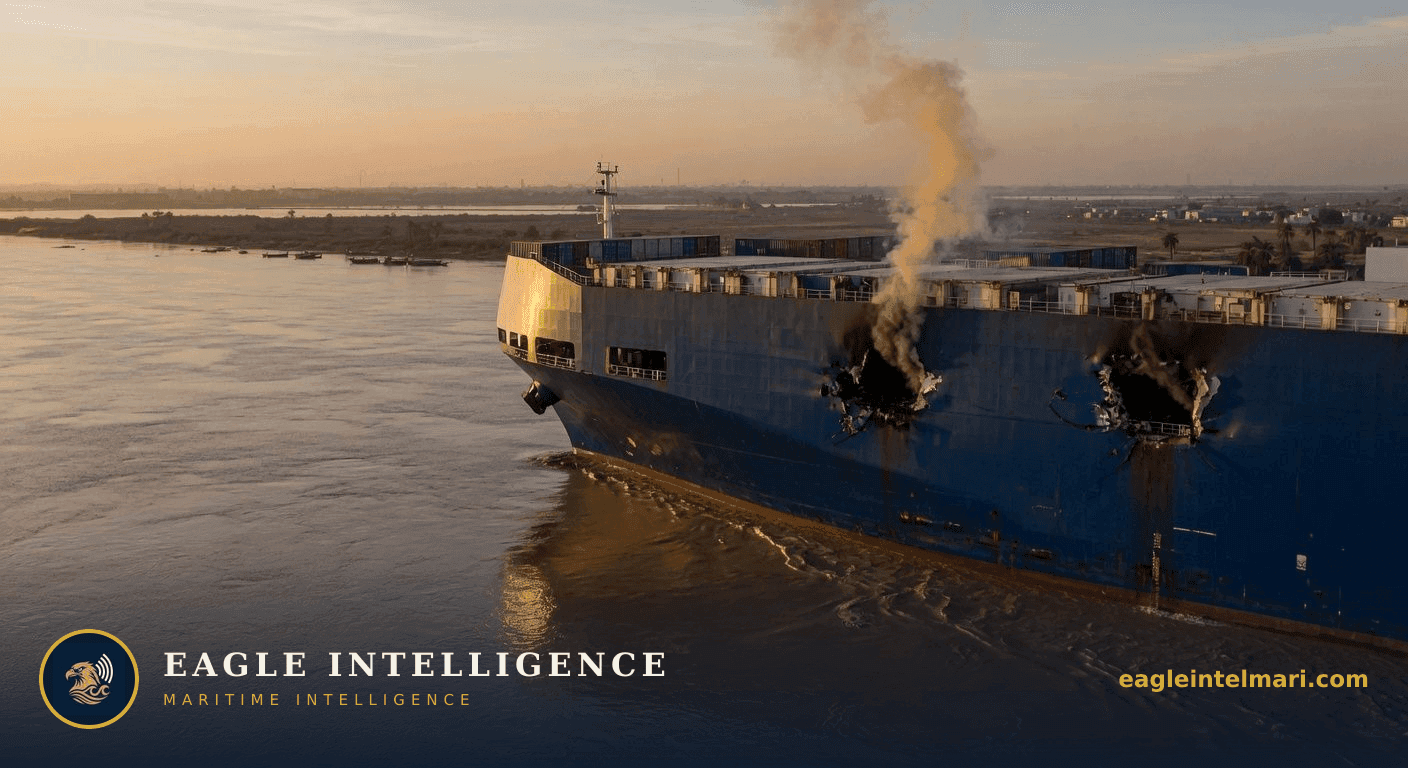
MSC Sariska V Takes Two Projectiles on Exit from Umm Qasr
A confirmed double strike on MSC’s containership as it left Iraq’s only deep-water port has reopened war-risk calculations for the northern Gulf and exposed how quickly a single incident can ripple through hull, cargo and crew cover.
Eagle IntelligenceDrafted by the Eagle desk system; no individual review recordedRecorded urgency at publication: High. Not a live alert.
Advertisement
Advertisement
Mediterranean Shipping Company’s confirmation that its 4,500-TEU Sariska V was hit twice by projectiles while clearing the Shatt al-Arab channel on 31 May has shifted the threat horizon from the Red Sea to the head of the Gulf faster than most carriers had modelled.
Double Impact Exposes Umm Qasr’s Narrow Exit
The vessel was outbound from Iraq’s sole deep-draft container terminal when the first projectile struck the port quarter and the second impacted higher on the accommodation block. MSC reported no fatalities and limited water ingress, yet the ship diverted to a regional anchorage for damage assessment. The geometry of the hits—both on the same side during a high-speed departure—suggests either a coordinated drone salvo or shore-based rocket fire timed to the vessel’s transit of the buoyed channel.
Insurance Markets Price the New Reality
Hull underwriters who had kept northern-Gulf additional premiums at 0.15–0.25 percent of insured value are already circulating indications that the rate will double for any call at Umm Qasr or Khor al-Zubair within 30 days. P&I clubs are reviewing whether the incident triggers the “weapons of war” exclusion clauses in crew contracts, a step that would immediately affect retention bonuses and war-zone allowances for officers and ratings on vessels still scheduled for Basra calls.
Cargo and Charter Ripple Effects
With roughly 28 percent of MSC’s Asia–Europe capacity already routing around the Cape, the Sariska V incident adds pressure on remaining Gulf services. Charterers holding COAs for Iraqi crude and petrochemical parcels are now weighing whether to declare force majeure or absorb the surcharge. Spot container rates from Jebel Ali to northern Europe rose $180 per FEU in the first 24 hours after the news, the sharpest single-day move since the initial Houthi attacks of late 2023.
Crew Welfare and Seafarer Sentiment
Seafarer unions have already flagged the incident in circulars to members, noting that many Filipino and Indian ratings on third-party tonnage serving Iraq have no contractual war-risk cover beyond the 12-mile limit. The psychological effect is immediate: several crewing agencies report a spike in refusals for Gulf voyages, echoing the pattern seen after the 2019 tanker attacks in the Strait of Hormuz.
Flag and Port-State Calculus
Iraq’s maritime authority has yet to issue a navigation warning, but the incident is certain to feature in the next IMO Maritime Safety Committee session. Panama and Liberia, the two largest flags on vessels calling Umm Qasr, are quietly urging owners to adopt night-time transits only, a measure that reduces exposure to shore-based observers but increases collision risk in the narrow channel.
Three Plausible Paths Through Q3
A contained outcome would see Baghdad secure Iranian or U.S. guarantees of channel security, returning additional premiums to pre-incident levels by mid-August. A second strike on another vessel would likely trigger a temporary suspension of liner calls, forcing cargo onto trucks across the Iraqi–Jordanian border and adding 12–15 days of transit. The most severe scenario—an escalation that closes the Shatt al-Arab to commercial traffic for more than ten days—would reroute an estimated 180,000 barrels per day of Iraqi crude onto longer-haul VLCCs from Mina al-Ahmadi, tightening the VLCC spot market and pushing war-risk rates above 1 percent for any northern-Gulf loading.
Advertisement
Advertisement