A World Cup screening drawing hundreds near Sidon’s gates amid active Israeli strikes on Lebanon illustrates uneven disruption to civilian port areas, keeping war-risk surcharges elevated for any vessel still willing to call Lebanese terminals.
Advertisement
Advertisement
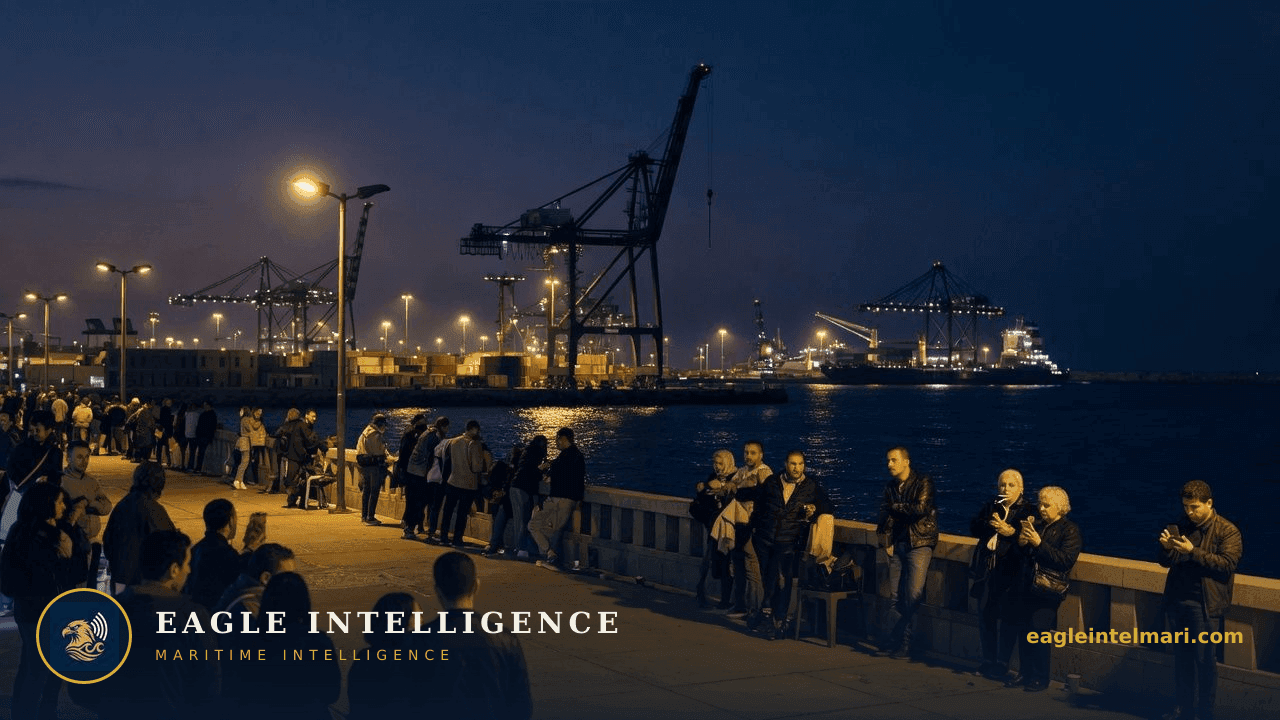
Hundreds of spectators gathered in Rmeileh this weekend to watch the 2026 World Cup, an event staged within sight of Sidon’s historic gate while Israeli operations continued inland. The scene offers a narrow but telling data point on how conflict is rippling through Lebanon’s southern coastal strip and the shipping lanes that serve it.
Sidon’s small commercial quay and adjacent fuel terminal have handled sporadic calls since the latest escalation began. The open-air screening site lies less than two kilometres from the harbour, suggesting that local authorities still judge the immediate waterfront secure enough for public assembly after dark. For charterers, this translates to a narrow window: daylight tanker or container calls remain feasible, yet any overnight crew rotation or bunkering operation carries elevated exposure to rocket or drone strike.
Hull and P&I underwriters have already widened the additional premium zone to include all Lebanese ports south of Beirut. The Rmeileh footage will not reverse that decision. Instead, it supplies fresh imagery for risk committees to argue that surface-level normality coexists with persistent overhead threat. Expect the next renewal cycle to embed a standing 0.35–0.50 percent of hull value surcharge for any voyage that lists Sidon or Tyre, regardless of actual berth occupancy.
Seafarers on vessels that still discharge at Sidon face contradictory signals. Local restaurants and cafés reopened for the match, yet the same streets remain subject to intermittent Israeli drone overflights. Flag states and crewing agents are therefore tightening guidance: shore leave is restricted to essential medical or consular needs, and vessels are advised to maintain armed guard or at least heightened bridge watches while alongside. The psychological strain on mixed-nationality crews calling a conflict zone for routine cargo is rising faster than the published advisories acknowledge.
During the 2006 war, Beirut port closed for seventeen days and war-risk rates briefly exceeded 1 percent of hull value. Today’s conflict has produced no comparable blanket closure, partly because strikes have focused on Hezbollah infrastructure rather than port infrastructure itself. The Rmeileh event reinforces that pattern: civilian life persists within a narrow geographic band, yet the threat envelope remains wide enough to deter most commercial traffic from lingering.
If Israeli operations shift decisively north of the Litani within thirty days, Sidon calls could resume at near-normal volumes and war-risk loadings would ease by half. Should Hezbollah retaliate with sustained anti-shipping missiles or drone swarms against coastal targets, every Lebanese port south of Beirut would face effective closure and freight rates on alternative eastern Mediterranean routes would spike. A third, muddled scenario sees episodic low-level strikes continuing through summer; owners would then maintain the current premium structure while quietly diverting discretionary cargoes to Tripoli or Mersin, lengthening average voyage times by three to five days.
Lebanon imports roughly 80 percent of its refined products through Sidon and Beirut. Any sustained drop in port reliability forces spot cargoes onto longer hauls from Greece or Italy, tightening clean-product tonnage in the eastern Mediterranean and supporting a modest uptick in time-charter equivalents. The World Cup screening, while trivial in tonnage terms, signals that local demand for fuel has not collapsed; traders will therefore continue to test the market with small-parcel deliveries rather than abandoning the route entirely.
Advertisement
Advertisement
Indicative Additional War Risk Premium (AWRP) ranges — not a binding insurance quote.
Live 1–5 shipping war-risk level across monitored chokepoints.
⚠️ Intelligence Disclaimer: This analysis is produced by Eagle Intelligence's AI-assisted automated analysis system and is provided for informational purposes only. See our editorial standards. It is not a substitute for official maritime safety advisories from UKMTO, MSCHOA, IMO, or flag state authorities. Operational decisions should always be based on official guidance and professional judgment. Eagle Intelligence accepts no liability for any loss arising from reliance on this content.
Live chokepoint status, war-risk shifts, and the daily maritime wire, straight to your inbox. Free.
Leave a comment
All comments moderated for quality
