Owners and charterers running dry-bulk tonnage toward India must now weigh the reliability of Indian Navy response times against the renewed skiff threat in the western Gulf of Aden after the July 1 attack on Saint Vincent-flagged Golden Arsenal.
Advertisement
Advertisement
Owners and charterers running dry-bulk tonnage toward India must now weigh the reliability of Indian Navy response times against the renewed skiff threat in the western Gulf of Aden after the July 1 attack on Saint Vincent-flagged Golden Arsenal.
Golden Arsenal was 300 nautical miles northeast of Djibouti when the skiff closed in on the afternoon of 1 July. That distance places the vessel well inside the historical high-risk corridor yet still outside the typical patrol density maintained by Combined Maritime Forces. Bulk carriers on the India-bound leg from the Red Sea therefore remain exposed for six to eight hours between the Bab el-Mandeb exit and the point where Indian surface units can reliably intervene.
The crew activated anti-piracy measures, transmitted a distress call, and secured themselves inside the citadel. The boarding attempt still inflicted superstructure damage before the suspects withdrew. Repair bills for even superficial hull and deck-house work on a 20-year-old bulk carrier can reach six figures; when added to the loss of two steaming days while INS Trikand and its MARCOS team completed the search, the incident converts a routine voyage into a measurable earnings hit for both owner and charterer.
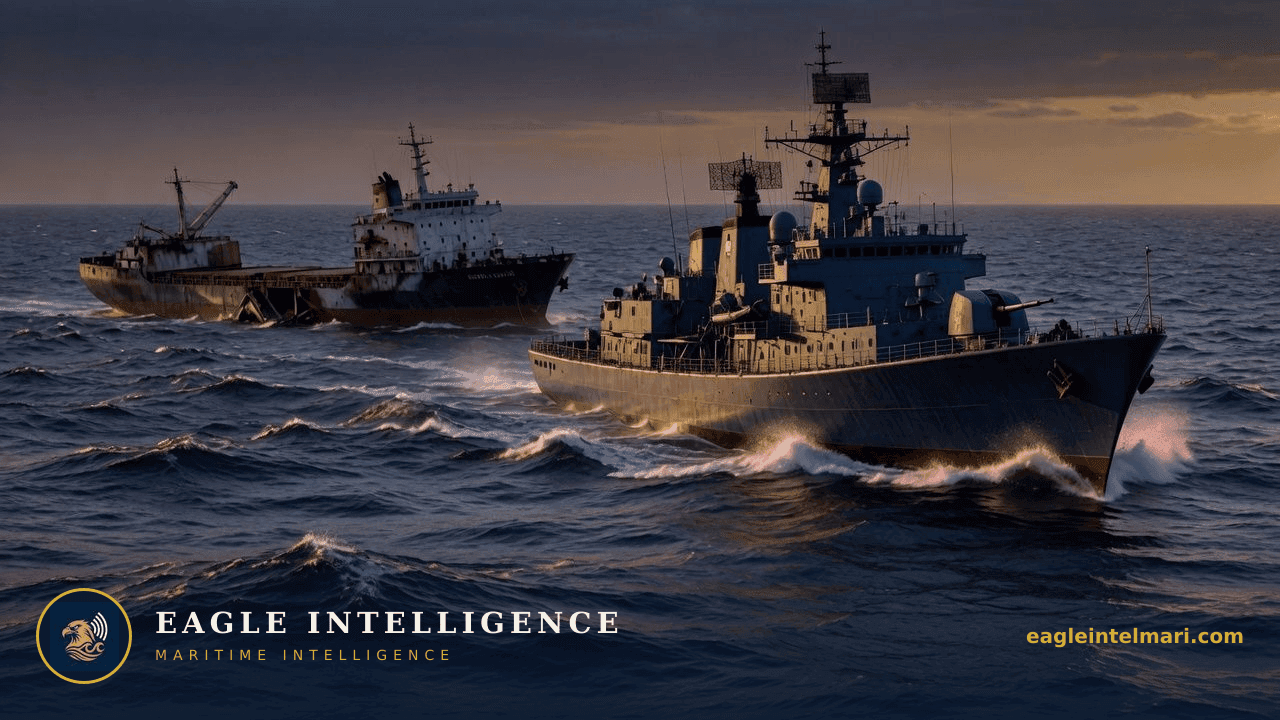
The Talwar-class frigate arrived on scene the following day and cleared the vessel compartment by compartment. This marks the third publicized Indian Navy intervention in the Gulf of Aden since May. For owners whose vessels fly flags without organic naval presence, the Indian response window—roughly 18 to 24 hours from distress call—has become a de-facto planning factor. Manning agencies rotating Indian or Filipino crews through the same corridor now treat INS Trikand’s availability as a partial but imperfect substitute for armed guards.
Registered in Saint Vincent and the Grenadines, Golden Arsenal sits outside the premium war-risk zones most London syndicates apply to the area. Nevertheless, the incident will prompt hull underwriters to review recent loss experience on similar tonnage. A single boarding attempt that leaves physical damage is enough to trigger a deductible claim and can push the next renewal quote upward by several thousand dollars per vessel. Charterers fixing India cargoes will watch whether P&I clubs begin requiring enhanced citadel drills or armed security as a condition of cover.
The 21 crew members are safe and the ship resumed its passage to Tuticorin. That continuity matters for the coal and grain parcels already priced into July–August fixtures. Any perception that Aden transits are becoming more hazardous, however, adds a risk premium that is quickly capitalized into the Capesize and Panamax spot market. Charterers with flexible routing options may divert tonnage via the Cape or press for lower freight rates on Aden-exposed legs, widening the spread between Red Sea and Cape voyages.
Track daily positions of INS Trikand and any accompanying Indian destroyers through open-source AIS and EUNAVFOR updates. A second boarding attempt within 200 nautical miles of Djibouti before the end of July would likely force a broader re-evaluation of whether armed security teams become standard again on the India run.
Advertisement
Advertisement
Live 1–5 shipping war-risk level across monitored chokepoints.
⚠️ Intelligence Disclaimer: This analysis is produced by Eagle Intelligence's AI-assisted automated analysis system and is provided for informational purposes only. See our editorial standards. It is not a substitute for official maritime safety advisories from UKMTO, MSCHOA, IMO, or flag state authorities. Operational decisions should always be based on official guidance and professional judgment. Eagle Intelligence accepts no liability for any loss arising from reliance on this content.
Live chokepoint status, war-risk shifts, and the daily maritime wire, straight to your inbox. Free.
Leave a comment
All comments moderated for quality
