The House Armed Services Committee has directed the Army to evaluate dedicated unmanned surface vessels to shield its logistics watercraft from asymmetric threats and enemy fires, a move that could accelerate the militarization of USV technology across both military and commercial maritime domains.
Advertisement
Advertisement
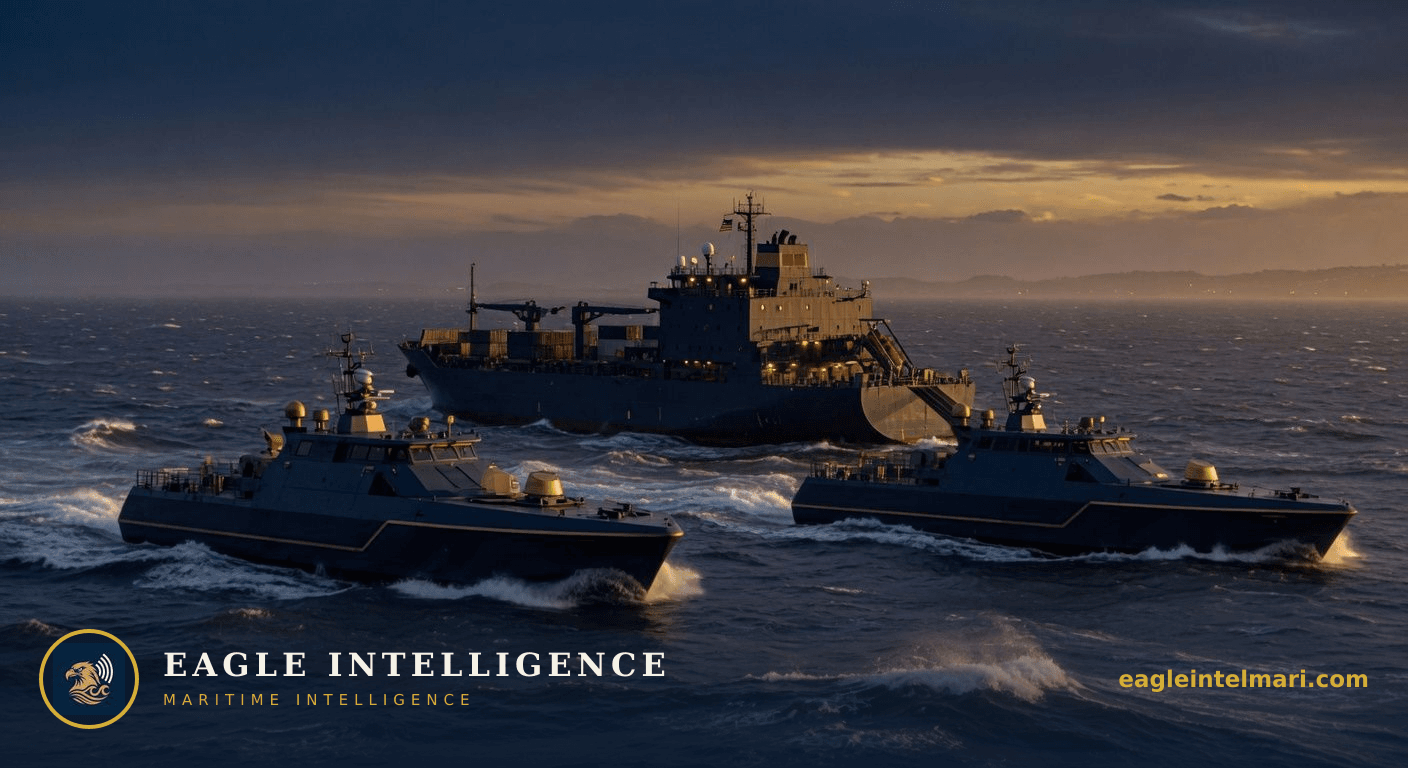
The House Armed Services Committee’s mark for the Fiscal Year 2027 defense bill instructs the Army to study unmanned surface vessels as escorts for its manned watercraft, citing insufficient organic defenses against drones, asymmetric attacks and precision fires during contested logistics operations.
Army watercraft, including the Maneuver Support Vessel (Light) and Logistics Support Vessel fleets, routinely operate inside the same confined waters where commercial tankers and container ships already confront Houthi-style drone and missile strikes. The committee’s language highlights that these vessels lack the layered air and surface defenses carried by Navy ships, leaving them exposed once an adversary achieves local unmanned superiority. A single successful swarm attack on an Army vessel carrying fuel or ammunition could halt an entire brigade deployment for weeks.
Current Army and Navy unmanned programs focus on intelligence, surveillance and strike missions. The new recommendation calls for purpose-built escort USVs whose primary role is force protection—sacrificial screening, decoy operations and close-in kinetic or electronic defeat of incoming threats. This distinction matters because escort duties require persistent station-keeping, rapid reaction times and integration with the protected vessel’s combat system rather than long-endurance ISR orbits.
Insurers tracking the same threat environment will watch whether the Army’s USV specification migrates to commercial hull and war-risk policies. A proven, low-cost unmanned escort package could lower premiums for vessels transiting the Red Sea or South China Sea, but only if classification societies certify the systems and rules of engagement are clarified. Conversely, early adoption by the military may drive up demand and prices for the same hull forms and sensors sought by commercial operators seeking self-protection.
The requirement mirrors the 1942–43 shift when the U.S. Army and Navy rushed small craft into Atlantic convoy duty after U-boat wolf packs exposed the vulnerability of unescorted merchantmen. Today’s version replaces corvettes with attritable USVs, yet the core problem—protecting slow, high-value logistics assets inside an adversary’s engagement envelope—remains unchanged. The speed at which the Army can field such escorts will determine whether history repeats itself in a future Taiwan or Baltic scenario.
If the Army moves quickly and secures supplemental funding, prototype escort USVs could reach initial operational capability inside 36 months, likely in the Indo-Pacific first. A slower path emerges if the service treats the study as a paperwork exercise and defers procurement, leaving watercraft exposed until at least the mid-2030s. The third trajectory sees Congress mandate joint Army-Navy acquisition, producing a common hull that also serves as a testbed for commercial autonomous escort concepts and thereby spreads development costs across both defense and shipping budgets.
Ports hosting Army prepositioned stocks or conducting joint logistics exercises may soon require new certification standards for unmanned escorts operating inside their approaches. Flag states that already scrutinize armed guards on commercial vessels will face parallel questions about rules for armed or electronic-attack USVs, potentially creating friction for vessels calling at sensitive chokepoints.
Advertisement
Advertisement
Live 1–5 shipping war-risk level across monitored chokepoints.
⚠️ Intelligence Disclaimer: This analysis is produced by Eagle Intelligence's AI-assisted automated analysis system and is provided for informational purposes only. See our editorial standards. It is not a substitute for official maritime safety advisories from UKMTO, MSCHOA, IMO, or flag state authorities. Operational decisions should always be based on official guidance and professional judgment. Eagle Intelligence accepts no liability for any loss arising from reliance on this content.
Live chokepoint status, war-risk shifts, and the daily maritime wire, straight to your inbox. Free.
Leave a comment
All comments moderated for quality
