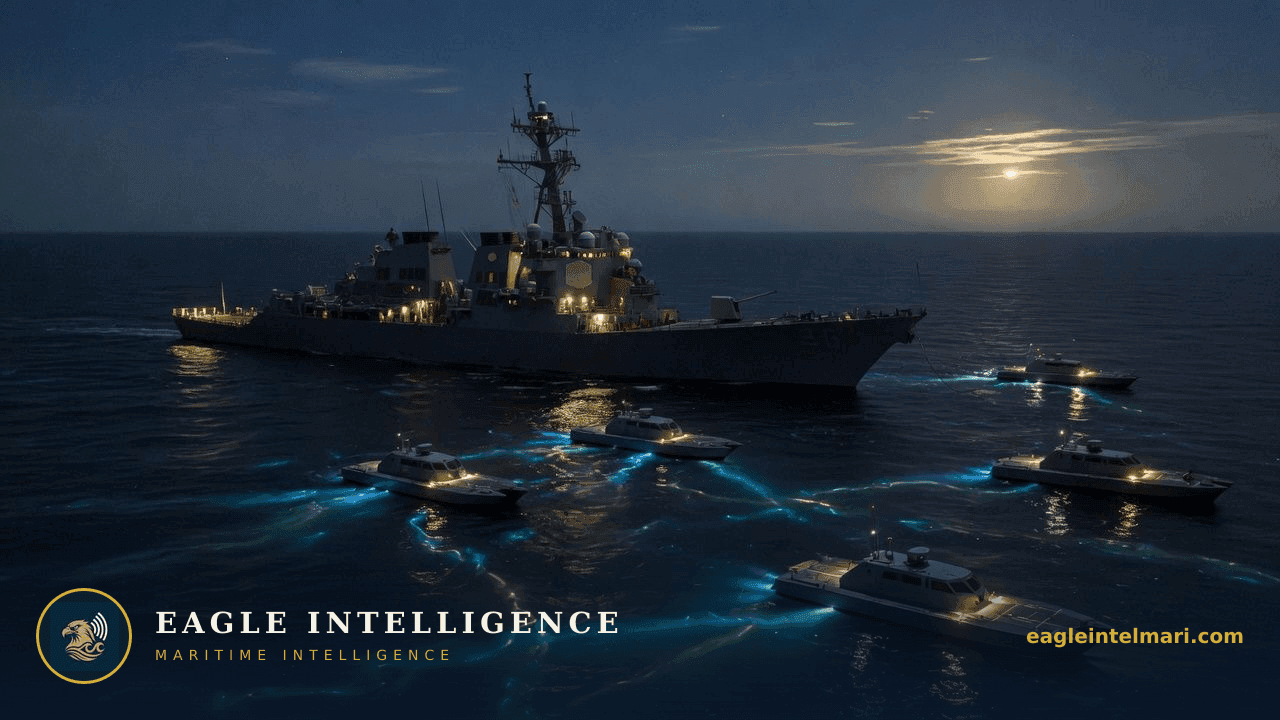
A new GAO report to Congress highlights critical organizational gaps that threaten the Navy’s timeline for deploying robotic autonomous systems at the scale required to counter peer adversaries in dispersed operations.
Advertisement
Advertisement
The GAO’s June 2026 assessment to the Senate and House Armed Services Committees concludes that the Navy cannot meet urgent requirements for robotic and autonomous systems without first fixing fragmented leadership and organizational structures.
The report underscores that current Navy doctrine remains anchored in a World War II-era model of concentrated battle groups. Recent combat in Ukraine and the Middle East has demonstrated how small, attritable RAS platforms can disrupt these formations and erode traditional superiority. Transitioning to a dispersed, adaptive force demands new command relationships that the service has yet to establish.
GAO identifies overlapping responsibilities across multiple Navy offices as the primary brake on progress. Without a single empowered authority for RAS development and integration, programs compete for resources and lack coherent requirements. This fragmentation risks delaying operational capability by years at a moment when adversaries are fielding their own unmanned systems at industrial scale.
Widespread naval adoption of autonomous vessels will accelerate technology transfer into the commercial sector through dual-use suppliers. Shipowners and hull insurers will confront new questions around cyber resilience, collision avoidance standards, and liability when unmanned military platforms operate near busy sea lanes. Charterers may see freight rates adjust as navies reserve yard capacity for RAS hulls.
Autonomous systems complicate the assignment of responsibility in any future incident. P&I clubs will need updated clauses to address damage caused by unmanned platforms whose operators may be located thousands of miles away. War-risk underwriters are already modeling scenarios in which low-cost RAS swarms target commercial traffic in chokepoints, raising the prospect of contested insurance markets in the Persian Gulf and South China Sea.
If the Navy establishes a dedicated RAS command within 18 months and secures sustained funding, initial dispersed squadrons could reach initial operational capability by 2029. A second path sees continued bureaucratic resistance pushing meaningful numbers to 2032, allowing adversaries to widen their lead. The third and most disruptive scenario involves rapid fielding driven by a crisis in the Western Pacific, forcing ad-hoc integration that exposes crews and platforms to higher early failure rates.
As naval RAS numbers grow, coastal states will face pressure to update traffic-separation schemes and port access rules for unmanned military craft. Crew welfare considerations will shift as fewer sailors deploy on surface combatants, altering the demographic profile of seafarers and the training pipelines that serve both naval and merchant fleets.
Advertisement
Advertisement
Live 1–5 shipping war-risk level across monitored chokepoints.
⚠️ Intelligence Disclaimer: This analysis is produced by Eagle Intelligence's AI-assisted automated analysis system and is provided for informational purposes only. See our editorial standards. It is not a substitute for official maritime safety advisories from UKMTO, MSCHOA, IMO, or flag state authorities. Operational decisions should always be based on official guidance and professional judgment. Eagle Intelligence accepts no liability for any loss arising from reliance on this content.
Live chokepoint status, war-risk shifts, and the daily maritime wire, straight to your inbox. Free.
Leave a comment
All comments moderated for quality
