Iran's closure of the Strait of Hormuz following the third round of US strikes has stopped commercial traffic and triggered crew abandonments, with one Indian seafarer missing after an attack on a container ship; the immediate stakes are crew safety and the viability of any continued Gulf oil and container movements.
Advertisement
Advertisement
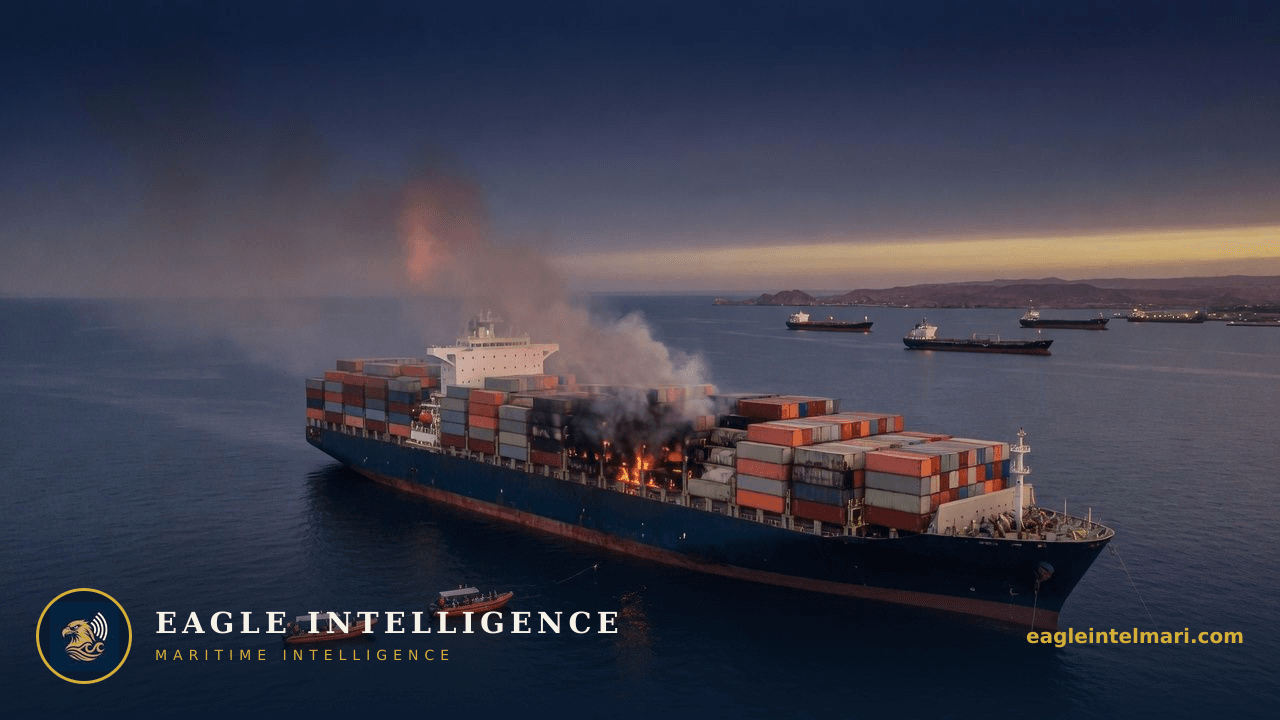
US forces conducted a third round of strikes on Iran on 12 July 2026, explicitly citing an earlier Iranian attack on a civilian vessel inside the Strait. Within hours Iran’s IRGC navy declared the strait closed until further notice. A container ship subsequently caught fire off the Omani coast; UKMTO and British military reporting describe crew abandonment into lifeboats, with one Indian seafarer still missing and ten others rescued. Separate accounts attribute the fire to an Iranian strike rather than an accidental onboard incident.
No commercial transits are now possible. The narrow shipping lanes are under direct threat from IRGC naval units and from ongoing US air and missile activity. Masters who were already inside the strait when the closure was announced have either turned back toward the Gulf of Oman or sought shelter in Omani waters. Routing alternatives around the Cape add twelve to eighteen days and roughly double bunker consumption for very large crude carriers and container ships serving Asia–Europe and Asia–US Gulf trades.
Hull war-risk underwriters have already withdrawn cover for the strait and adjacent waters. P&I clubs are advising members that any transit constitutes a breach of trading warranties. Flag states whose vessels remain inside Iranian territorial waters face conflicting obligations: coastal-state duties versus the duty to protect seafarers. The absence of a functioning salvage or rescue regime inside the closed strait leaves owners and clubs exposed to potential large-loss claims if vessels are abandoned or scuttled.
We know US forces struck Iranian targets three times in seven days, that the strait was declared closed by the IRGC, and that at least one container ship suffered a serious fire with crew forced into lifeboats. We do not know whether the fire resulted from an Iranian missile or from secondary effects of the US strikes. We also lack verified positions for the majority of tankers that were approaching the strait at the time of closure.
EAGLE ASSESSMENT (medium confidence): The closure is operationally real and will last at least seven days; any reopening will require explicit Iranian and Omani agreement rather than a unilateral US declaration.
Charterers holding contracts for July loadings face force-majeure claims and cargo diversion costs. Refineries in Asia that rely on spot Gulf crude are already bidding up Atlantic-basin barrels. Manning agencies with Indian, Filipino and Pakistani crews on vessels inside the Gulf are fielding family queries; some owners have begun offering hazard pay or early repatriation from safe ports. Port congestion in Fujairah and Salalah is rising as vessels divert and wait for clearer routing.
Iran and Oman have continued bilateral talks on a shipping framework. If those talks produce a monitored transit corridor within seventy-two hours, the closure could prove shorter than the market currently prices. Evidence that would support this scenario includes an Omani-flagged escort agreement or a joint statement from Tehran and Muscat authorising limited daylight passages.
Next 24 hours: any verified commercial transit through the strait or an IRGC statement extending the closure.
Next seven days: outcome of Iran–Oman framework talks and any joint statement on partial reopening.
Next thirty days: first documented insurance claim or general-average declaration arising from the closure, and any change in US strike tempo.
Advertisement
Advertisement
Live Hormuz transit status and war-risk band.
Live 1–5 shipping war-risk level across monitored chokepoints.
⚠️ Intelligence Disclaimer: This analysis is produced by Eagle Intelligence's AI-assisted automated analysis system and is provided for informational purposes only. See our editorial standards. It is not a substitute for official maritime safety advisories from UKMTO, MSCHOA, IMO, or flag state authorities. Operational decisions should always be based on official guidance and professional judgment. Eagle Intelligence accepts no liability for any loss arising from reliance on this content.
Live chokepoint status, war-risk shifts, and the daily maritime wire, straight to your inbox. Free.
Leave a comment
All comments moderated for quality
