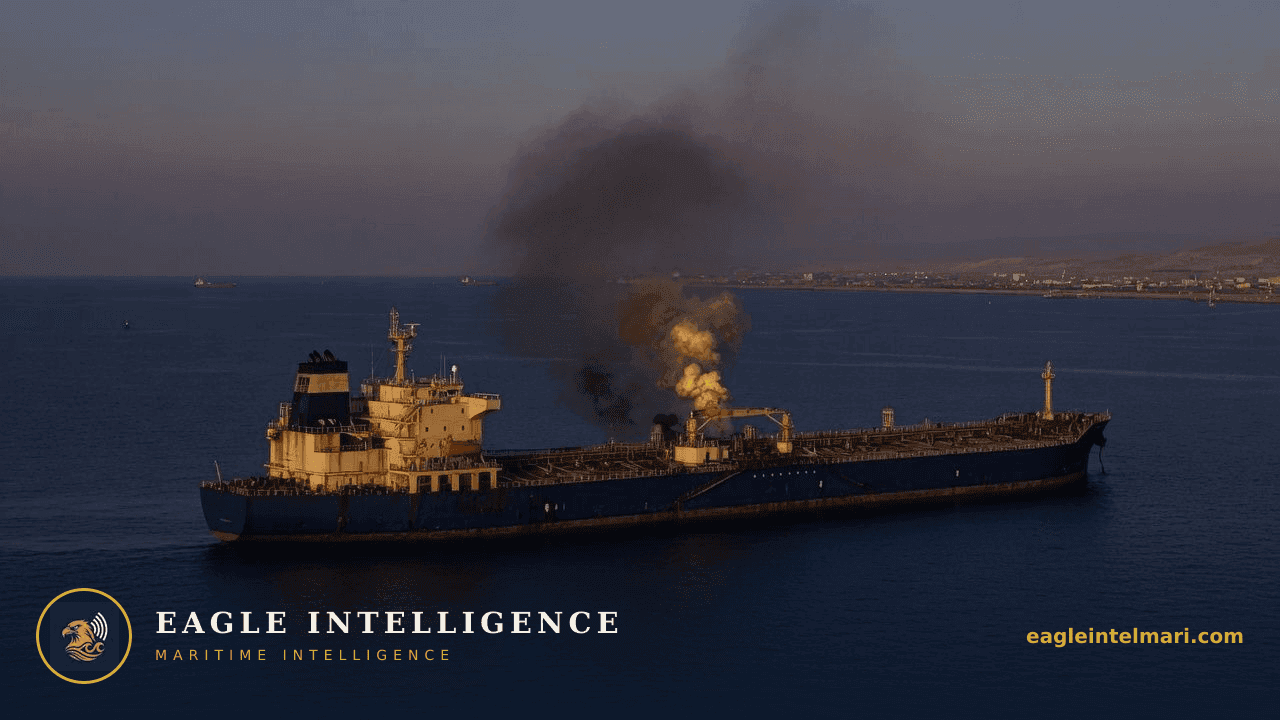
Renewed strikes in the Strait of Hormuz have forced a second tanker abandonment within 24 hours, with crews evacuating a burning vessel left adrift after a projectile hit. Saudi crude cargoes have executed U-turns in the Red Sea following Houthi warnings, while Kuwait has summoned Iran's ambassador over the latest attack. War-risk coverage, already strained a month after the US-Iran truce memorandum, now faces immediate pressure on both pricing and availability for Hormuz transits. Black Sea disruptions at the CPC terminal have separately stalled Kazakhstan oil loadings and Ukrainian corn exports. Decision-makers must reassess routing, insurance terms and charter obligations within the next 24-48 hours.
Advertisement
Advertisement
Renewed strikes in the Strait of Hormuz have forced a second tanker abandonment within 24 hours, with crews evacuating a burning vessel left adrift after a projectile hit. Saudi crude cargoes have executed U-turns in the Red Sea following Houthi warnings, while Kuwait has summoned Iran's ambassador over the latest attack. War-risk coverage, already strained a month after the US-Iran truce memorandum, now faces immediate pressure on both pricing and availability for Hormuz transits. Black Sea disruptions at the CPC terminal have separately stalled Kazakhstan oil loadings and Ukrainian corn exports. Decision-makers must reassess routing, insurance terms and charter obligations within the next 24-48 hours.
Crew abandoned a burning vessel in the Strait of Hormuz; ship left adrift following renewed strikes.
Why it matters: Direct operational halt and insurance trigger barely a month after the truce memorandum, with Saudi cargoes already reversing course.
Who is exposed: Owners and operators of tankers still routing through Hormuz; war-risk underwriters facing immediate claims.
Houthis issued explicit threats targeting vessels visiting Saudi ports and forced two Saudi-crude tankers to execute Red Sea U-turns.
Why it matters: Extends risk from Bab el-Mandeb into the Red Sea proper, raising the prospect of sustained diversion around the Cape.
Who is exposed: Saudi-bound crude and product carriers; charterers with fixed laycan windows at Saudi terminals.
Tanker attacks at the CPC terminal have halted loadings on Kazakhstan's primary export route.
Why it matters: Removes a key non-OPEC supply source at the same moment Hormuz volatility is already tightening Middle East barrels.
Who is exposed: Black Sea charterers, CPC terminal users and downstream refiners reliant on CPC crude.
Volatility in Hormuz and Red Sea has prompted immediate reassessment of war-risk terms and limits.
Why it matters: Coverage availability and pricing will dictate whether vessels continue transiting or divert, directly affecting freight rates and cargo values.
Who is exposed: Hull and P&I underwriters; owners without pre-negotiated additional-perils cover.

Sustained Hormuz avoidance will push additional VLCC tonnage into the Atlantic basin, tightening clean-product availability for West Africa and South America within two weeks.

Houthis have imposed a full naval blockade of Bab el-Mandeb Verdict: unconfirmed Threats and targeted warnings are documented; no evidence of systematic interdiction of all traffic has been supplied.
Next scheduled Hormuz VLCC transit that does not receive war-risk clearance by 22:00 UTC 23 July.
Which charter-party clause will first be tested by the combination of Hormuz abandonments and Houthi Red Sea warnings?
The Daily Eagle Brief separates reported fact from Eagle assessment. Confidence percentages express editorial confidence based on the available sourcing, not mathematical certainty.
Advertisement
Advertisement
Live Hormuz transit status and war-risk band.
Live 1–5 shipping war-risk level across monitored chokepoints.
⚠️ Intelligence Disclaimer: This analysis is produced by Eagle Intelligence's AI-assisted automated analysis system and is provided for informational purposes only. See our editorial standards. It is not a substitute for official maritime safety advisories from UKMTO, MSCHOA, IMO, or flag state authorities. Operational decisions should always be based on official guidance and professional judgment. Eagle Intelligence accepts no liability for any loss arising from reliance on this content.
Live chokepoint status, war-risk shifts, and the daily maritime wire, straight to your inbox. Free.
Leave a comment
All comments moderated for quality
