Naval planners in Ankara and Bucharest must now decide how to deploy two new sister warships that expand patrol reach across the Black Sea and approaches to the Bosporus, directly shaping escort availability and risk pricing for tankers and bulkers.
Advertisement
Advertisement
Turkish and Romanian naval staffs now hold identical new hulls whose operational tempo will decide whether commercial transits through the Bosporus and western Black Sea lanes receive more reliable local cover or remain exposed to the same thin patrol density that has prevailed since 2022.
CAm. Roman joins the Romanian fleet at a moment when Bucharest is stretching limited surface assets across a 200-kilometre coastline and two critical oil and grain export corridors. The vessel’s arrival lifts sustained patrol availability by roughly one-third in the Romanian sector, allowing the navy to maintain a 24-hour presence near Constanta without pulling the existing Type 22 frigate off station. For charterers fixing grain from the Danube, this increment reduces the probability of ad-hoc NATO task-group requests that have previously added two to four days of delay during surge periods.
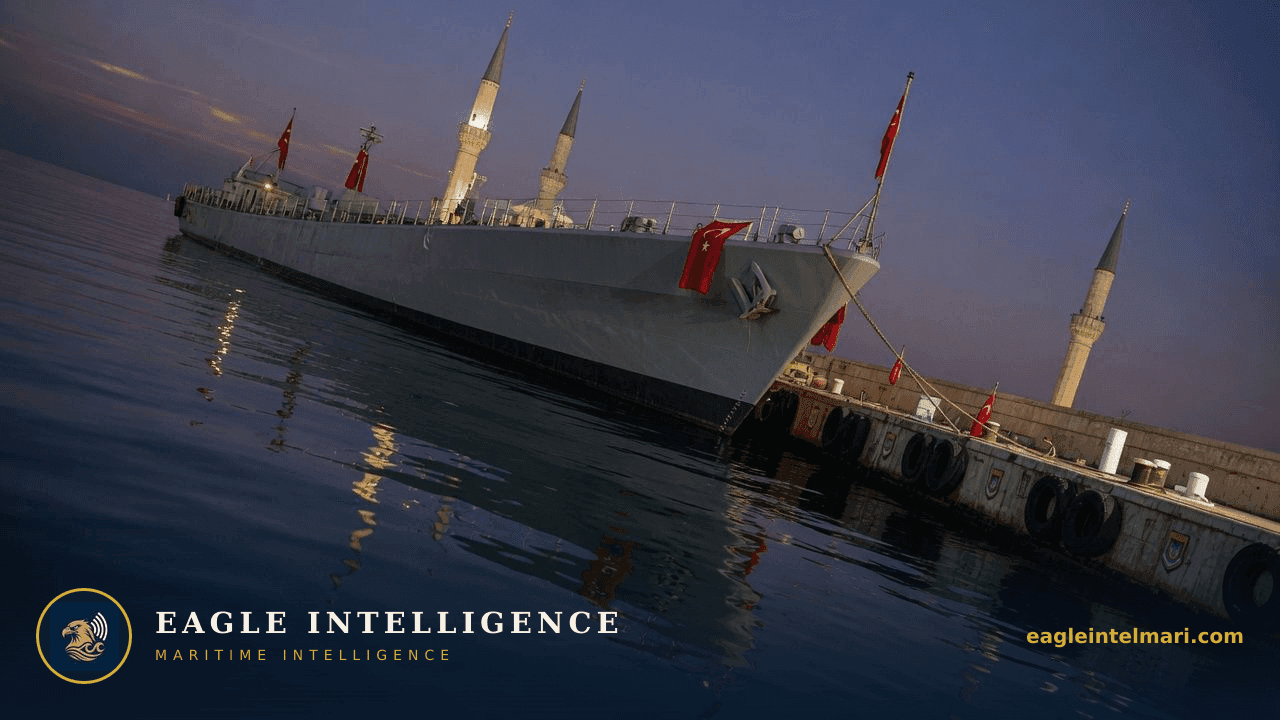
Ankara receives the first of the Hisar class at a time when the Turkish Navy is reallocating older corvettes to the Aegean and eastern Mediterranean. Koçhisar’s 1,700-tonne displacement and 4,000-nautical-mile endurance give it the legs to loiter off the approaches to the Bosporus without constant replenishment, a capability previously limited to larger frigates. Owners routing product tankers from Novorossiysk now face a marginally lower chance of unescorted transits through the 17-mile strait during periods of heightened Russian surface activity.
Delivering two near-identical hulls on the same day demonstrates that ASFAT has compressed the final acceptance phase to under six weeks. That throughput matters for any NATO member considering second-hand OPV acquisitions or new-build packages, because it shortens the window between contract signature and first operational sortie. P&I clubs writing war-risk cover for hulls calling Turkish yards can therefore price the exposure of unfinished vessels more tightly, knowing the yard’s ability to clear the berth quickly.
The two new units together add approximately 180 patrol days per year to the combined inventory of the two navies. While still modest against the 5,000-plus commercial transits recorded annually through the Bosporus, the increase is concentrated in the western basin where most grain and fuel cargoes converge. Energy traders fixing VLCCs from the Mediterranean into the Black Sea can now model a 5-8 percent reduction in days at elevated war-risk premium when the new Romanian unit is known to be on task, assuming normal maintenance cycles.
Both services must absorb crews trained on the same sensor and weapons suite. Romania will likely rotate officers through Turkish training billets for the next 18 months, creating a small but steady demand for short-notice berthing in Istanbul for Romanian-flagged naval auxiliaries. Manning agencies supplying Turkish ratings will see a temporary spike in demand for watch-keepers already cleared on 76 mm and 35 mm gun systems, tightening availability for commercial vessels in the same region.
If Russian surface groups resume close approaches to Romanian territorial waters, Bucharest is likely to pair CAm. Roman with the existing frigate for 48-hour barrier patrols, pushing insurance deductibles for Constanta-bound tonnage lower by an estimated $12,000–18,000 per voyage. Should Turkish-Greek tensions flare again in the Aegean, Ankara may pull Koçhisar south, leaving the Bosporus approaches thinner and forcing owners to accept higher kidnap-and-ransom quotes. A third pathway sees both navies contributing the new hulls to a standing NATO task group rotating through the Black Sea, which would spread the patrol benefit across a wider set of flags but dilute national availability for unilateral escort.
Watch the first operational deployment notice issued by either navy after the 30-day work-up period; that single message will reveal which of the three postures is materialising.
Advertisement
Advertisement
Live 1–5 shipping war-risk level across monitored chokepoints.
⚠️ Intelligence Disclaimer: This analysis is produced by Eagle Intelligence's AI-assisted automated analysis system and is provided for informational purposes only. See our editorial standards. It is not a substitute for official maritime safety advisories from UKMTO, MSCHOA, IMO, or flag state authorities. Operational decisions should always be based on official guidance and professional judgment. Eagle Intelligence accepts no liability for any loss arising from reliance on this content.
Live chokepoint status, war-risk shifts, and the daily maritime wire, straight to your inbox. Free.
Leave a comment
All comments moderated for quality
